
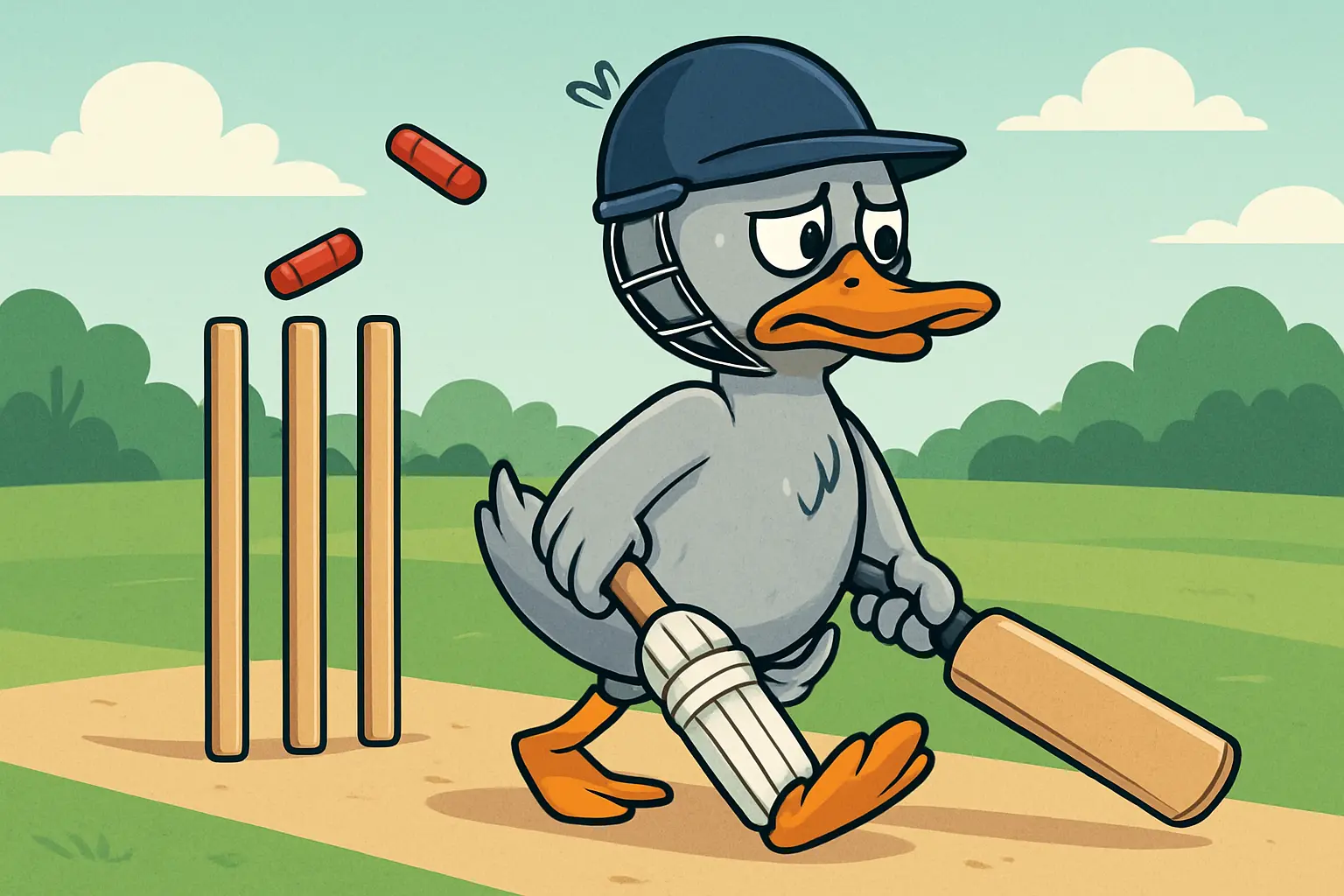
A silver duck in cricket means a batter is dismissed for zero on the second ball they face. It’s a clean, unambiguous idea: first ball survived, second ball out, no run scored. Unlike a golden duck (out first ball) or a diamond duck (out without facing a ball), “silver duck” lives in the world of cricket slang, not in the official Laws. It exists because cricketers and commentators love precision and color in their language, and the moments right at the start of an innings are loaded with story.
That’s the headline. But to fully understand the silver duck—where it’s used, how it differs from other ducks, why it happens more often than fans think—you need the texture that comes from the dressing room, the slip cordon, and the scorer’s box.
What Is a Silver Duck? Meaning, Usage, and the Small Print
Definition in one line: a silver duck is when a batter gets out for zero on the second ball they face.
This is colloquial. The Marylebone Cricket Club (MCC) Laws, which are the sport’s formal rulebook, only recognize “out for zero” (a duck). Every variation you hear—golden, diamond, silver, bronze, platinum, royal—belongs to the shared language of players, broadcasters, and fans. That’s part of cricket’s charm and also a source of occasional confusion.
Usage varies slightly by region and outlet:
- In most English-language coverage, silver duck means out second ball faced without scoring.
- Some broadcasters don’t use the term at all; they’ll say “out second ball” or “second-ball duck.”
- Bronze duck sometimes appears for a third-ball duck, but it’s rare enough to feel like a novelty when it pops up on air.
Why silver needs a crisp definition: golden ducks and diamond ducks are widely accepted slang. Silver, being less frequently used, can get muddied if it isn’t firmly tied to “second ball faced.” This article uses that precise meaning throughout and explains how it fits with other types.
Silver vs Golden vs Diamond vs Platinum vs Royal: Quick Table
Below is a straightforward comparison table that sorts out the common duck terms. Remember: only “duck” is formal. Everything else is a nickname used by cricket people to communicate nuance and drama.
| Term | What It Means | Balls Faced | Match Context | Typical Example |
|---|---|---|---|---|
| Duck | Out for zero | Any | Any format/inning | Score reads 0; batter dismissed without scoring |
| Golden duck | Out first ball faced | 1 | Any format/inning | Batter edges the first ball to slip |
| Silver duck | Out second ball faced | 2 | Any format/inning | Batter defends first ball, trapped lbw on second |
| Bronze duck (rare) | Out third ball faced | 3 | Any format/inning | Plays and misses twice, nicked third ball |
| Diamond duck | Out without facing a ball | 0 | Run-out at non-striker, obstruction, timed out | Non-striker run-out by bowler backing up; no delivery faced |
| Platinum duck | Used variously for out first ball of the innings/match | 1 | First ball of team innings/match | Opener bowled first ball of innings; some call this “royal” |
| Royal duck | Used variously; often synonymous with platinum in some regions | 1 | First ball of team innings/match | First ball wicket; terminology varies by broadcaster |
Notes and caveats:
- The terms platinum and royal are the foggiest. In some commentary boxes, platinum duck means out first ball of the match (absolute first delivery). In others, platinum/royal both mean out first ball of your team’s innings. In everyday talk, many people avoid the ambiguity and just say “first ball of the innings—gone.”
- A diamond duck happens only when a dismissal is recorded before the batter faces a delivery: run-out at the non-striker’s end, obstructing the field while changing ends, timed out, or retired out before any ball is faced. It can create bar-stool debates, but the core is simple: no ball faced.
Where These Terms Come From: A Short Origin Story
“Duck” itself goes back to the shape of a duck’s egg. On old scorecards, a zero looked like an egg, and the lingo stuck. The color-coding—golden, silver, bronze—reflects how cricket folk love honoring or ribbing moments of rare precision.
- Golden duck: the ultimate sting—the very first ball, and you’re gone. The adjective adds drama that players understand deeply; there’s nothing quite like a golden duck to make a long walk feel longer.
- Silver and bronze: if you give a narrative device to a commentary box, they’ll refine it. Once golden became standard, it was only a matter of time before silver (second ball) and bronze (third ball) were minted. Silver is far more commonly heard than bronze.
- Diamond: a perfect metaphor for a dismissal without even the dignity of a ball faced. You were in the book—dismissed—before your innings began in any meaningful way.
Are These Terms in the MCC Laws?
No. The MCC Laws define dismissals, scoring, and records at a formal level; they do not differentiate “types of duck.” Officially you are out for zero, and that’s that. What the scoreboard shows and how statisticians classify your dismissal (balls faced, mode of dismissal, over, bowler, fielder) are official. The color-metals of duck-speak live entirely in the vernacular.
This is why arguments arise online: people hear platinum on one broadcast meaning one thing and royal on another meaning something else. The cure is to return to the core: golden is first ball faced, diamond is no ball faced, silver is second ball faced. Everything else is frill.
A Decision Guide: Got Out for Zero—What Duck Is It?
This simple mental flow mirrors how analysts and scorers think:
- Did you face a delivery?
- No: that’s a diamond duck (run-out at the non-striker’s end, timed out, obstruction without facing, or retired out without facing).
- Yes: how many balls did you face before dismissal?
- 1: golden duck.
- 2: silver duck.
- 3: bronze duck (rarely used).
- Was it the first ball of the innings or match?
- If you were dismissed on the first ball of your team’s innings, some call it a platinum or royal duck. Because usage varies, most analysts clarify: “out first ball of the innings.”
That’s the taxonomy. Now let’s put the silver duck under the microscope.
Silver Duck in Different Formats: Tests, ODIs, T20s, and the IPL
Each format creates different rhythms in those first two balls. The silver duck sits in a particular pocket of pressure—right after the nerves of ball one, right before a batter settles. Coaches talk about the second-ball danger more than fans realize.
Silver Duck in Test Cricket
Tests have the purest new-ball challenge. A red ball, lacquer intact, upright seam, early movement through the air and off the turf—openers and top-order specialists design their entire preparation for those first few minutes. The silver duck is born in that tension:
- The first ball is recon. Batters take guard, see the sight-screen color, feel the seam fizz past. Leave. Block. Smell the wind. Survive.
- The second ball often changes incentive. Bowlers love the two-card trick. They’ll float one a little wider to tease the leave, then straighten the next one to hit the top of off. Or they’ll start at the stumps, show the angle, then jag the second ball across the right-hander for the nick.
Even when the batter survives the first delivery, they haven’t computed the full threat profile: length, bounce, wobble, release height. That’s why second-ball LBWs feel so common in Tests. The batter thinks they’ve calibrated; the ball darts late, and the pad is trapped.
Two frequent silver-duck patterns in Tests:
- The wobble-seam surprise: First ball shapes away—safe leave. Second ball is wobble seam, holds the line, kisses the pad in front. Finger up.
- The bouncer-then-full trap: First ball is back-of-a-length or a hip-high bumper to push the batter’s weight back. Second ball, the trap: a full, late in-ducker. Front pad frozen.
For middle-order players in Tests who walk in after a wicket, the field is hot, slips hungry, short leg chirping. They can survive ball one with a check-drive and then get snagged second ball by a fuller one with the seam angled in. The silver duck is a product of a strong bowling plan and a batter’s incomplete data set after only one delivery.
Silver Duck in ODIs
The white ball swings less and loses its shine earlier, but the ODI Powerplay inflates the cost of misjudgment. A top-order player will often have scoring intent from ball one, because modern one-day batting assumes the field will close quickly and middle-overs scoring can be tough.
- A common ODI silver-duck trap is the backup move: the batter sees a gentle first ball, thinks “freebie,” and steps down or across for the second. The bowler, sensing ambition, drags the length or angles into the pads to expose leg stump or trap LBW.
- Left-arm seamers moving the ball across the right-hander love using first-ball across, second-ball in—hands follow the line, bat half-open, pad trapped.
- The ODI white ball can still bend early, especially under lights. The second delivery after a safe sighter is exactly when aggressive batters flick the switch. Bowlers plan for that.
Silver Duck in T20 Cricket
T20 attacks the timeline. A batter rarely has the luxury to play themselves in. A dot ball feels heavy. That reality is silver-duck fertilizer.
- The first ball might be an information ball: a hard length just outside off. The batter watches or parries. On the second, they go for a scoring option: scoop, drive, slog over midwicket. If the bowler reads that intent, they counter with pace variation, fuller length, or a wide line to induce the toe-end or the check-swing.
- Match-ups dominate T20 planning. If the bowling team has data that the new batter is slow to score against a particular angle, they set a field and go to the second-ball bait. First ball: feel. Second ball: strike.
- Wrist-spinners thrive here. First ball: stock leg-break, keep the line. Second ball: googly to a right-hander with a slip, pad or inside edge—done. The batter has no time to read the wrist.
Because T20 normalizes early risk-taking, silver ducks are not rare. They’re a price batters accept. Coaches will even tell a new batter: you’re not judged for a second-ball duck when the ask is double-digit per over; you’re judged for intent. Cruel comfort, but honest.
Silver Duck in the IPL
The IPL has its own weather system: premium bowling attacks, heavy data science, fresh-ball fuss under floodlights, and layered match-ups. You can feel the choreography of a silver duck here.
- New-ball maestros use the lights. With white-ball swing in the first over, first ball sets the corridor, second ball hunts the pad or top of off with a change of seam position. Wobble seam becomes a weapon because of the surfaces and balls in play.
- Left-arm pace vs. right-hand power-play hitter is almost a genre. First ball across, watch or miss. Second ball, shape back into the pads at a fuller length with fine leg back and square leg up. LBW or bowled is live.
- Off-spinners with a slip to left-handers love using the new batter’s eagerness. First ball is a dart or a flat off-break. Second ball is a little slower with drift—bat out front, edge to slip or pad trapped.
- Review pressure is real. A batter who burns a DRS on ball one (for a pad brush) sometimes gets pinned in front ball two and cannot overturn it. With DRS rhythms and bowling groups gaming them, second-ball entrapments are a quiet art.
Examples and Rare Scenarios: How Different Ducks Actually Happen
Scorecards flatten drama, so here are clean, scoreboard-style snippets illustrating typical routes to a silver duck and its relatives. They’re representative, not tied to a single historical match, but they mirror dozens you’ve watched.
- Silver duck, Test opener vs right-arm seamer:
- Ball 1: Leave outside off. Seam away, no stroke.
- Ball 2: Length at off stump, wobble seam. Batter plays around front pad. lbw. Score: 0 (2).
- Silver duck, ODI top-order vs left-arm seamer:
- Ball 1: Good length angling across. Thick inside edge onto pad. Dot.
- Ball 2: Fuller, late shape in. Bat just closes. Bowled through gate. Score: 0 (2).
- Silver duck, T20 middle-order vs leg-spinner:
- Ball 1: Length leg-break outside off. Pushed to cover. Dot.
- Ball 2: Googly on middle and off. Batter misreads, pads up. lbw. Score: 0 (2).
- Diamond duck (non-striker run-out backing up):
- Before facing: Bowler spots backing up early. Runs out non-striker. Dismissed without facing. Score: 0 (0).
- Diamond duck (timed out):
- New batter fails to be ready within the allowance. Timed out. No ball faced. Score: 0 (0).
- Note: This is vanishingly rare, but by convention it’s treated as a diamond duck because there was no delivery faced.
- Platinum/royal scenarios:
- Opener bowled first ball of the innings. Many will call it a platinum or royal duck; others avoid the label and say “out first ball.”
- Bronze duck (rare slang):
- Ball 1: Leave. Dot.
- Ball 2: Play and miss. Dot.
- Ball 3: Drive on the up, edge to second slip. Score: 0 (3).
Are These Labels Recorded Officially?
Not in formal stats. Scorebooks record runs, balls faced, dismissal type, bowler, fielder, and context. Analyst teams can filter for second-ball ducks easily because balls faced is captured. But “silver duck” rarely appears as a field in official databases. You’ll hear it on air or see it as a social clip caption. In internal team reviews, the note would be “0(2), lbw, seam in from over-of” with a tactical tag—useful, not ornamental.
Why Silver Ducks Happen: Technique, Psychology, and Bowling Plans
The second ball sits in a unique psychological gap. Ball one is inertia-breaking: the batter’s eyes adjust to speed, pitch, sightscreen, and crowd. Muscles settle. Adrenaline spikes, then dips. Between ball one and two, decisions change.
Technical and mental factors that breed silver ducks:
- Incomplete read of movement: One delivery doesn’t reveal much. If a bowler hides the seam well, the second can be the first true data point—and the last.
- The two-card trick: Good bowlers play setup-delivery games. First ball shows you a pattern; second ball exploits your adjustment. Show-away, then hold-line. Show-bounce, then pitch-up. Show-pace, then take-pace-off.
- Over-eager correction: Batter leaves the first ball with the bat behind the pad; coach in the head says “present the full face next time.” They do, and are late if the ball ducks in.
- Guard and alignment: If a batter adjusts guard after ball one (common), a seam-up delivery can now align differently with their stance. Pads become a hazard if hips aren’t clearing.
- Fields that whisper: A pack of catchers in the cordon on ball one might subtly shift on ball two. That visual suggestion can draw the bat into a line it shouldn’t take.
Bowling blueprints that target silver ducks:
- Right-arm over to right-hander: Fourth-stump away-swinger sighter, then a wrist-loaded wobble that straightens at off stump. LBW/bowled in play.
- Left-arm over to right-hander: Slant away first ball; seam-up, hooping in second ball with leg-side catchers re-positioned. Pad trap.
- Off-spinner to left-hander: First ball fast and flat to middle; second one loopier, dipping at off peg. Inside edge or pad.
- Leg-spinner to right-hander: Stock leg-break followed by a googly with a ring of infield catchers. Catches at slip/short leg are alive.
How Batters Can Avoid a Silver Duck
There’s no magic, but there is craft. The best players own the two-ball window with a simple checklist:
- Trust your leave: Ball one can be a leave. Ball two can be, too. If you don’t have the line, don’t chase the maker’s name.
- Guard, then commit: Make your guard choice before ball one, and only adjust if the read is glaring. Tiny shifts introduce new risks. If you must adjust, do it with full intention and pre-meditated shot maps.
- Delay the bat: Against new-ball movement, show pads later. Get your head over the line first; let the ball come. Hands last.
- Watch for the two-card trick: If the first ball is a show-away, expect the second to challenge the stumps. Conversely, if the first was on the body, be ready for a width tease next.
- Neutralize the second ball: A dead-bat block on a length ball—dropping it under the eyes—remains underrated. Not glamorous, but it turns the second ball into just another ball.
- Game awareness: In T20/ODI chases, your coach may still want intent on ball two. Intent doesn’t always mean swing—hard run a tight single to mid-off or steer to third if the field invites it. Rotate, reset.
How Bowlers Hunt a Silver Duck
The second ball is a great time to show you were paying attention on the first.
- Read the first ball reaction: Was the batter late? Feet stuck? Front hip closed? Second ball can exploit exactly that glitch.
- Change the seam, not the line: A subtle seam-position tweak delivers a different ball that looks identical in flight. Batters misread this constantly.
- Field signals: A sharp change in the cordon or leg-side ring can sell one story while the ball tells another. Smart captains use micro-movements, not theater.
- Angle shifts: Change of angle—over to around, or crease-walking—on the second ball can create parallax that warps the batter’s line pick-up.
- Pace deception early: Especially in white-ball cricket, a pace-off second ball after a hard first ball invites checked drives and mis-hits to catching covers.
Silver Duck vs Golden Duck vs Diamond Duck: Why the Distinction Matters
In the dressing room, clarity about these terms isn’t pedantry; it’s feedback. Was the batter caught cold by a first-ball beauty (golden)? That’s not always a tactical fault. Was the batter second-ball trapped because they over-corrected (silver)? Coaching opportunity. Did a diamond duck happen through a non-striker lapse? That’s a discipline issue for the whole unit.
In the commentary box and on social feeds, precision avoids empty argument. “Silver duck” immediately conjures the image: survived one, gone the next. It’s narrative shorthand that respects the margins at the start of an innings.
Records, Context, and the Limits of Duck Labels
“Most ducks in Test cricket” or “most ducks in the IPL” are evergreen fan interests. Those leaderboards are kept by major stats houses with clear definitions: a duck is zero, regardless of balls faced. They don’t typically split by golden, silver, or diamond in official summaries, though analysts can surface those with filters.
A few evergreen bits of context that matter:
- Pair vs. king pair: In multi-innings cricket, a pair is out for zero in both innings. A king pair is out first ball in both innings—double golden. The “king” descriptor attaches only to the first-ball element; silver doesn’t meaningfully enter that picture.
- Quickest ducks: Analysts sometimes tag the “quickest ducks” by balls faced; by definition, a diamond duck is the fewest balls possible. Among balls-faced dismissals, the golden duck is the swiftest; silver is next.
- Most golden ducks vs most ducks: These can differ. A player might have a disproportionate number of first-ball dismissals relative to total ducks, which says something about their entry patterns and match-ups at the crease.
- Role matters: Lower-order batters (tailenders) often cop golden ducks because they face narrow tactical windows—late innings, new ball reversing, fields swarming. Silver ducks can spike among aggressive top-order players in white-ball cricket because of early intent.
- IPL quirk: With match-ups and analytics so central, bowlers chase early wickets on pre-planned sequences. That planning creates fertile ground for both golden and silver ducks in the powerplay.
Regional and Commentary Usage: India, UK, Australia, and Beyond
If you tune in across different broadcasts, you’ll hear different flavors of the slang:
- India: Broadcasters and digital shows are comfortable with “silver duck,” especially in listicles, explainers, and highlights captions. “Diamond duck” is also common, particularly for non-striker run-outs. “Platinum” and “royal” appear in social graphics around first-ball-of-the-innings dismissals.
- UK: “Golden duck” is ubiquitous; “diamond duck” is understood and used. “Silver duck” appears less often on linear commentary, with “second-ball duck” more typical. “Royal” can surface in county chatter but not with rigid meaning.
- Australia: Similar to the UK, with “golden” and “diamond” the staples. “Silver” pops up in conversational commentary rather than in formal graphics.
- Pakistan, Bangladesh, Sri Lanka: Digital platforms and fans on social media lean toward using silver/diamond in captions. On-air use varies by channel and crew.
The point is not to litigate a single dictionary. It’s to be clear for your reader or viewer: if you say silver duck, mean second ball faced. If you say platinum or royal, define whether you’re talking about the first ball of the innings or the match. That keeps everyone on the same page.
Tactics Board: Coaching Notes for the Silver-Duck Phase
From a coaching perspective, the two-ball window is its own micro-session. Here’s the kind of language you’ll hear in team meetings and one-on-ones.
For batters:
- Your first scoring shot doesn’t need to be ball two. Give yourself permission to leave again if the ball isn’t in your map.
- Don’t fix a non-problem. If your first-ball leave was good, you don’t need to “play one” to show you’re in. The scoreboard doesn’t care for displays of intent if the swing is live.
- If you saw wobble or late dip on ball one, assume it’s there on ball two even if the shape looks different. Treat line as a lie until you’ve verified movement.
- Against spin in T20: expand your scoring options to include the late dab or drop-and-run. Those are low-risk escapes from the silver-duck trap while you decode the wrist.
- Center yourself with a routine: deep breath, pick your seam, one clear thought. The second ball can feel emotionally noisier than the first.
For bowlers:
- If the first ball revealed a hard hands pattern, consider a fuller second ball to tempt the drive. Hard hands plus swing equals outside edge.
- If the batter shuffled across, straighten your line early. Pad targets are in play.
- If ball one died a little off the pitch, keep the second ball on the stumps. Natural variation is your ally.
- For spinners, vary pace and drift rather than line too dramatically. Batter eyes adapt to line; pace and dip beat bat speed.
Silver Duck Meaning in Cricket: The Essence
When people ask “what is a silver duck in cricket,” they want two things: clarity and examples. The clarity is easy: out on the second ball you face, no run scored. Examples are everywhere once you know to look: a Test opener lbw after a neat first-ball leave; a T20 hitter misreading a googly on ball two; an ODI No. 3 nicking off after a sighter. Because batters make their biggest early adjustments between balls one and two, the silver duck sits right in the ambush zone.
Silver Duck vs Golden Duck vs Diamond Duck: Key Takeaways
- Silver duck = dismissed for zero on the second ball faced. It’s a slang term, not an official Law.
- Golden duck = out first ball faced. The most famous duck variant.
- Diamond duck = out without facing a ball (non-striker run-out, timed out, obstructing the field without a delivery, or retired out before facing).
- Bronze duck is sometimes used for third ball faced—rare and far from universal.
- Platinum/royal duck usage varies; often used for out first ball of the innings or first ball of the match. Define it when you use it.
- MCC Laws only define the duck as zero; the labels are culture, not code.
Frequently Asked Questions
Is silver duck the same as golden duck?
No. A silver duck means out for zero on the second ball you face; a golden duck is out on the first ball you face.
What is a silver duck in IPL?
In the IPL, the meaning is identical: a batter dismissed for zero on the second ball they face. You’ll mostly see it during the powerplay, when new batters juggle swing, field restrictions, and immediate scoring pressure.
What is a royal duck vs a platinum duck?
Both are unofficial and used inconsistently. Many commentators use either term for a dismissal off the first ball of the innings. Some reserve platinum for the first ball of the match. Because there’s no formal definition, it’s best to say “out first ball of the innings” to avoid confusion.
Can a non-striker get a diamond duck?
Yes. If the non-striker is run-out before the ball is delivered, they are out without facing a ball—that’s widely called a diamond duck.
Does a timed out count as a diamond duck?
By convention, yes. Since the batter is dismissed without facing a ball, most fans and analysts treat it as a diamond duck.
What is a bronze duck in cricket?
Bronze duck is an uncommon slang term for out on the third ball faced without scoring. It’s not widely used and rarely appears on official graphics.
Are duck types official in the Laws of Cricket?
No. Only “out for zero” is recognized formally. Golden, silver, diamond, platinum, royal, and bronze are colloquial.
What is a king pair in cricket?
In multi-innings cricket, a king pair is when a batter is dismissed first ball in both innings. It’s essentially a double golden duck across the match.
What is out for zero on debut called?
Formally, just a duck on debut. If it’s first ball faced, people may call it a golden duck on debut; if it’s second ball faced, a silver duck on debut. Those are informal descriptors.
How many balls faced for a silver duck?
Exactly two balls faced. If you’re dismissed having faced two deliveries without scoring, that’s a silver duck.
Strategic Scenarios: How Silver Ducks Shape Games
People often underestimate the tactical ripple of a silver duck compared with a golden. The differences are subtle but real.
- Bowler rhythm: A golden duck catapults a bowler into the spell; a silver duck does the same but offers the added confidence of a setup working. Bowlers draw heavily on that early validation: “My read is right.” Captains will then lean into the bowler’s plan for the next batter, not just the next ball.
- Batting order pressure: For a side planning a flexible batting order in T20, a second-ball wicket can upend the rotation more than a first-ball wicket. Teams sometimes use the first ball to see if a left-right combo or spin match-up exists; the ball-two wicket resets the chessboard, often forcing a suboptimal next batter out of the dugout.
- Powerplay math: In ODIs/T20s, a silver duck can be more damaging to run rate than a golden if the first ball was a dot and the second is a wicket. Two deliveries for no runs plus a wicket compress the over; the bowling side now controls intent on ball three and four, opening the door for a low-risk over.
For analysts building models, those subtleties show up as over-level pressure spikes. Golden and silver are both early wickets, but the ball-by-ball cadence matters to field and bowling plans in a way fans don’t always see.
Inside the Dressing Room: Language That Surrounds Silver Ducks
Players don’t sit around naming ducks; they solve problems. But language matters because it sharpens memory.
- “Second-ball suck-in”: A phrase batting coaches use when a player chases width on ball two after a safe leave on ball one.
- “Trap sprung on two”: Bowling units note this in debriefs when a planned second delivery gets the wicket. It’s evidence that the scouting report landed.
- “Don’t validate the setup”: Advice to batters—if you know bowlers love the two-card trick, don’t give them your pad or your outside edge just because you feel obligated to play.
- “Ball one sighter, ball two live”: A mantra in white-ball batting—the first delivery tests; the second demands intent. The art is expressing intent without handing over your wicket.
Silver Duck in Commentary and Social Clips
Because silver duck is crisp and visual, it travels well in short-form media. You’ll often see it in:
- Score graphics or post-innings carousels: 0(2) with “silver duck” in the caption.
- Explainer reels: Golden vs silver vs diamond comparisons gain traction because newer fans latch on to catchy labels.
- Player trends: “X has suffered Y golden ducks this season” is more common; silver ducks data appears when an analyst wants to show early-innings vulnerability without asserting reckless intent.
What You’ll Rarely See
- Official score overlays printing “Silver duck” during a broadcast. Overlays typically show 0(2). The term might be used by commentators, then picked up by highlight editors.
The Umpire’s Angle: Why Balls Faced Matters
For this taxonomy, balls faced is the spine:
- If you didn’t face a ball: diamond duck territory.
- If you faced one: the golden is live.
- If you faced two: silver zone.
Umpires don’t label ducks, but their ledger—deliveries bowled, legal balls, penalties—controls whether a “ball” counts as faced. No-balls, wides, dead balls, and late changes affect whether a striker has legally faced a delivery. That’s why the scorer-umpire handshake is sacred. Those tiny calls determine if a batter’s zero is golden, silver, or something else entirely in the eyes of fans and analysts.
The Human Side: How a Silver Duck Feels
Ask any top-order batter what goes through the mind after a silver duck:
- Frustration, because you got a look at it.
- Bewilderment, if the second ball moved differently and you over-corrected.
- Anger at yourself, if you chased a false scoring shot too soon.
But also—oddly—some relief. Golden ducks can feel like a trapdoor; silver ducks offer at least one tiny frame of reference for the video session. You saw two balls. There’s a clue in there.
For bowlers, a silver duck is a lightbulb moment. The plan worked. That matters because it influences confidence for the rest of the day. A bowler who wins the first two-ball duel often goes on to win the spell.
A Short Glossary of Contextual Duck Talk
- Duck: Dismissed for zero.
- Golden duck: Out first ball faced.
- Silver duck: Out second ball faced.
- Bronze duck: Out third ball faced (rare).
- Diamond duck: Out without facing a ball.
- Platinum/royal duck: Often used for out first ball of the innings, sometimes first ball of the match. Ambiguous; clarify when you use it.
- Pair: Out for zero in both innings of a multi-innings match.
- King pair: Out first ball in both innings.
Silver Duck vs Diamond Duck: The Practical Difference
- Agency: A silver duck implies the batter had at least one look and made one more decision; a diamond duck implies the batter’s agency was minimal or nil. Coaching feedback follows that split.
- Blame: Teams are slower to apportion blame for diamond ducks at the non-striker to the individual alone; they frame it as a system issue (backing up discipline, communication).
- Narrative: Silver ducks often suggest tactical battles. Diamond ducks create curiosity and controversy.
Silver Duck Meaning in Test, ODI, T20, and IPL: A One-Line Summary Each
- Test: Survive one, get trapped by movement or a setup on two.
- ODI: Powerplay plans and early intent meet swing and seam; pad and edge live on ball two.
- T20: Scoring urgency meets deception; second-ball scoops and googlies claim many.
- IPL: Data-led two-ball traps under lights; match-ups engineered to harvest early wickets.
How Media Should Use These Terms (And How Fans Can Read Them)
If you’re writing a report or caption:
- Use “silver duck” when it’s 0(2), clearly.
- Avoid platinum/royal unless you immediately define: “Dismissed first ball of the innings (often called a platinum/royal duck).”
- Keep diamond duck for no-balls-faced dismissals; specify method where relevant: “Run-out at non-striker before facing.”
If you’re reading or listening:
- Translate the slang into balls faced. It’s the cleanest way to understand what really happened and how the wicket was engineered.
Why You Almost Never Hear “Bronze Duck”
Bronze lacks the bite of golden and the neat clarity of silver. Third-ball dismissals don’t carry a distinct narrative meaning; by ball three, you’re already in the innings in a way that deprives the label of energy. Broadcasters may use it for fun, but it hasn’t stuck. In the language of cricket, words that stick either clarify or dramatize a common event. Bronze does neither especially well.
The Analyst’s Notebook: How We Track Silver Ducks
Because the official record doesn’t tag “silver,” analysts get it from:
- Balls faced: filter for dismissals with runs = 0 and balls_faced = 2.
- Dismissal types: add context—lbw, bowled, caught, run-out, stumped.
- Phase of play: new ball vs old ball, powerplay overs, night vs day conditions.
- Bowler types: seam vs swing vs spin; left-arm vs right-arm; wrist vs finger spin.
- Field sets: slips in, gully present, short leg, ring field, leg trap.
When you aggregate these, patterns appear. Silver ducks cluster against moving balls and deceptive spinners, spike under lights, and correlate with teams that emphasize aggressive second-ball intent. None of that is shocking, but it is actionable.
Common Myths About Silver Ducks
- Myth: Silver ducks are just bad batting. Reality: Many are good bowling plans exploiting minimal information windows.
- Myth: Only openers get silver ducks. Reality: Middle-order players walking into hot situations also pick them up, especially in T20s.
- Myth: Silver duck isn’t a “real” term. Reality: It’s not official, but it’s persistent and widely understood among fans and many commentators.
Practical Examples Worth Watching For During Matches
- New batter after a wicket in T20. First ball is a pace-on hard length. Second ball is a slower-ball into the pitch with midwicket up and deep square back. Check-slog mis-hit—caught. Silver duck born from intent.
- Day-one morning in a Test with a fresh pitch. First ball is left alone on a fourth-stump line. Second ball decks in late. LBW. Silver duck born from movement and the classic two-card trick.
- ODI under lights. First ball across, dot. Second ball at the base of off with a scrambled seam. Inside edge onto stumps. Silver duck born from seam ambiguity.
A Note on Language: Hindi and Vernacular Usage
In Hindi-language coverage, you’ll hear “duck” transliterated or explained as “shoonya par out.” Golden duck is used commonly; silver duck surfaces occasionally as “second ball par out, bina run.” The English terms dominate because they’re snappy, but explainers regularly clarify the meaning in local language during broadcasts and on digital clips.
Closing Thoughts: The Second Ball, The Small Margin, The Big Story
The silver duck doesn’t have the celebrity of the golden or the curiosity of the diamond. It doesn’t trend on its own. But it lives at the beating heart of batting: decision-making at the earliest edge of an innings. You’ve taken guard, breathed once, read a line. And now the game asks: did you really read it? The second ball is often the first true test of that answer.
That’s why “silver duck in cricket” deserves its own line in the lexicon. It says, in a few words, exactly what happened and hints at why: a calculated plan met a half-formed read. Somewhere, a bowling coach is circling “ball two” on a session plan. Somewhere else, a batter is watching two deliveries on loop, trying to stitch them into a story that makes sense. That thin thread—between the first look and the second mistake—is the drama that keeps cricket honest. And sometimes, it ends with a small, shining word: silver.