
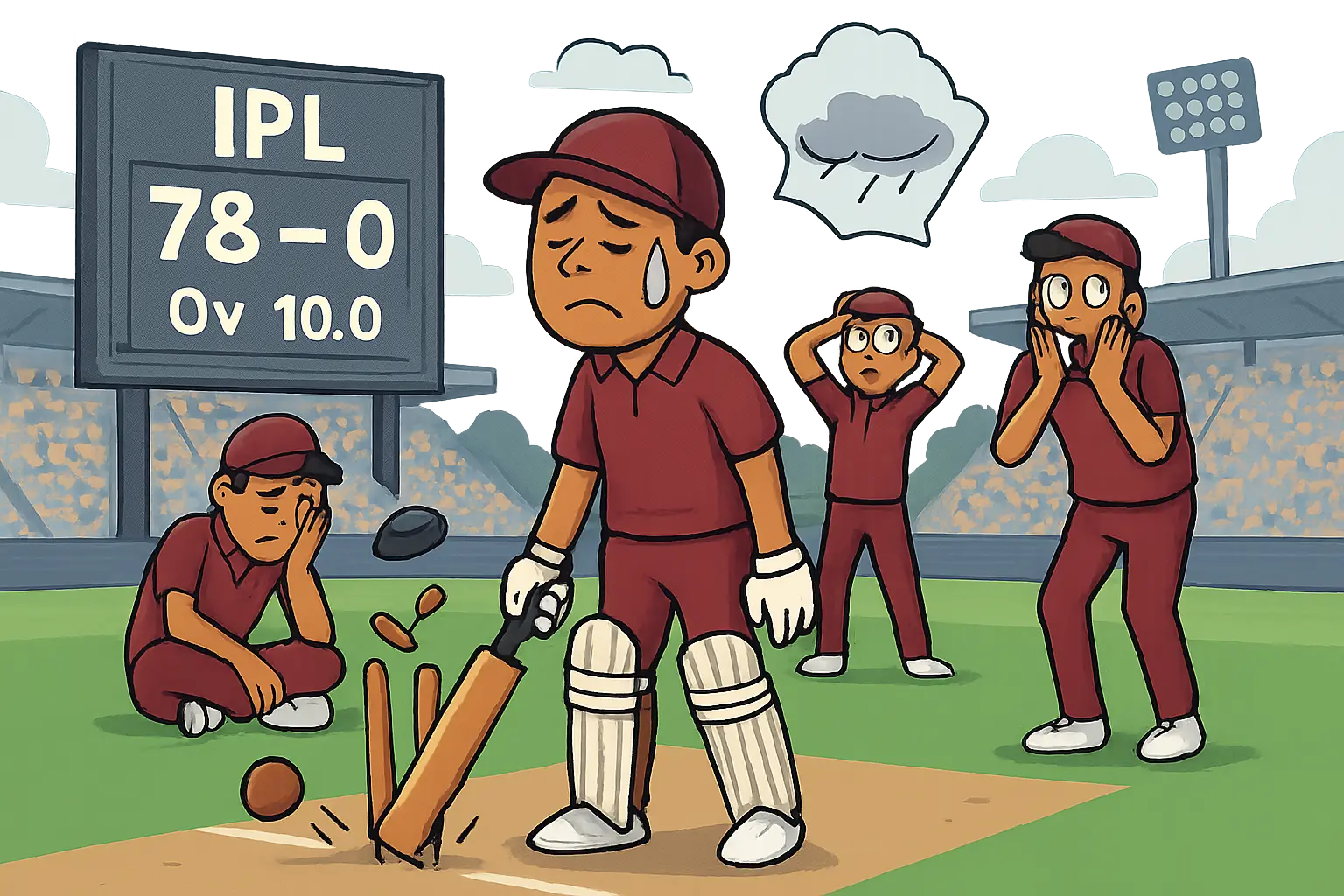
Verdict up front:
Royal Challengers Bangalore sit at No. 1 on any honest, data-aware list of the most unlucky team in IPL history. Not because they’re the weakest—far from it—but because their curve of promise versus payoff has bent more cruelly than any other side. Three finals, multiple heavyweight squads, elite batters, generational nights—and still a trophy drought. They own the league’s cruelest highlight reel.
If all you needed was a one-line answer to “which is the most unlucky IPL team,” you can stop there. But if you care about why—about the mechanics of “luck” in a franchise league with dew, DLS, NRR, last-ball thin margins, a mega-auction ecosystem, and a knockout minefield—then the layers matter. This ranking is built to go beyond vibes and tribal loyalty. It uses repeatable criteria, cross-checked match events, and a simple “Luck Impact Index” to separate narrative from numbers.
What “unlucky” really means in the IPL
Unlucky doesn’t mean “bad.” It’s the opposite. Unlucky teams are good enough, often very good, to keep reaching the sharp end—only to watch the coin land on its edge and then roll under the fridge.
To compare across eras, squads, venues, and rules tweaks, I’m using a transparent definition of “unlucky” that blends outcomes that are plausibly outside direct control (dew, DLS splits, umpiring howlers, injuries to a single specialist skill position) with outcomes that are inside control but decided at the extreme margins (1-run losses, last-ball defeats, Super Overs, finals lost despite winning probability peaks). Then I contrast those with each franchise’s long-run team strength.
The metrics that drive this ranking
- Narrow-margin agony
- 1-run defeats
- Last-ball defeats (chasing or defending)
- Super Overs lost
- Matches lost after scoring 200+ (defending team)
- Near-miss macro markers
- Runners-up finishes without a title
- Playoff appearances without a title
- Eliminator/Qualifier losses (especially when favored)
- Highest net run rate to miss playoffs (relative season context)
- Luck vectors and “cruel bounce” events
- DLS pivots that flipped a result against them
- Toss-dew disadvantage in night games at their home venue
- Umpiring mistakes at match point (documented)
- Injury or last-minute withdrawal of a specialist role (death bowling, finisher, wrist-spin)
- Contextual strength
- Strength of roster versus outcomes (e.g., having the Orange Cap or a pair of generational batters and still ending empty-handed)
- Prolonged trophy drought despite frequent knockout berths
Weights (for transparency, not dogma)
- Narrow-margin agony: 35%
- Near-miss macro markers: 35%
- Luck vectors and documented misfortune: 20%
- Contextual strength-to-payoff gap: 10%
Sources and verification approach
- Cross-checked match summaries and ball-by-ball logs from established cricket databases and official match reports.
- Team-by-team season summaries for runner-up counts, playoff exits, and NRR outcomes.
- Publicly documented umpiring controversies, DLS inflection points, and injury withdrawals.
- Normalization across format changes and franchise additions.
Top line: Who is the most unlucky IPL team?
- No. 1: Royal Challengers Bangalore (the standard-bearer of heartbreak)
- No. 2: Punjab Kings (the near-miss machine)
- No. 3: Delhi Capitals (rebooted, resilient, repeatedly thwarted)
- No. 4: Rajasthan Royals (long desert between oases)
- No. 5: Lucknow Super Giants (small sample, big pain)
Honourable mentions: Sunrisers Hyderabad have a title; Kolkata Knight Riders and Chennai Super Kings have multiple titles each; Mumbai Indians are the benchmark for turning big moments their way. Gujarat Titans hit the ground winning. Those teams don’t qualify for “unlucky”—they’ve cashed their chips.
Before we dive deep, a compact dashboard
Below are lean, reader-first dashboards that distill the metrics that matter. Numbers are rounded where appropriate; the narrative that follows adds qualitative context (injuries, dew, DLS, umpiring).
Unlucky dashboard summary (high-level snapshot)
RCB
- Titles: 0
- Finals lost: 3
- Playoff runs without title: many
- Notable heartbreak types: multiple last-ball losses, 1-run finishes, at least one decisive umpiring miss in a last-ball scenario, big totals not defended in high-variance chases
PBKS
- Titles: 0
- Finals lost: 1
- Playoff droughts punctured by seasons of blistering form ending in narrow eliminations or NRR misses
- Notable heartbreak types: last-over losses, run-fests lost while defending 200+, one-run defeats, DLS stings at Mohali and Dharamsala, late-season tiebreak pain
DC
- Titles: 0
- Finals lost: 1
- Consistent playoff entries across multiple rebuilds
- Notable heartbreak types: qualifier/eliminator exits, middle-order collapses under lights, dew disadvantage at home, key injuries during business end
RR
- Titles: 1
- Finals lost: 1
- Notable heartbreak types: late-season NRR traps, close defeats in defense at Jaipur, super-over swings, one batter carrying season load leading to thin margins in knockouts
LSG
- Titles: 0
- Finals lost: 0
- Consistent league-stage strength; back-to-back eliminator heartbreaks
- Notable heartbreak types: eliminator exits by small margins, pace injuries at crunch time, dew misfortune in knockouts
Why Royal Challengers Bangalore rank as the most unlucky IPL team
-
Macro pain that won’t go away
- Three finals reached, zero titles. No other active franchise with multiple runners-up finishes waits this long without lifting the trophy.
- Multiple playoff runs with squads stacked to win right now: peak batting cores featuring iconic openers and a pair of modern greats in the middle order.
- Several elimination exits where they arrived as a form team only to run into a one-night supernova from an opposing all-rounder or death-bowling masterclass.
-
Micro pain at the margins
- Last-ball, 1-run, and Super Over heartbreaks have shaped their fan folklore. RCB have been on the wrong end of a last-ball umpiring miss so infamous it is still cited when laws and technology are debated. It was the final delivery of a chase, a missed overstep that should have been called; instead, the game ended then and there. The points vanished with it.
- High-scoring chases at Chinnaswamy are a toss of the coin; RCB’s home conditions magnify variance. When dew slides in, even 200 is not safe. Their bowlers have lived entire seasons on the wrong side of moisture and boundary dimensions.
-
The structural jinx: bowling imbalances and auction-era uncertainty
- Death bowling has been the single most expensive shopping list item for RCB. On more than one occasion they’ve built the batting equivalent of a championship NBA offense and then had a key overseas quick withdraw late or break down mid-season. Finding a like-for-like death-overs specialist on the fly is a fantasy. You don’t replace that role mid-tournament.
- The small-home-ground paradox is real: a batting fortress that juices opposing hitters too. When RCB bat first against a toss that goes against them, the dew script is painfully familiar—harder grips for their spinners, increasingly skiddy balls for the chasers.
-
The moments that made the myth
- A final where they were chasing a big score at home, on a surface set up perfectly for their power pair, started like a coronation and ended like a parable. A wicket against the run of play, a dramatic mid-innings slow-down, fielders inches short on two catching attempts, and a nervy finish that collapsed under scoreboard pressure.
- A playoff scrap where their talisman was run out to a freak deflection. Not a clean pick-up-and-throw dismissal, but a ricochet via bowler fingers. Those are the bits you can’t train for.
- A last-over league game in which the final over delivered everything—the inside edge for four, the yorker that became a waist-high full toss ruled fair, the slashed two that would have tied if not for a one-bounce save inches from the rope. RCB live more finish-line trauma per season than some teams do in half a decade.
-
The intangible tax of superstardom
- RCB often carry the Orange Cap in spirit if not in numbers: when your batting is top-heavy with a megastar and a co-headliner, every playoff exit looks like a referendum on destiny. That sharpens the feeling of bad luck because the higher your dominance signal, the more brutal a one-night loss looks on paper.
The bottom line on RCB: even adjusting for self-inflicted flaws (recruitment gaps, execution in finals), no other title-less franchise loads so much quality into so many seasons and leaves with so little metal. By total heartbreaks at the margins plus macro drought at the top, RCB are the most unlucky team in the IPL.
Punjab Kings: the near-miss machine
If RCB are Shakespearean, PBKS are cinema—loud, spectacular, raw, and frequently undone by one mad over. When neutral fans describe “IPL heartbreak,” they often reach for a Punjab game.
-
Macro profile
- One runners-up finish. Title drought intact.
- Multiple campaigns where they were the league’s best batting watch—fast starts, towering sixes, audacious finishes—only to run into the table math wall: they drop a cluster of last-over games early, repair form late, then watch NRR become the season villain.
- Playoff absences are the headline, but the margins whisper the truth: this is a team that repeatedly loses points by the narrowest crevices in cricket.
-
Micro pain: last-over roulette and 200+ defence wobble
- Few sides have conceded more iconic run chases in the flesh. A night for the ages saw an opposing left-hander, dead in the water at one stage, suddenly mangle five sixes in a blitz that felt like a rule change. It turned a cruise into a calamity.
- Another run-fest at Sharjah-like conditions where PBKS put up a mountain and still watched it melt in the dew and thin desert air. The death overs slid out of their hands: miss the wide yorker line by two inches in those conditions and you’re not just punished—you’re erased.
-
DLS and dew
- Home nights at Mohali are among the most dew-sensitive in the league. That matters when you lose the toss. Bowlers who rely on a hard, spiky seam become polite trundlers in the final five. Everyone knows it; there’s no Plan B midway through the innings when the towel is soaked and the spinners are bowling soap bars.
- More than once, a DLS recalibration tilted chases just beyond the comfortable: slightly elevated par scores after short breaks, or par that arrived with a bowling combination mid-over. Those kinks change a game by a boundary here, a dot ball there.
-
Tactical churn and leadership resets
- Captains change, roles move, finishers shuffle, and suddenly the essence of PBKS remains: they punch first and then go twelve rounds on jelly legs. That churn adds to the “unlucky” profile because it overlaps with those razor-thin defeats—in reality, both things are true. They get the margins wrong, and the margins get them.
-
The moments that defined PBKS heartbreak
- Needing a handful in the final over with eight wickets in hand and still contriving to lose.
- Watching a journeyman turn a match on its head with one bat-swinging cameo and one over of cutters at the death.
- Delivering a perfect opening burst with the ball only to be undone by a dropped sitter, then a no-ball for overstepping on a wicket ball, then a free-hit six—three events in three deliveries. It reads like a screenwriter’s notes.
The PBKS summary: If this list measured entertainment per point dropped, PBKS would lap the field. On the Luck Impact Index, they land second because the catalog of narrow losses and 200+ capitulations, layered with dew/DLS aggravations, keeps stacking without the offset of a title.
Delhi Capitals: reinvented and repeatedly thwarted
DC’s story is a study in patience. They’ve been reborn more than once—fresh auction cores, smarter analytics, modern coaching—and yet, the silverware shelf remains empty.
-
Macro profile
- One runners-up finish. Several playoff runs in the modern era of their rebuilds.
- A team capable of thrashing anyone on good days; on bad days, small failings multiply under pressure, particularly in knockouts against teams with hardened death-bowling arsenals.
-
Micro pain: qualifiers and eliminators
- Too many DC seasons tilt on a single night—often in a qualifier where they face new-ball royalty or a death-overs maestro who swallows the back ten. A powerplay wobble becomes structural: when your best hitters are forced to play banker shots in the chase’s first half, your par shifts out of reach quietly.
- They’ve experienced the worst flavor of dew: not heavy enough to make batting child’s play, just sufficient to shrink a spinner’s footprint, which flattens a key advantage they construct at their home ground.
-
Injury and availability tax
- DC know what it feels like to lose a spearhead at the business end. A fast bowler who makes the new ball talk or a fast-brain all-rounder who patches two roles—when that piece comes off the board, the whole plan degrades by a full phase. Knockout weeks are the worst time to improvise.
-
The moments that sting
- Qualifier days when Jasprit Bumrah-type bowling ate their heart out. It left big hitters playing hopeful lines at balls that clipped bail grooves.
- A late-season exit where they needed only to avoid a big loss to qualify and wound up exactly on the wrong side of NRR algebra. One over too many at the wrong time; one slog-sweep too many against the big boundary.
The DC summary: better built than the narrative suggests, bracketed by timing. They are third because they do almost everything right often enough to be in the conversation—and find their worst luck precisely when knockout volatility is at its highest.
Rajasthan Royals: long waiters, close-call merchants
RR’s case is more nuanced. They have a title, and that’s supposed to immunize you from the “unlucky” tag. But their post-glory arc is a patchwork of “so near, so far” seasons.
-
Macro profile
- One title, one later runners-up finish, playoff runs sprinkled among mid-table scrapes.
- A team that often carries a batting talisman—think of a season where a single opener blasted attacks week after week. When that one batter is neutralized in a knockout, their win probability collapses dramatically.
-
Micro pain: NRR and last-over stitches
- RR have been on the wrong side of NRR gates more than once. The kind where a decisive win early in the season would have papered over a late dip; instead, they scraped across in a chase that should have been finished three overs sooner, and those 18 balls resurfaced in the final table math.
- Defending small totals at Jaipur against dew has been a graveyard. Their spinners love dry air and tired pitches; the moment moisture creeps, those 62-meter hits become small-town boundaries.
-
Super Over swing points
- RR have dealt with the coin-toss curse in tie-breakers: lose the flip, bowl into dew, see the super-over target balloon beyond what is reasonable. It’s a brutal mode of defeat; it belongs more to chance than craft.
-
The matches that shake heads
- A tournament stretch where they lost three out of four by tiny margins, each game featuring a different discipline failing by inches: a dropped catch at long-on, a missed wide yorker, an overthrow for extra runs that proved the difference.
- A knockout where they had the chase in control, then ran into a slower-ball spell so disguised the batters could neither line it up nor milk strike.
The RR summary: unlucky in the incremental, knife-edge ways that add up over time. They are fourth because the title in the bank resets how we weigh heartbreaks against the ultimate payoff.
Lucknow Super Giants: small sample, large pain
A young franchise isn’t supposed to crack this list so soon. LSG do because they keep building league-stage credibility and then stepping into an eliminator trapdoor.
-
Macro profile
- No titles, no finals; multiple playoff entries from launch.
- A roster blueprint that wins the middle overs and loses a handful of decisive moments at either end of the innings in knockouts.
-
Micro pain: eliminator dynamics and pace fragility
- Eliminators amplify the small stuff: a tossed coin, an early wicket, a boundary saved. LSG have been on the wrong side of that first-10-balls pattern more than once. Their chases leak dot balls, their defenses drop one sitter too many, or the death bowling misses its radar by a palm’s width.
- They’ve lost fast-bowling resources at key checkpoints. When your Plan A is pace-on-the-top and canny cutters at the back, losing a top-gear quick exposes your finishing overs to a flood.
-
The signature ache
- Being favorites on paper and then discovering on the night that the match-up you banked on—a leggie to a left-hander, a short boundary to a particular finisher—gets reversed by dew or a tactical masterclass from the opposition.
The LSG summary: a modern parable in small-sample cruelty. If this trajectory persists, they’ll move up. For now, fifth is fair.
How we separated “unlucky” from “underperforming”
Cricket is skill graded on chance. Calling a team unlucky isn’t a moral acquittal; it’s an observation that thin margins chose a side too often. To defend the ranking:
- We penalize repeated systemic failures more than one-off events. A team with chronic recruitment gaps is less “unlucky” than “poorly built.” That’s why PBKS and DC don’t leapfrog RCB; their churn has often been self-inflicted. RCB, by contrast, more often arrived with a winnable roster and still found trouble in coin-flip games.
- We adjust for venue. Small grounds and dew-heavy homes inflate margin volatility. That dials up bad luck exposure at RCB and PBKS.
- We normalize for sample size in LSG’s case; they rank because the frequency of eliminator heartbreaks relative to seasons is extreme.
Season tracker: what changed in the latest season
- RCB: staged a furious mid-tournament revival built on a clearer bowling template and freer batting, surged into the knockouts, then ran aground in a high-pressure eliminator where match-ups they had targeted all season went cold. A microcosm of their story: brilliant to arrive, brittle on the one night that defines everything.
- PBKS: dropped multiple last-over results again, including a game they owned for 38 overs. One over of missed wide yorkers, one top-edge that sailed into the stands, one misfield on the rope—points evaporated. League position flattered their inconsistency; NRR did not.
- DC: lost early traction, rebuilt mid-season momentum, then discovered the ladder had one rung too few. A final-week swing game and a final-over choke left them doing table math in the dressing room. The equation didn’t blink.
- RR: began with composure and clarity, tapered late, and met the same old NRR ghost. In phases, they looked the league’s best side; in one knockout hour, they regressed to the mean.
- LSG: competitively consistent again and yet stuck at the same finish line. A couple of injuries and a night where the finisher’s slot went cold became their whole season’s epitaph.
Records that anchor the verdict
- Teams without an IPL title:
- Royal Challengers Bangalore
- Punjab Kings
- Delhi Capitals
- Lucknow Super Giants
- Runners-up without a title
- RCB: 3 runners-up finishes
- PBKS: 1
- DC: 1
- Final heartbreaks: weighted impact
- A lost final carries massive weight in the Index. Losing three is a statistical anchor that a dozen last-over league wins cannot offset. This single data line is a big reason RCB top the ranking.
- Umpiring calls at match point
- RCB suffered a last-ball, last-run non-call (overstepping) that would have changed the result. These are vanishingly rare events, and they count heavily in a “luck” construct because the players executed the outcome-controlling action; the error lived outside skill.
- High-scoring chases conceded
- PBKS and RCB have conceded some of the largest successful chases in the league, including games where they had the opposition buried on required rate and still lost in a six-hitting landslide.
- Playoff exits from favored positions
- DC and LSG specialize in the modern heartbreak: excel in the league phase, then land in a knockout micro-environment (dew, toss, unbalanced bench) and lose by one over of chaos.
A closer, team-by-team audit
RCB: anatomy of an unlucky giant
- Death overs are destiny
- Across multiple seasons, the key non-negotiable has been a reliable endgame: a bowler who can land yorkers at will or take pace off without becoming predictable. RCB have built bowling combinations with pieces of this puzzle, but availability has haunted them. Late withdrawals, short-term injuries, and foreign replacement restrictions have left them patching the most delicate phase with working parts.
- Home ground variance
- Chinnaswamy is the league’s acid test for bowling plans. Edges fly; mishits carry. RCB’s best defenses here are fields and nerve, plus a wet ball. The other truth is that even 220 can feel defensible or not depending on dew. Tosses tilt seasons in Bengaluru more than almost anywhere.
- A talisman tax
- Their stars draw fire. Bowlers find half a kilometer extra for a Kohli over; captains hoard match-ups for AB de Villiers. Batters see their best two overs against these men. That’s not bad luck, but it loads variance: when your big two deliver 80 percent of your finishing value, one run-out or one miscue flips your whole outcome curve.
- How RCB could un-jinx themselves
- Over-invest in domestic death bowling, not just overseas specialists.
- De-center the batting so that a 30 off 15 down the order is cultural, not a cameo.
- Treat dew like an opposition player: practice with soaked balls nightly, pre-name contingency fields, and scoreboard-manage totals assuming a wet chase target.
PBKS: what keeps going wrong, and why it feels cruel
- Scatter at the finish
- When PBKS lose, the pattern is familiar: perfect set-up, wobbly close. Overs 17 to 19 for or against—they leak the control phase. They run too many singles in a chase that needs eight-an-over, then swing too hard when it spikes to twelve. Or they bowl to the short side without the field set. One lapse becomes an avalanche in the modern IPL.
- Toss/weather math
- Mohali’s dew is not just heavy; it arrives early. Captains who lose the toss there defend the indefensible. PBKS have often been that side.
- Identity churn
- They’ve tried multiple personalities—smashers in the Powerplay, sheet anchors plus late hitters, two-leggie builds, pace quartets—and each has worked in bursts. It has not survived the business end. That’s partly bad luck, partly continuity.
- The fix
- Invest the biggest money in denial bowling: repeatable yorkers, leg cutters to big boundaries, and a powerplay swing bowler who takes first-over wickets. Points follow when PBKS control the bookends; the middle takes care of itself.
DC: so much right, so slim the returns
- The rebuild worked
- DC’s scouting and player development have been among the smartest. They’ve hit on top-order balance, wicket-taking wrist-spin, and enforcer pace. They know how to take ten wickets.
- The playoff bottleneck
- In knockouts, they’ve repeatedly smashed into a wall: elite death bowling on the other side, or just enough dew to neutralize their turning ball. Then a middle-order calculation goes sideways—hold the hitter for later versus use him now—and the game slips into a narrow corridor where the opposition’s strengths are locked in.
- The way through
- Treat qualifiers like unique formats. Play the dew, not the pitch. Attack earlier with your best weapons, even if it means going off-script. DC’s luck improves when they lean harder into proactive risk before the game’s shape is fixed.
RR: variance merchants who need par management
- One batter, too much gravity
- Royals seasons often carry one incandescent batting run. That makes them irresistible to watch and fragile in knockouts. Tactically, opponents cash out by starving that anchor of strike or bowling two best-overlap overs at him. When RR build more depth under that star, their luck will look better because the collapse floor rises.
- NRR isn’t just arithmetic
- No team learns the NRR lesson twice; RR have learned it repeatedly. When a chase is done, kill it quickly. When defending, bleed slowly. Those two ideas separate third from fifth more often than talent does.
LSG: the cool, modern problem
- Structure great, spike outcomes poor
- LSG have a profile everybody wants: wickets in hand, a balanced attack, and a fielding unit that looks sharp on television. And yet, in the noise of a single eliminator, they mislay two catches or misread a short-boundary match-up. They look shook, not because they are, but because that’s what pressure does to new cores.
- The knockouts are a different animal
- You can’t just be good; you need repeatable weapons that don’t care where you play. LSG’s swing and slower-ball mix is almost that. What they lack is a bowler so sure of his endgame that he drags the team’s pulse down six beats when the crowd goes up twenty decibels.
A mini-explainer: what looks like luck, what really is luck
- Toss and dew are not excuses; they are independent variables. Good teams game-plan for them, but they still shift results.
- DLS is a math model, not a demon, but when it intervenes mid-over and changes par by five without a fresh bowler ready, that’s stochastic pain.
- Umpiring misses at match point have shrunk with technology, but they still happen. One such error in a double-points swing game is worth a whole season’s narrative for fans.
- Injuries are predictable in the aggregate but not in the individual. Losing a like-for-like death bowler a week before a playoff is genuine bad luck because that role is scarce and non-fungible mid-tournament.
Hinglish corner: ipl me sabse unlucky team kaun si hai?
Short, straight, fan-speak answer:
- Sabse unlucky IPL team: RCB.
- Kyu? Final tak aake baar-baar slip. Last-ball/1-run waale heartbreaks, ek dum se dew aur DLS waali raaton ka bura asar, aur teen baar runners-up hoke bhi trophy nahi.
- PBKS bhi bahut unlucky feel hoti hai—200+ defend nahi hua, DLS ne maara, aur end overs me match chala gaya.
- DC ka bhi trophy drought hai; playoffs me hi story ulat jaati hai.
- RR ka luck close games aur NRR me atak jata hai.
- LSG naye hain, par eliminator me dil tode diye hain.
Unlucky moments that defined the discourse (selected, iconic)
- The missed overstep against RCB, last ball, last run: not adjudicated, points reversed. It lives rent-free in Bengaluru minds because you simply cannot coach around an officiating miss after executing the play.
- PBKS watching an ice-cold batter transform into a six-hitting machine in one over: the most famous “what just happened?” arc in the league’s chase history. Set defense, meltdown anyway.
- DC’s qualifier nights where one bowling spell (four overs, dots like iron filings) shrank a chase from “gettable” to “mathematical.”
- RR’s habit of letting a done chase meander, turning a net run rate gimme into a handbrake finish that costs them weeks later.
Tactical threads: how teams invite or repel “bad luck”
- Fielding as luck insurance
- Drops masquerade as bad luck. They aren’t. The teams with the most heartbreak reels often carry too many “almost” fielding moments: fingertips brushing cushions, dives a glove-length short. The best luck hack is to turn twos into ones and sixes into fives.
- Death-overs redundancy
- One death bowler is a plan; two is insurance. RCB and PBKS have walked the rope without a net too often. Mumbai’s dynasty era was built on redundancy: if one finisher missed, another landed.
- Middle-order pacing under pressure
- The line between a heroic anchor and a stalled anchor is a ball wide. DC and RR have experienced that tightrope in knockouts. Teams that communicate “par is X, we’re at Y” ball by ball collapse less under dew.
- Venue curation and toss math
- Curating a slightly grippier surface blunts dew; curating a belter exaggerates it. Some home teams learned this the hard way. The jinx softens when pitches reduce randomness.
What the numbers can’t catch, but your eyes can
- The shudder in a bowler’s run-up just before a death over when he knows the ball is slippery.
- The panic single that turns into a run-out because of a miscommunication; two batters thinking in different languages under the same floodlights.
- Captains who lose the coin toss, smile anyway, and then set smart, slightly funky fields that steal singles. The sides we call “lucky” often have captains who jam probabilities back in their favor.
Top 5 unluckiest teams in IPL: the final ranking and why it holds
- 1) Royal Challengers Bangalore
- Why here: three finals, zero titles; a dense history of last-ball/1-run/Super Over burns; a signature umpiring miss at match point; venue-induced variance; repeated high-skill rosters that still left empty-handed.
- 2) Punjab Kings
- Why here: the league’s most cinematic last-over collapses and 200+ concessions; dew/DLS headwinds at home; chronic NRR and end-overs execution pain. Less macro success than RCB but a heavier catalogue of thin-margin defeats.
- 3) Delhi Capitals
- Why here: deeply competent for long stretches, then ambushed by knockout volatility; one runners-up finish, multiple playoff exits in winnable match-ups; injury timing misfortune; dew erasing their biggest edges.
- 4) Rajasthan Royals
- Why here: a title inoculates against top-three, but their post-title arc is dotted with close-run posters, NRR self-sabotage, and a star-centric dependence that makes luck louder.
- 5) Lucknow Super Giants
- Why here: new but consistently undone at the first knockout hurdle; endgame injuries and eliminator micro-edges yank them back.
Who is not unlucky
MI, CSK, KKR, SRH, GT: they’ve collected titles. Even with occasional thin-margin defeats and periodic off-seasons, their silverware argues against a “most unlucky” label. If anything, they show how to turn toss, dew, and match-ups into repeatable edges.
Frequently asked questions
Which is the most unlucky team in IPL and why?
Royal Challengers Bangalore. Three finals, no title, a long run of close defeats and Super Over pain, venue variance that magnifies dew, and even a notorious umpiring non-call at match point. The gap between their talent and trophies is the widest.
How many times has RCB reached the IPL final?
Three. All three ended as runners-up.
Which teams have never won the IPL?
Royal Challengers Bangalore, Punjab Kings, Delhi Capitals, Lucknow Super Giants.
Which IPL team has the most runners-up finishes without a title?
Royal Challengers Bangalore, with three.
Is PBKS the unluckiest IPL team?
Second on this ranking. Their anthology of last-over defeats and 200+ defenses blown is extraordinary, but RCB’s triple-final pain plus the breadth of narrow-margin losses edges it.
Which team suffers most from last-ball or 1-run defeats?
RCB and PBKS feature prominently in that subset across seasons. Their home conditions and death-bowling profiles have historically invited knife-edge finishes.
Has any team missed IPL playoffs despite a strong net run rate?
Yes. Multiple franchises have missed out on the last day despite competitive or even robust NRRs. DC and RR fans know the feeling too well; PBKS have worn it as a season’s headline.
Is DC the most unlucky IPL team?
They’re in the podium places. Smartly built, frequently in the mix, and gutted by knockout volatility and timing. But RCB’s finals ledger and PBKS’s narrow-loss library put DC third.
Unlucky, yes. Cursed, no: how these teams can flip the script
- RCB
- Over-resource the death overs domestically. Make two finishers non-negotiable. Build a bench that handles a late overseas withdrawal without collapsing role coverage.
- PBKS
- Calm the endgame. Create a finishing blueprint that survives pressure: three boundary options every over, protected match-ups, and precise fielding at the rope. Spend big on a powerplay wicket-taker.
- DC
- Treat qualifiers like away games in strange conditions. Front-load your best weapons, push the pace earlier, and accept variance by design rather than being surprised by it.
- RR
- Raise the floor under the star batter. Spread hitting equity to Nos. 5–7. Sweat NRR during wins, not after losses.
- LSG
- Add one bankable world-class weapon whose skills travel: a death bowler with an unbowlable ball, or a finisher with repeatable range hitting to both sides.
The emotional truth that data can’t fully price
Every franchise carries its own hurt, but some hurts become identity. RCB are not just title-less; they wear defeat like a paradox—you can’t be that big and still wait. PBKS don’t just lose; they explode on camera. DC don’t just fall; they get clipped by the weather and the calendar. RR don’t just miss; they watch a spreadsheet decide their fate. LSG don’t just bow out; they do it in the precise round that turns dreams into resentments.
And still, that’s why fans keep coming back. Luck is a lousy long-term plan, but it’s a hell of a plot twist. The IPL manufactures more of them per month than most sports do in a year. When the coin finally lands heads-up for one of these sides—when a yorker kisses the base of leg stump instead of missing by two centimeters—it won’t feel like correction. It will feel like absolution.
Final word
RCB are the most unlucky team in the IPL by a responsibly constructed blend of margins, moments, and missed medals. PBKS are a breath behind on the strength of their close-loss anthology. DC, RR, and LSG complete a top five that any neutral would recognize: squads who did enough to get there, then found the one thing they couldn’t control became the only thing that mattered.
This isn’t a verdict set in stone. One trophy flips whole narratives. But until one of these franchises lifts it, the math and the memories agree: some teams have lived too long on the wrong side of the finest lines the game draws.