
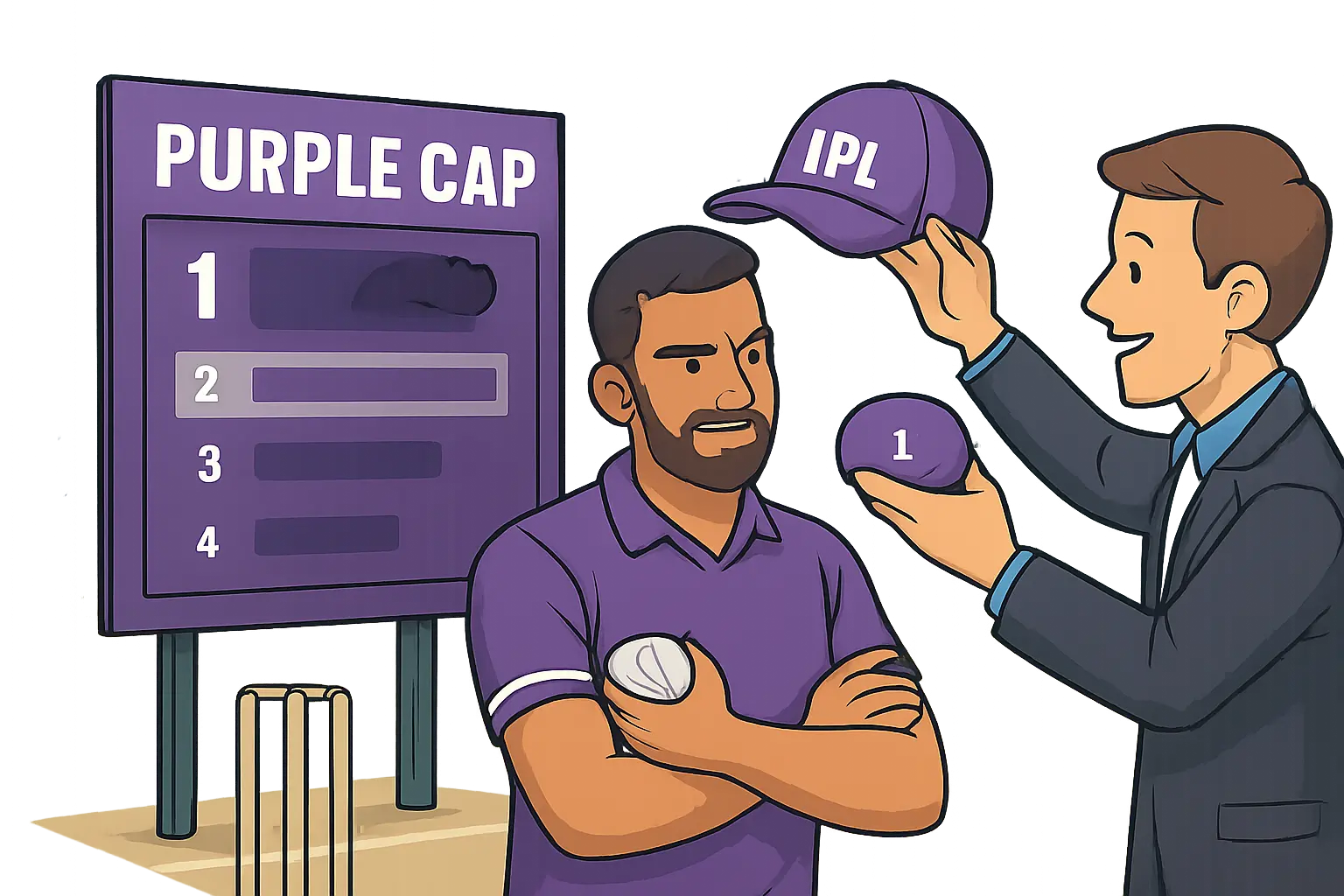
The Purple Cap sits at the intersection of skill, nerve, and relentless adaptation. It isn’t handed to the bowler who merely turns up with a decent slower ball; it gravitates to someone who reads the season, outthinks batters across phases, and keeps landing the right ball when the game and the crowd are pushing in the other direction. This is the definitive hub for the IPL Purple Cap list—how the race unfolds live during a season, who has owned it across the league’s history, how the rules and tie-breakers work, and what deeper splits tell us about the art of wicket-taking in the IPL.
Across formats and franchises, the most enduring truth is simple: wickets under pressure change seasons. The Purple Cap celebrates exactly that.
Live IPL Purple Cap Table (Ongoing Season)
The Purple Cap race is dynamic. After every match, the leader changes hands if someone goes past on total wickets; during a game, the on-field leader actually wears the cap. A typical live table tracks:
- Rank
- Player
- Team
- Matches
- Overs
- Wickets
- Runs Conceded
- Average
- Economy Rate
- Strike Rate
- Best Bowling
- 4-wicket hauls
- 5-wicket hauls
- Phase splits: Powerplay, Middle-overs, Death-overs
As the season matures, the leaderboard often skews toward bowlers who reliably bowl in two of the three phases (Powerplay and Death) or absolutely dominate the middle with relentless, repeatable skills.
Purple Cap Winners Season-Wise
Season-by-season winners from the inaugural season to the latest completed season:
| Season 1 | Sohail Tanvir (Rajasthan Royals), 22 wickets |
| Season 2 | RP Singh (Deccan Chargers), 23 wickets |
| Season 3 | Pragyan Ojha (Deccan Chargers), 21 wickets |
| Season 4 | Lasith Malinga (Mumbai Indians), 28 wickets |
| Season 5 | Morne Morkel (Delhi), 25 wickets |
| Season 6 | Dwayne Bravo (Chennai Super Kings), 32 wickets |
| Season 7 | Mohit Sharma (Chennai Super Kings), 23 wickets |
| Season 8 | Dwayne Bravo (Chennai Super Kings), 26 wickets |
| Season 9 | Bhuvneshwar Kumar (Sunrisers Hyderabad), 23 wickets |
| Season 10 | Bhuvneshwar Kumar (Sunrisers Hyderabad), 26 wickets |
| Season 11 | Andrew Tye (Punjab), 24 wickets |
| Season 12 | Imran Tahir (Chennai Super Kings), 26 wickets |
| Season 13 | Kagiso Rabada (Delhi), 30 wickets |
| Season 14 | Harshal Patel (Royal Challengers), 32 wickets |
| Season 15 | Yuzvendra Chahal (Rajasthan Royals), 27 wickets |
| Season 16 | Mohammed Shami (Gujarat), 28 wickets |
| Season 17 | Harshal Patel (Punjab), 24 wickets |
- Death is destiny: bowlers who closed out innings with nerve and novelty thrived.
- The middle is a trap: spinners hunted the space between caution and ambition.
- The new ball still sings: seam and swing at the start remain lethal.
All-Time IPL Bowling Records
Most wickets in IPL history
Yuzvendra Chahal sits atop the all-time chart. Behind him are Piyush Chawla, Dwayne Bravo, Bhuvneshwar Kumar, Ravichandran Ashwin, and Lasith Malinga—bowlers who combined longevity with consistent wicket-taking craft.
Most wickets in a single IPL season
The record (32 wickets) is shared by Dwayne Bravo and Harshal Patel—two very different paths to the same summit: one via death-over mastery, the other via variations and cunning.
Best bowling figures in IPL
Alzarri Joseph’s debut 6 for 12 is the standout spell. Sohail Tanvir’s 6 for 14 remains a landmark as well—proof that a single near-perfect spell can puncture batting chaos.
4-wicket and 5-wicket hauls
Sunil Narine, Lasith Malinga, Bhuvneshwar Kumar, Amit Mishra, and Anil Kumble populate the top echelons for destructive bursts. Their four- and five-fors are a mix of control, yorkers, top-spin, and old-school guile.
How the Purple Cap Is Decided (Rules and Tie-Breakers)
- What is the Purple Cap: Awarded to the tournament’s top wicket-taker. The current leader wears it on field while his team bowls.
- How it’s decided: By total wickets from legal deliveries across the tournament. Run-outs do not count.
- Tie-breakers: If bowlers finish level on wickets, economy rate is the first separator. If still tied, the tournament’s operational rules favor efficiency (fewer overs bowled or superior strike rate).
Purple Cap vs Orange Cap
Orange Cap = most runs in the tournament. Purple Cap = most wickets. Both are live, both can change hands during a match, and both tell you how a team’s batting or bowling engine performed.
The Tactical Heart of the Purple Cap Race
The powerplay hunt
New-ball artists who attack the stumps and corridor—swing and accuracy—can bank early breakthroughs that keep the Purple Cap conversation alive.
The middle squeeze
A leg-spinner’s promised land: wrong’uns, drifting fuller lengths, and fields that turn pressure into wickets. Many Purple Cap winners have thrived here.
The death gamble
Yorkers, slower balls, wide lines, and practiced deception. Death overs create volume—hence many winners come from performers in this phase.
Reading venues and dew
Venues and weather shift the balance: Chepauk rewards guile, Wankhede can reward pace at the death, dew changes grip and execution. Preparation often decides the last few wickets.
Season Stories Behind the Purple Cap
- The knuckleball age: Slower variations and knuckleballs punished batters at the death.
- Bravo’s theatre of deception: Setup sequences and deliberate baiting of batters produced wickets.
- Leg-spinners retake the middle: Chahal and Tahir proved wrist spin remains central in the middle overs.
- The new-ball renaissance: Shami-type seamers showed simply moving the ball late still breaks innings.
- The modern cutter boom: Cutters and back-of-the-hand variations provided cheap wickets on dry squares.
Advanced Split Angles That Actually Matter
- Most IPL wickets in powerplay: Swing and seam merchants often dominate early overs (Bhuvneshwar, Chahar, Shami, Boult).
- Most IPL wickets in death overs: Bravo, Rabada, Bumrah, T Natarajan, Andrew Tye—decisive death-over specialists.
- Best economy among Purple Cap winners: Bhuvneshwar’s peak years set the standard—wickets with low economy.
- Most wickets by venue: Venues define styles—Chennai for spin, Wankhede for death specialists, Ahmedabad for bounce, etc.
Team-Wise Leading Wicket-Takers (Highlights)
A quick look at how franchises built their Purple Cap stories:
- Chennai Super Kings: Dwayne Bravo, Ravindra Jadeja, Deepak Chahar.
- Mumbai Indians: Lasith Malinga, Jasprit Bumrah.
- Royal Challengers: Yuzvendra Chahal, Harshal Patel.
- Kolkata Knight Riders: Sunil Narine, Andre Russell.
- Rajasthan Royals: Yuzvendra Chahal, Trent Boult.
- Delhi: Amit Mishra, Kagiso Rabada.
- Sunrisers Hyderabad: Bhuvneshwar Kumar, T Natarajan.
- Punjab: Piyush Chawla, Arshdeep Singh, Andrew Tye.
- Gujarat: Mohammed Shami, Rashid Khan.
Playoffs Purple Cap Race
Leaders entering the playoffs can be hunted down quickly—Qualifier 1 and the Eliminator often produce single-game surges that affect the final tally. The final swap, if any, usually comes from a precise two-wicket performance rather than fireworks.
FAQ: Quick Answers
- Purple cap holder today: The live table after the latest match decides the holder.
- What is purple cap in IPL: The award for the highest wicket-taker across the tournament; the current leader wears it on field.
- How purple cap is decided: By total wickets. Tie-breaker: economy rate, then efficiency criteria.
- Most wickets in IPL history: Yuzvendra Chahal.
- Most wickets in an IPL season: Dwayne Bravo and Harshal Patel (32 each).
- Best bowling figures in IPL: Alzarri Joseph, 6 for 12.
The Anatomy of a Purple Cap Season
- Conditioning and craft: Late-season winners often finish stronger due to fitness and repetition.
- Fielding echo: Catching and dot-ball pressure amplify a bowler’s wicket tally.
- Captaincy and trust: Great captains stick to plans and allow bowlers to fail loud before success.
- Psychological warfare: Body language and small celebrations change batter intent.
Phase-Wise Skills: What Works, and Why
- Powerplay: Length discipline, attacking stumps, and controlled swing.
- Middle-overs: Pace changes, widths that tempt the slog, and spin trap fields.
- Death-overs: Target management, yorkers, and rehearsed slower balls.
Micro-Trends That Shift Purple Cap Races
- Rise of batting depth pushes bowlers to seek wickets late.
- Scheduling and surfaces influence fatigue and variation usage.
- Data literacy means bowlers execute ball-by-ball plans with analyst support.
- Left-arm angle remains a decisive edge for many match-ups.
Purple Cap Winners: Profile Archetypes
- The Closer: Death specialists who bowl the last overs (Bravo, Rabada, Bumrah).
- The Middle Maestro: Leg-spinners and control spinners (Chahal, Tahir).
- The New-Ball Surgeon: Swing and seam early-wicket takers (Bhuvneshwar, Shami, Boult).
- The Swiss Army Knife: Adaptable bowlers who thrive in all phases (Harshal, Narine, Rashid).
Understanding the Metrics Behind the Cap
- Wickets: Primary currency.
- Economy Rate: First tie-breaker and narrative of value.
- Average: Measures the quality of wickets.
- Strike Rate: How often a bowler takes wickets.
- Phase splits: Reveal where the wickets came from (PP, middle, death).
Common Misreads About the Purple Cap
- “It’s all about death overs.” — Often true for volume, but some winners dominate middle overs.
- “Spinners can’t survive on flat decks.” — They can, by controlling tempo and inviting mistakes.
- “Yorkers or bust.” — There are multiple paths: wide lines, off-pace, and tactical baiting all work.
What a “Purple Cap Over” Looks Like
- Ball 1: Stock delivery—measure and set field.
- Ball 2: Small adjustment—target the stumps or a touch fuller.
- Ball 3: Set-up ball—wide or sharp to change the arc.
- Ball 4: The lure—slower ball or disguised variation.
- Ball 5: The finisher—the yorker or the baited leg-break.
- Ball 6: Insurance—take one, prevent boundary, close the over.
The Human Side of the Cap
Preparation, repetition, fielding support, and captaincy trust are as important as raw skill. The Purple Cap is a season’s worth of coin-flip moments weighted by craft and consistency.
Current Purple Cap Holder: Where to Look
The “purple cap holder today” updates after the last ball of each day; live leaderboards and on-field visuals are always in sync.
Shareable Quick Reference
- Most wickets in IPL history: Yuzvendra Chahal
- Most wickets in an IPL season: Dwayne Bravo & Harshal Patel (32)
- Best bowling figures in IPL: Alzarri Joseph, 6 for 12
- Purple Cap tiebreaker: Economy rate first; then efficiency-based criteria
Season-Wise Winners Table (Compact)
| Season 1 | Sohail Tanvir (RR) — 22 |
| Season 2 | RP Singh (DC) — 23 |
| Season 3 | Pragyan Ojha (DC) — 21 |
| Season 4 | Lasith Malinga (MI) — 28 |
| Season 5 | Morne Morkel (Delhi) — 25 |
| Season 6 | Dwayne Bravo (CSK) — 32 |
| Season 7 | Mohit Sharma (CSK) — 23 |
| Season 8 | Dwayne Bravo (CSK) — 26 |
| Season 9 | Bhuvneshwar Kumar (SRH) — 23 |
| Season 10 | Bhuvneshwar Kumar (SRH) — 26 |
| Season 11 | Andrew Tye (Punjab) — 24 |
| Season 12 | Imran Tahir (CSK) — 26 |
| Season 13 | Kagiso Rabada (Delhi) — 30 |
| Season 14 | Harshal Patel (RCB) — 32 |
| Season 15 | Yuzvendra Chahal (RR) — 27 |
| Season 16 | Mohammed Shami (GT) — 28 |
| Season 17 | Harshal Patel (PBKS) — 24 |
Closing Perspective: Why the Purple Cap Matters
Every season births its own vocabulary—knuckleballs that decide chases, yorkers that end arguments, googlies that turn a match into a museum piece. Yet the Purple Cap keeps the story anchored. A bowler at the top of this list has balanced brutality with economy, guile with courage. He has navigated dew, small boundaries, data-eaten match-ups, and a schedule that tests every tendon and nerve. Wickets in the IPL are the hardest currency to earn. That’s why they’re counted, cherished, and crowned—one Purple Cap at a time.
If you track only one number through the IPL’s storms and fireworks, track the wickets. The rest of the tale will write itself: the live surges, the season’s center of gravity, and eventually, a single name that defines the campaign.
Aaj IPL Purple Cap kiske paas hai? The leaderboard will tell you. But the why—the patterns, the tricks, the hard miles under lights—that’s the part you now know how to read.