
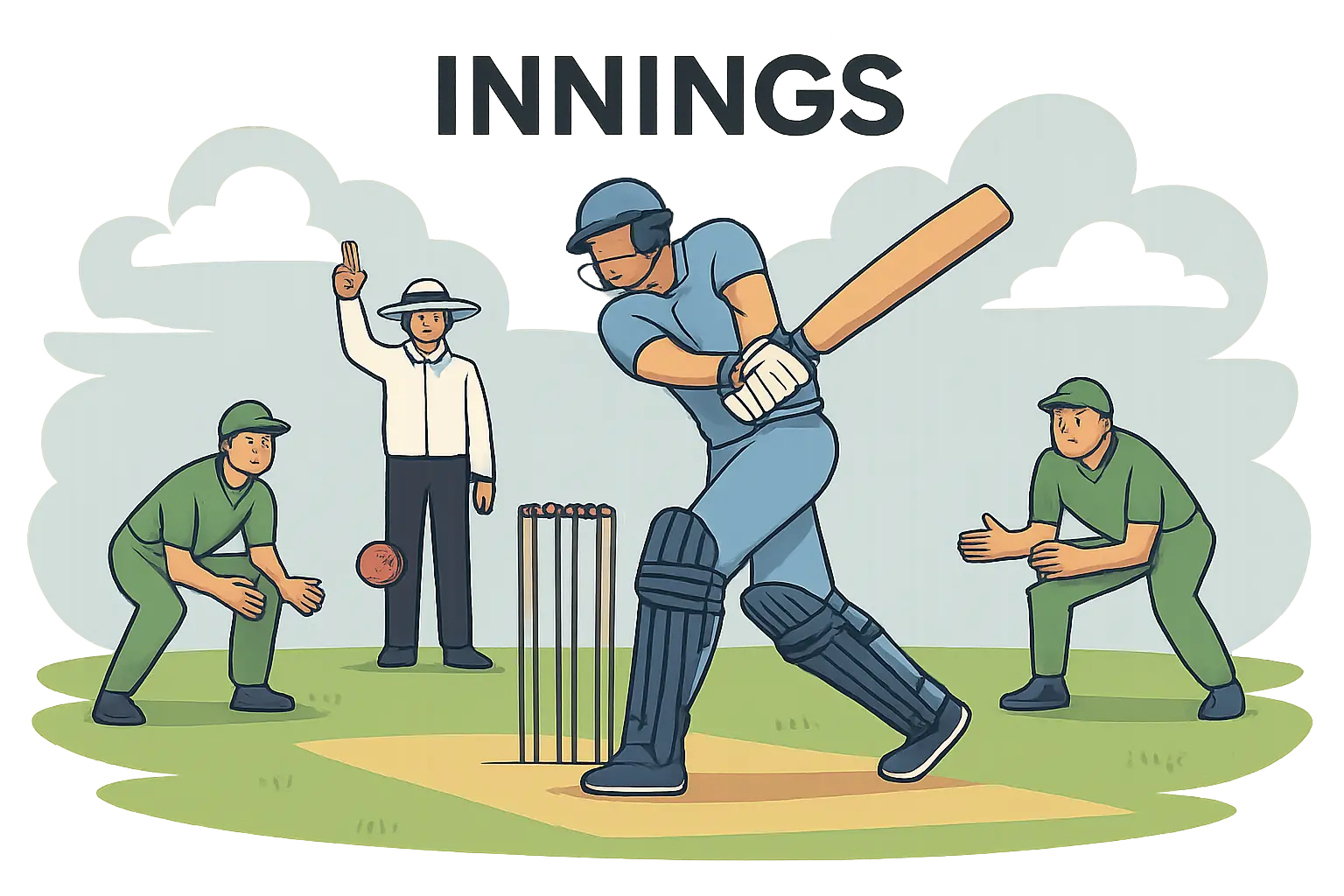
An innings in cricket is a team’s turn to bat or bowl. During an innings, one team tries to score runs while the other tries to take wickets and restrict those runs. It begins when the first ball is bowled to two batters and ends under specific conditions. Unlike an over, which is a set of six legal deliveries, an innings is an entire phase of play for a batting side.
An innings ends when:
- Ten wickets are down (all out).
- The captain declares or forfeits (in longer formats).
- Overs run out (limited-overs cricket).
- The chasing side reaches its target.
- The match time or conditions end play (e.g., result decided via DLS).
What actually starts and ends an innings
Start of an innings
- Toss and choice: Before the match, the coin toss decides who bats first. The batting side nominates its order; two openers walk out.
- Umpire call: The innings formally begins when the umpire calls “Play” and the first delivery is bowled.
- Ball-in-play conditions: A new ball may be taken depending on the format and conditions; in ODIs and T20Is a white ball is used, in Tests a red (or pink, at night) is common.
How an innings can end
- All out: Ten wickets have fallen, or at the fall of the ninth wicket no other batter can take the field (e.g., injured, ill, or absent). The scorebook shows “all out.”
- Overs completed: In ODIs and T20s, the batting side has faced its allotted overs (50 or 20, unless penalties or interruptions adjust them).
- Target reached: In the second innings of ODIs/T20s or the fourth innings of Tests, the chasing side surpasses the target, and the innings closes the moment the winning run is completed.
- Declaration (Tests and other multi-day matches): The batting captain voluntarily “closes” the innings to put the opposition in, usually to force a result.
- Forfeiture (rare): A captain can forfeit an innings entirely without batting a ball.
- Time cut-off: In a timed match, the day’s play might end mid-innings and resume next session. In the final session of the final day, the match itself can end before an innings completes, often producing a draw.
- DLS result: In limited-overs cricket, weather can halt play. If enough overs have been bowled, the Duckworth–Lewis–Stern method may set or chase a par score. If play cannot resume, the current innings can be effectively “closed” by the match result being declared.
How many innings in cricket?
- Test cricket: Up to two innings per side. That’s four innings total if the match runs its full course. The order can be altered by the follow-on.
- ODI cricket: One innings per side, up to 50 overs each.
- T20 cricket: One innings per side, up to 20 overs each.
- Super Over: A tiebreaker in limited-overs matches. Each side gets a one-over innings with special conditions.
In a Test, a team might bat only once if the contest ends early—typically in an innings victory or because time runs out with just three innings completed. In limited-overs formats, if rain ends the game before the second innings starts and no result is possible, the match is abandoned; otherwise, DLS may produce a result after a partial second innings.
Format-by-format: what an innings means and how it works
Innings meaning in Test cricket
Test cricket is the canvas where the concept of an innings is fullest and most strategic. Each side has two innings, with no limit on how many overs can be bowled in each. Time, not overs, is the constraint: play is divided into sessions with lunch and tea breaks, and a Test lasts multiple days. An innings can last for thousands of deliveries if a batting side chooses to bat long, blunt the opposition, and build an impregnable lead.
-
Declarations shape the match:
The captain of the batting side can declare the innings closed at any time (Law 15). Declarations are chess moves. They weigh runs on the board against time remaining and the likely behavior of the pitch. You might see a team declare during the afternoon session, unleash a swing-bowling barrage under lights, and hunt early wickets with a new ball. Or an overnight declaration to exploit the damp morning conditions that make the ball whisper and the batsmen fidget.
-
The follow-on lurks:
After the first innings of both sides, if the side batting first leads by a pre-set margin, it can make the opposition bat again immediately (Law 14). That changes the order: instead of A-B-A-B, it becomes A-B-B-A. This move is high-stakes: it keeps tired bowlers out longer, but it can also end the match inside three innings.
-
Second vs fourth innings pressure:
When a side returns for its second innings (the “third” innings of the match if no follow-on is enforced), the surface is older, the rough patches wider, and cracks may have opened. In the fourth innings, even moderate targets can feel steeper: a spinner’s shadows grow long; the seam bites unpredictably. Memories of match-defining last-innings stands—at Headingley, at Eden Gardens—come from this crucible where one wicket can feel like a landslide.
-
Innings victories:
If Team A, batting first, posts a big total and bowls out Team B twice for fewer runs than A managed in its first innings alone, A wins by “an innings and X runs.” You’ll see this line in scorecards: “Won by an innings and 46 runs.” It’s emphatic—three innings were enough; the fourth wasn’t needed.
Tactics that define a Test innings
-
Bat time, not just runs:
In Tests, an innings can be a siege. See openers leave ball after ball, sapping the bowlers. The middle order cashes in after the shine is off. Later, a late-order batter can add 50 priceless, ugly runs that break an opponent’s spirit.
-
Bowling in layers:
Fielding sides operate in waves—new-ball bursts, holding patterns with spinners, reverse swing in the afternoon, a second wind late in the day when batters are tired.
-
Declaration choreography:
Captains read the forecast, the light, and the pitch. Declare too late and you choke your chance to bowl the opposition out; too early, and you risk a chase flipping the narrative. It is instinct plus data—scoring rates by session, average wicket probabilities, and the rhythm of the match.
What is the follow-on in cricket?
Under Law 14, the follow-on allows the team that batted first to make the other team bat again immediately if the first-innings lead is large enough. In a Test, the threshold is traditionally 200 runs. In shorter first-class matches, the margin is smaller. Dominant captains enforce it to press the advantage: bowlers are on top, batters are brittle, and time is precious. But it’s not automatic.
-
Why a captain might enforce the follow-on
- Momentum and conditions are ideal. Cloud overhead, ball hooping, or a spinner in a trance on a chipping surface.
- Time is short due to weather or slow over rates; the follow-on saves the hours needed for a second bat.
-
Why a captain might decline the follow-on
- Bowlers need rest. Fast bowlers who just delivered 80 overs collectively may not be at their best without a recharge.
- Pitch will deteriorate further. Better to bat once more, set 400, then bowl last on a minefield.
- Injury risk and workload management across a series or tour.
A famous cautionary tale: a side forced to follow on can still turn the match around with a giant partnership and a fourth-innings spin web. The risk is real, and the great captains balance ruthlessness with patience.
Declaration and forfeiture explained
Under Law 15, a captain can declare an innings closed or forfeit an innings altogether. Declarations happen frequently in Tests and other multi-day games; forfeitures are rarer than comets.
-
Declaration:
A strategic closing of the innings before being all out. This typically happens when the batting side believes it has enough runs and wants time to bowl the opposition out. It changes the scoreboard message from “we’re still batting” to “your turn—feel our scoreboard pressure.”
-
Forfeiture:
A captain may, in the spirit of pursuing a result, skip an innings. Very occasional and usually forced by unusual circumstances—time constraints, weather darts, or to deny the opposition leverage from late-day conditions.
Limited-overs cricket does not permit declarations or forfeitures. The engine of ODIs and T20s is a set number of overs, not the captain’s timing choice.
Innings meaning in ODI cricket
An ODI innings is a 50-over sprint with strategic pit stops. One side bats, faces a maximum of 300 legal balls (adjustments aside), and the other bowls to control the rate and harvest wickets. Then roles reverse.
-
Powerplays:
The opening overs come with fielding restrictions to encourage scoring. White-ball fields are choreographed: two outside early, then four, then five in the final block of overs. These rhythms define the “shape” of an ODI innings—front-loaded assaults, middle-over accumulation, death-overs acceleration.
-
No declaration:
You bat until you’re all out or the 50 overs end. That’s it.
-
Second innings and the chase:
The target is the first-innings total plus one. The game becomes a study in required run rate (RRR)—runs still needed divided by overs left—and risk tolerance. Bowlers hunt breakthroughs that spike the RRR; batters time the chase to avoid a tail exposed under pressure.
-
DLS and truncation:
Weather can shave overs off either innings. DLS resets par totals based on “resources”: wickets in hand and balls remaining. A team can win a rain-affected chase at the end of an over if it’s above the par score, even if 50 overs weren’t completed.
-
Net run rate:
Across tournaments, an ODI innings contributes to a team’s NRR: (total runs scored/overs faced) minus (total runs conceded/overs bowled). Every dot ball and every frantic single can ripple through the table.
Innings meaning in T20 cricket
A T20 innings is white-heat cricket: 20 overs, six an over if you’re conservative, 10 an over if your intent is sky-high. There’s almost no time to “get your eye in”; intent and match-ups rule.
-
Powerplay and match-ups:
The first six overs allow only two outfielders. Openers target slots—deep midwicket, long-off, backward point—and bowlers counter with hard lengths or swing. Captains keep their mystery spinner back for left-hand match-ups or unleash him inside the powerplay to choke a boundary hitter.
-
Roles matter:
Anchors hold an end on good nights; finishers cash in at the death. The average T20 innings has a distinctive pulse—brisk start, slight middle dip, surge at the end.
-
No declaration, no second life:
You’re all out or you face your 20 overs. Every delivery matters.
-
Innings break and timeouts:
The innings break is short—around 10 minutes in international T20s—while some leagues add brief timeouts for strategy. Bowlers are hustled for overrates; slow play brings penalties, like fewer boundary riders late in the innings.
Innings vs over: the clean difference
- An innings is a team’s entire turn to bat or bowl.
- An over is a set of six legal deliveries by one bowler.
- An innings can contain hundreds of overs (Test) or just 20/50 (T20/ODI).
- Overs are micro; innings are macro. Think sentences vs chapters.
All out, innings closed, end of innings: the vocabulary that trips people up
-
All out meaning in cricket:
Ten wickets have fallen, or the side cannot field the next batter due to absence, injury, or retirement-out scenarios. Scorecards mark “all out.” A team can be all out without ten dismissals if, for example, two players are unfit to bat after the ninth wicket falls.
-
Innings closed meaning:
The innings has ended without being all out. Reasons include declaration, forfeiture, allotted overs completed, or target achieved. In short: ended by rule or tactic, not by losing all wickets.
-
End of innings meaning:
The umbrella term—the innings has finished for any lawful reason. The next innings begins (in limited-overs immediately after a break; in Tests, either after the break or the next session).
-
Retired hurt/out:
A batter “retired – not out” can return later if able. “Retired – out” counts as a wicket and reduces resources. One doesn’t by itself end an innings but it can contribute to “all out” if resources vanish.
The innings break: what actually happens between innings
The innings break is the sport’s reset button. It exists in all formats, but it varies in length and purpose.
-
Test cricket:
There’s no fixed “innings break” beyond the scheduled lunch and tea intervals. If an innings ends near an interval, the break can be taken then. If not, play restarts with minimal delay or rolls into the next session.
-
ODI cricket:
The innings break is typically around 40 minutes, with some flexibility for day-night playing conditions. Teams use it to switch mindsets: from padding up to strapping on spikes for a new-ball assault, or from bowling plans to batting targets.
-
T20 cricket:
Around 10 minutes. It’s a blur—batting orders set, scouting reports revisited, bowlers select their powerplay plans. In some leagues, short strategic timeouts punctuate the innings itself.
Inside the rooms: Coaches run video clips of bowlers’ release points, rehearse options for match-ups (“If left-arm seam is on, we send the right-hander”), and debate the first two overs of the chase. Bowlers roll the ball across their fingers to feel seams; batters tap the toe of the bat against the concrete to test the pick-up.
Scoring tempo, targets, and the shape of an innings
An innings is not just a total—it’s a narrative curve.
-
Run rate (RR):
runs per over. In ODIs and T20s, RR paints tempo; in Tests it’s ambient—useful, but secondary to wickets and time.
-
Required run rate (RRR):
in a chase, runs remaining divided by overs left. If RRR is climbing, bowlers are winning.
-
Phases of ODI/T20 innings:
-
Powerplay:
Lower boundary riders, fielders in the ring. Risk-reward leans toward aggression.
-
Middle overs:
Spinners and canny seamers squeeze singles; set batters milk gaps.
-
Death overs:
Batting teams unleash scoops and ramps; bowling teams nail yorkers and slow-ball variations.
-
-
Net run rate:
Tournament math. Every innings contributes. Being cautious in a winning chase can leave your NRR flat; a brisk chase can buy you leverage later. In leagues where rain lurks, NRR becomes insurance.
Weather, DLS, and truncated innings
Limited-overs cricket lives with the weather—and a mathematics called DLS manages fairness when time disappears.
-
Resource theory:
DLS treats an innings as a pool of resources: balls remaining and wickets in hand. Lose wickets early? Your future scoring potential shrinks. Lose overs to rain? Resources drop too.
-
First-innings interruptions:
If the first innings is cut short, the par score for the second innings adjusts to reflect the reduced resources.
-
Second-innings interruptions:
If rain stops play and the minimum overs have been bowled (as defined by the competition), the current score is compared to the DLS par at the end of the last complete over. If above par, the chasing side wins; if below, it loses; if equal, it’s a tie.
-
Innings “ending” via DLS:
In practice, the innings is halted by weather and the match is decided; the innings is treated as closed for result purposes even if the 20 or 50 overs weren’t completed.
Special cases and edge scenarios worth knowing
-
Timed out:
A batter not in position to take guard within the allowed time after a dismissal can be given out “timed out.” Rare, but a reminder: an innings has procedural oxygen.
-
Super Over:
In knockout or league matches requiring a result, tied games can go to a Super Over—each side faces a one-over innings. It’s technically an innings but governed by special playing conditions. Think of it as cricket’s penalty shootout, but with bat, ball, and six deliveries.
-
Absent batters:
If players are injured or ill and cannot bat, their side’s innings can still be all out with fewer than ten dismissals when no eligible player can come in at the fall of the ninth wicket.
-
Concussion substitutes:
Modern playing conditions allow a like-for-like concussion replacement to bat if approved. That can alter the resource picture mid-innings.
-
Penalty runs and over-rates:
Fielding sides penalized for slow over-rates can be restricted in field placement late in the innings; penalty runs can swing tight games and re-shape the chase equation.
Mini comparison: cricket innings vs baseball innings
-
Sequence:
Cricket teams bat their entire innings at once; baseball alternates half-innings (top and bottom) each frame.
-
Outs vs wickets:
Baseball offers three outs per half-inning, an automatic changeover. Cricket has ten wickets for an entire innings—tactical resource management spread across a long arc of play.
-
Balls vs overs:
Baseball pitches are discrete; cricket groups deliveries into overs, shaping bowling workloads and plans.
-
Scoring:
Cricket’s scoring accumulates continuously, with no “reset” after outs until ten wickets fall or overs end. In baseball, runs are inning-specific and reset each half-inning.
Format snapshot: innings rules at a glance
| Format | Innings per side | Overs per innings | Declaration allowed | Follow-on possible | Typical innings break |
|---|---|---|---|---|---|
| Test (multi-day) | Up to 2 | Unlimited | Yes | Yes | Lunch/Tea intervals; flexible on innings end |
| ODI | 1 | 50 (subject to DLS) | No | No | Around 40 minutes |
| T20 | 1 | 20 (subject to DLS) | No | No | Around 10 minutes |
| Super Over | 1 | 1 over | N/A | N/A | Very short reset |
Why the innings matters tactically
You can’t understand cricket without understanding the innings as a living organism. Captains talk in phases—new ball, change bowlers, spin squeeze, reverse swing window. Batters talk in rings—first 30 runs off defense and rotation, then boundary options when the ball softens. Coaches pour over wagon wheels and control percentages to set fields not just for a batter, but for a batter at a certain stage of an innings. A wide half-volley in the powerplay is four; the same ball at the death can be two if the outfield is stacked right.
Real-world innings stories that explain everything
-
The declaration gamble:
A captain posts a brisk 360 on the first two days of a Test. Forecast whispers rain later. Instead of piling on to 500, he declares mid-afternoon, gives his quicks the breeze, and knights the off-spinner for a late-day holding pattern. Two wickets at stumps send a message: runs on the board beat dreams in the dressing room.
-
Follow-on refused, win secured:
Another captain leads by 230 after the first-innings exchange. The easy temptation is to enforce the follow-on. Instead, he bats an hour, adds 120 at a run-a-ball, then gives the new ball to his fresh quicks under clouds. The fourth-innings 350 target becomes a mirage at 70 for 5.
-
ODI chase mastered:
Set 285, a side loses its opener early. The No. 3 knocks 70 at just under a run-a-ball while a left-hander works angles on the leg side. They are behind the RRR at the mid-point but keep wickets in hand. At the last 10 overs, a finisher goes 4, 6, 4 to a missed yorker and the chase crests on schedule. That’s a well-shaped innings.
-
T20 mayhem contained:
A bowling team leaks 55 in the powerplay. Panic? Not quite. They bowl pace-off into the wind, a legspinner takes pace off further, and the mid-overs see 32 for 3. Suddenly 200 becomes 165; an entirely different second innings awaits.
Common terms explained in plain English
-
First vs second innings:
In limited-overs cricket, “first innings” is the team batting first; “second innings” is the chase. In Tests, “first innings” and “second innings” refer to each side’s individual entries on the scorecard; “third” and “fourth” innings describe the match’s sequence of innings.
-
Run chase meaning:
The act of batting second to overhaul a target. Strategy in chases can be measured (bat deep, rotate) or ballistic (attack, compress RRR early).
-
Powerplay overs:
Fielding restrictions applied at the start (and in stages of ODIs) to encourage scoring and balance bat and ball.
-
Net run rate per innings:
Each innings adds to your tournament NRR calculus; big wins swell it, narrow wins shrink it.
-
Innings victory/defeat:
In Tests, winning by “an innings” means your opponent’s two innings didn’t reach your first-innings score. It’s a three-innings match and a statement win.
Innings vs inning, and usage quirks
- In cricket English, “innings” is both singular and plural. “His innings was chanceless.” “They played two innings.” If you see “inning,” you’re likely reading baseball copy. In cricket context, stick with “innings.”
Examples that clarify edge cases
-
Innings closed, not all out:
A Test side is 410 for 7. The captain declares. Scorecard: “Innings closed.” Three wickets remain unspent—but time is the currency.
-
All out with fewer than ten dismissals:
A side at 198 for 9 has two batters injured and unable to return. At the fall of the ninth wicket, no further batter can take guard. The innings is all out at 198.
-
DLS closes the chase:
In an ODI chase reduced to 30 overs by rain, the par score after 25 overs is 180. The chasing side is 182 for 5 when another shower ends play. The second innings ends right there with a DLS win.
Frequently asked questions about innings in cricket
- What starts and ends an innings in cricket?
It starts when the first legal delivery is bowled to two batters after the toss. It ends when the side is all out, the overs finish (ODI/T20), the chasing team reaches the target, the captain declares/forfeits (Tests), or the match is concluded due to time/conditions (including DLS decisions). - How many innings are there in a T20 or ODI?
One innings per side: 20 overs in T20s and 50 in ODIs, subject to adjustment by playing conditions or DLS. - How many innings in a Test match?
Up to two innings per side, for a maximum of four innings total. The match may end earlier if a result is achieved or time expires. - Can a team declare in ODI or T20?
No. Declarations and forfeitures apply to multi-day cricket. ODIs and T20s run to their allotted overs or to all out/target reached. - What is the follow-on and when is it enforced?
In multi-day matches, after both sides complete their first innings, if the side batting first leads by enough runs (200 in a Test), that team can require the opposition to bat again immediately. It’s optional and strategic. - What is an innings break and how long is it?
In T20s, around 10 minutes. In ODIs, around 40 minutes. In Tests, intervals (lunch and tea) structure play; an innings break can overlap with or trigger an interval. - What does “innings closed” mean vs “all out”?
“Innings closed” means the innings ended without the side losing all ten wickets (declaration, overs completed, or target reached). “All out” means ten wickets are down or no further batter can bat. - Can a team bat only once in a Test match?
Yes. If the other side is dismissed twice for fewer than the first side’s initial total, the first side wins by an innings and does not bat again. Or time may expire with only three innings completed. - What happens after the first innings in ODI/T20?
The roles reverse after the break: the side that bowled now bats to chase the target. The second innings starts with two new openers. - What is an innings victory/defeat?
A team wins by an “innings and X runs” if the opponent’s combined two innings total is less than the winning team’s first-innings score. - What is the difference between an over and an innings?
An over is six legal balls from one bowler; an innings is the entire batting turn of a team—many overs stitched together. - Can an innings end due to time or weather (DLS)?
Yes for weather in the sense that the match result can be declared once the DLS par comparison is possible and play cannot continue. In Tests, the day can end mid-innings; the match can end with an unfinished innings if time is up. - Who bats in the second innings?
In limited-overs, the team that fielded first now bats to chase. In Tests, the batting order alternates: A then B, then A then B—unless the follow-on is enforced (A then B, then B then A). - Is a Super Over an innings?
Yes. It’s a special, one-over-long innings per side used as a tiebreaker under competition rules.
A short guide to the nuts and bolts you’ll actually see on the field
-
Scoreboard language:
“Overs” tick upward; “wickets” tick downward. “Score 152/4 (17.2)” means 152 for 4 after 17 overs and 2 balls. The innings might read “Innings closed” if a declaration occurs or a target is reached.
-
The end-of-innings dance:
Fielders jog off, batters take the salute, bowlers glance at figures—10-0-52-2 in ODIs matters; economy rate is a currency. In Tests, a bowler’s 25 overs for 58 could be match-defining control.
-
Over changes:
Bowlers alternate ends. In the last over of a limited-overs innings, you’ll often see a death specialist: pace on for surprise, pace off for deception, a yorker to the base of off stump, a bouncer just inside the shoulder line.
Strategy snapshots: captains and coaches talk
-
“We bat once” mindset in Tests:
The perfect innings is so large that the opponent is batted out of the match. Coaches talk about batting “two sessions without risk,” then building tempo after tea. The declaration is the exclamation mark, not the question.
-
ODI blueprint:
Target-based batting flows from pitch reading. On a slow surface, 260 is gold. On a belting outfield with short boundaries, 320 might be par. Anchors who run hard and protect their wicket enable finishers; finishers repay it in the last 10 overs.
-
T20 progressions:
Teams plan for 50 in the powerplay, 80 at the 13th, a total near 170–190. They train death overs batting as a separate craft: pre-meditation, boundary options for yorkers, and shape against slow bouncers.
Umpire and law book corner: where the definitions live
-
Law 13 (Innings):
Establishes how many innings are played, the order, and how they’re completed.
-
Law 14 (The follow-on):
Sets the conditions for requiring a team to bat again.
-
Law 15 (Declaration and forfeiture):
Empowers captains in timed matches to close an innings or skip one entirely.
While competition-specific playing conditions can modify details (over limits, powerplays, DLS thresholds), those Laws provide the backbone. They’re the reason the word “innings” carries precise meaning across school grounds, domestic leagues, and international arenas.
Common mistakes and how to avoid them when talking about innings
- Confusing innings with over: Remember, an over is six balls; an innings is a team’s whole batting turn.
- Assuming every format has two innings: Only Tests and other multi-day matches do. ODIs and T20s are one innings per side.
- Thinking a declaration is possible in ODIs/T20s: It isn’t. If a team “walks off,” it’s abandoning the innings and the match.
- Misreading “innings closed” as a special event: It’s just the scorebook way of saying the innings ended other than by being all out.
Short scenarios to lock it in
-
Test, Day 3:
Team A 475/6 decl. Team B 210 all out. Follow-on enforced. Team B 180 all out. Result: Team A wins by an innings and 85 runs. Only three innings played; A’s second innings not required.
-
ODI:
Team A 279/8 in 50 overs. Team B 240/5 after 40. Required: 40 in 10 overs with 5 wickets in hand. A well-paced chase likely; bowlers target two wickets to open the tail and move the RRR needle.
-
T20:
Team A 166/7. Team B 42/0 after 5—on top. But two wickets in the 6th change the mood; the middle stalls at 81/4 after 12. Finishers need 86 in 8 overs. One 20-run over can flip everything; the innings is a squeeze, then an explosion.
Key takeaways
- An innings is a team’s turn to bat or bowl; its beginning and end are strictly defined by the Laws and playing conditions.
- Tests allow two innings per side and add layers: declaration, follow-on, innings victories, and time pressure.
- ODIs and T20s allow one innings per side, no declarations, and use overs and powerplays to shape the contest.
- “Innings closed” means ended without being all out; “all out” is ten wickets or no eligible batter remaining.
- Weather and DLS can truncate innings and still produce a fair result.
- Strategy, not just rules, gives the innings its soul: pacing, match-ups, risk, and the captain’s feel for the moment.
Conclusion: why the innings defines cricket
The innings is cricket’s heartbeat. It gives the sport its layered drama: a batter fighting for rhythm, a bowler playing long games with lines and lengths, captains feeling the air and the pitch and the clock. In a Test, an innings can be an epic that swallows hours and changes tone with the light; in a T20, it’s a sprint where one misread slower ball rewrites the night. Across formats, the meaning is consistent—one side goes to bat, one side goes to work with the ball—but the expression is infinite. Get the innings right, and you understand not only what is happening on the field, but also why. And once you understand why, you’re inside the real game.