
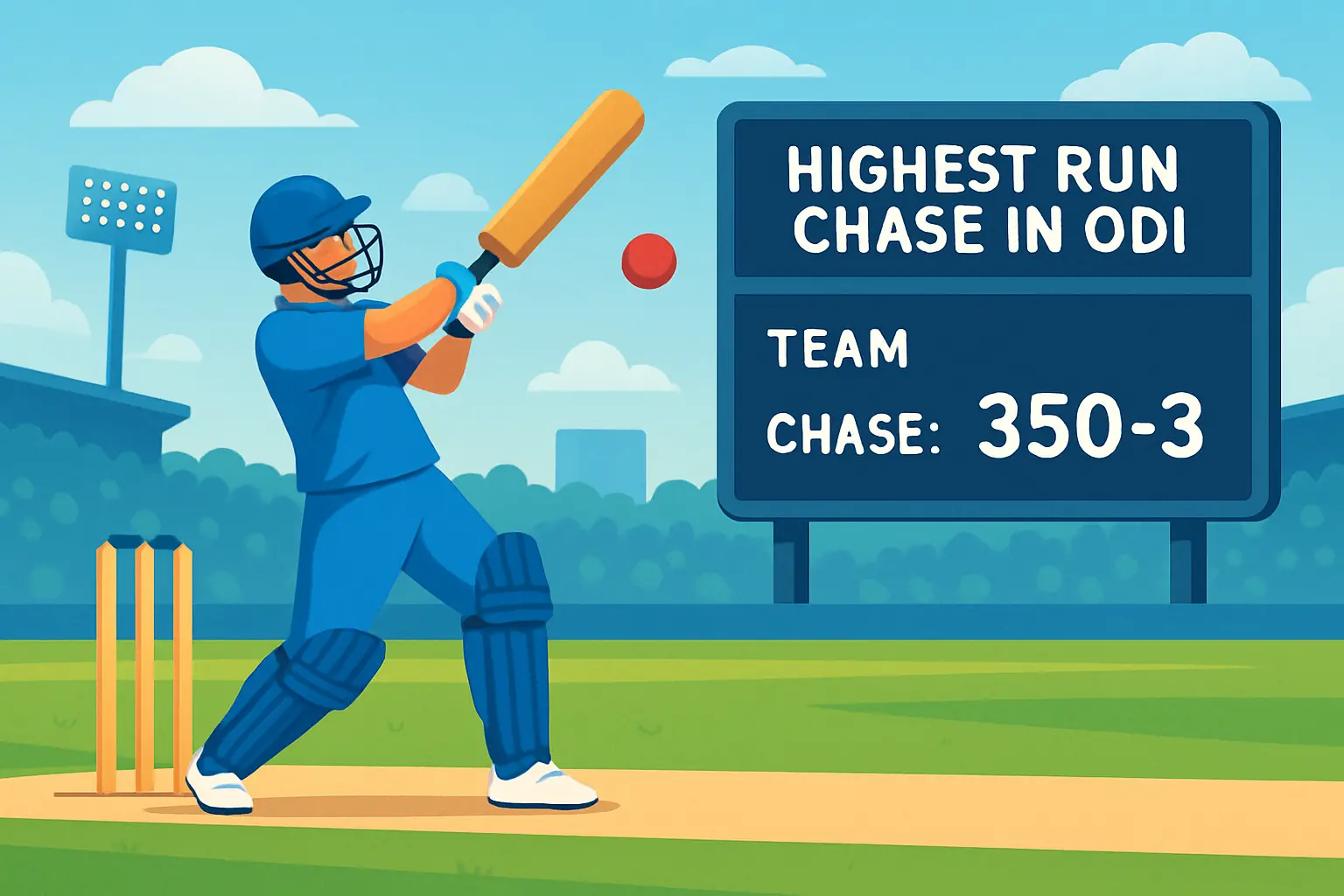
A successful ODI run chase means one team bats second and reaches the target set by the opponent within the allocated overs. Among cricket’s many thrills, nothing jolts the senses like a high‑wire chase under lights, dew glistening on the outfield, fielders shifting nervously as every clean strike redraws the odds. The highest run chase in ODI cricket is a monument to nerve, method, and audacity. This is the definitive deep dive: records, context, tactics, signature venues, and the matchcraft great teams use to turn colossal targets into trophies and folklore.
What “highest run chase” really means
- In ODIs, the “highest successful run chase” is the largest target ever overhauled while batting second.
- It’s not simply a big score; it’s about the art of pacing, wicket management, and calculated risk under pressure.
- These records matter because they bend long‑held assumptions about what is defensible in 50‑over cricket.
The day 434 was hunted: the 438 epic
Every discussion of the highest successful run chase in ODI history begins in Johannesburg, at the Wanderers. Australia stacked up 434, a total so far beyond par that professional optimists barely bothered with permutations. Then South Africa came out and did the unthinkable, sprinting at a rate that made fielding look ornamental. The chase seemed fuelled by collective indignation, reinforced by a tiny boundary on one side, altitude‑aided carry, and an unwavering resolve to keep the asking rate in reach.
Here’s what made that chase a masterclass in ODI run‑chasing strategy:
- They never allowed the required rate to balloon. Each mini‑phase—powerplay, middle consolidation, death—was played in tempo.
- Matchups were exploited: pace carried into the stands, spin forced off the length, and angles were opened to carve the field.
- Batters played roles, not reputations; the top anchored momentum, the middle punished anything short of perfection, and the finishers treated ten‑an‑over as acceptable background noise.
That day, an ODI team showed that a 400 plus run chase in ODI cricket is not mythology. Since then, every dressing room confronting a stiff target has had a blueprint in hand: keep wickets, hunt overs, break the chase into chasable tens, and attack the bowling you’re set against. Modern white‑ball batting owes a debt to that afternoon—when a line was crossed and never walked back.
All‑time top ODI chases — selected landmarks
Complete, filterable lists and sortable leaderboards will always be the beating heart of a pillar page on this topic. Here, instead of a long data dump, is a tight selection of landmark successful chases that shaped the narrative. They carry the big keywords in their bones: highest successful run chase in ODI, biggest run chase in ODI, highest target chased in ODI, highest World Cup chase.
Note: Totals reflect targets, with successful chases shown as the second‑innings score.
- South Africa 438/9 vs Australia, Johannesburg — the highest successful run chase in ODI history; the famous “438 game.”
- Pakistan 345/4 vs Sri Lanka, Hyderabad — the highest run chase in Cricket World Cup history.
- England 364/4 vs West Indies, Bridgetown — England’s biggest one‑day run chase.
- India 362/1 vs Australia, Jaipur — India’s highest chase in ODI history; a display of clinical top‑order control and assault.
- Australia 359/6 vs India, Mohali — Australia’s highest successful ODI chase and one of the game’s cleanest exhibitions of mid‑innings acceleration into a calculated finish.
- Bangladesh 322/3 vs West Indies, Taunton — Bangladesh’s highest ODI chase, orchestrated with surgical hitting and expert strike rotation.
- Sri Lanka 321/6 vs India, The Oval (Champions Trophy, ODI status) — a highest‑profile tournament chase for Sri Lanka, remembered for fluid batting in English conditions.
- South Africa 372/6 vs Australia, Durban — a flagship 350 plus run chase in ODI cricket that underlined the Proteas’ chasing culture.
Highest run chase in ODI World Cup
The World Cup turns a tough chase into a legacy moment. Nerves change, fielding sharpens, and innings management carries the gravity of a tournament arc.
- Pakistan 345/4 vs Sri Lanka, Hyderabad — the highest run chase in ODI World Cup history. Built methodically on a fast outfield, it was a masterclass in not flinching as the rate climbed into the high sevens and then easing past it with clean hitting and immaculate pacing.
300 plus, 350 plus and 400 plus chases — rarity and reality
- 300+ — Once a rare story, now a semi‑regular headline on batting‑friendly grounds.
- 350+ — Still special. Demands excellent powerplay returns, fearless middle‑overs aggression, and a finishing kick of at least ten‑an‑over.
- 400+ — Unicorn territory. The Johannesburg epic is the proof. To chase four hundred you need a true pitch, smallish boundaries, zero panic, and a lineup stacked with ball‑strikers.
By team — who chases best, and how they do it
South Africa: No side’s DNA is as linked with modern mega‑chases. Their template combines hard swing‑power in the top three with middle‑order hitters who can mow seam and knock spinners off lengths.
India: “Chase culture” might as well be a second crest. Consistency across 300–330 chases comes from denying the required rate the oxygen of dots, then sprinting in the final third.
England: Rewired white‑ball cricket to break par on both sides of the toss; case studies in run‑rate insulation and fearless tempo.
Australia: Tempo, trust in deep batting, clarity in matchups, and cool finishes—timed accelerations that turn a steep ask into a stroll.
Pakistan: Peak Pakistan is a chasing force—rhythm hitters at the top, a craftsman in the middle, a finisher who disappears good length; dew is often their ally.
Sri Lanka, New Zealand, Bangladesh, West Indies: Each carries a distinct chasing identity—wristy acceleration, pragmatic finishing, measured hitting, or raw boundary power respectively.
Emerging sides: Afghanistan, Ireland, Netherlands and others have raised the ceiling by reading conditions and cultivating specialists.
By venue and country — where big chases live
- Wanderers, Johannesburg: Cathedral of run‑gluttony; altitude carry and a short straight boundary.
- Wankhede, Mumbai; Rajkot; Jaipur: Hard, true surfaces with quick outfields and evening dew.
- Hyderabad: Fast outfield and even bounce—site of the highest World Cup chase.
- Trent Bridge, The Oval, Edgbaston: English white‑ball rebirth zones—flat strips with cross‑breezes producing high totals.
- Bridgetown and Caribbean venues: Square boundaries and fast outfields that reward aggressive intent.
- Centurion, Durban: South African surfaces where length balls turn into hitting range.
The anatomy of a mega‑chase
There is a system inside the chaos. The best teams treat a 340 as twelve short sprints with small, winnable margins.
- Powerplay priorities: Modern chasers use the new ball window to generate boundaries and rotate; dot‑ball discipline is crucial.
- Middle‑overs craft: Break the back of the chase by scoring just above the required rate—matchup hunting, sweeps, and targeted aggression.
- The endgame: A set batter plus a hitter in shape is essential; target areas are pre‑mapped for consistent strike zones.
- The wicket resource: Think in “burnable” wickets—aim to have at least five by over 30 and three by over 40.
- Strike rotation: Singles are oxygen. Running between the wickets is an active weapon.
- The dew tax: Dew alters bowling clarity—good teams time their chase to harvest dew when it matters most (overs 41–50).
The last 10 overs — where chases are actually won
- Identify the weak over in the opposition attack and attack it hard.
- Pace the surge with controlled bursts rather than one reckless blitz to lower failure risk.
- Boundary or bust? If the yorker is perfected, take the single, reset, and attack the next mistake.
The bowler’s counterplan — how to defend a towering total
- Straight yorkers remain emperor; miss the length and you hand back tempo.
- Widen angles to disrupt left‑right pairs; change fields quickly to deny simple scoring lanes.
- Refuse freebies—if a slower ball doesn’t grip, don’t bowl it.
- Tight inner rings and athletic fielding can save twenty runs in singles and twos.
Player‑centric long tails — the art of chasing as a batter
- Masters of the chase manage pace control and pressure denial—anchors who spike late or metronomes who keep a high strike rate.
- Centuries in successful ODI chases often come from openers or No. 3 who bat deep and raise the risk threshold responsibly.
- Highest individual scores in successful chases typically belong to players who combine occupation with acceleration.
Related records and comparisons
- T20I chases can exceed 250 but sustaining an 8+ RPO for 50 overs is a different strain—mega ODI chases are a different species.
- Tests vs ODIs: ODIs are governed by rate; Tests by patience and time. Both heroic, but not mechanically comparable.
- Most times defending 350+ failed: Often the product of flat home decks and proactive opposition reading conditions better.
A working table you can sort (blueprint)
A compact, human‑curated subset of landmark chases (not exhaustive):
| Team | Target | Score (wkts) | Opponent | Venue | Tournament / Note |
|---|---|---|---|---|---|
| South Africa | 435 | 438/9 | Australia | Johannesburg | Highest successful run chase in ODI history |
| Pakistan | 345 | 345/4 | Sri Lanka | Hyderabad | Highest run chase in ODI World Cup |
| England | 361 | 364/4 | West Indies | Bridgetown | England’s biggest ODI chase |
| India | 360 | 362/1 | Australia | Jaipur | India highest chase in ODI history |
| Australia | 359 | 359/6 | India | Mohali | Australia’s highest successful ODI chase |
| Bangladesh | 322 | 322/3 | West Indies | Taunton | Bangladesh’s highest ODI chase |
| Sri Lanka | 321 | 321/6 | India | The Oval | Champions Trophy (ODI status) |
Why big chases are more frequent now than they once were
- Two new balls: truer carry deep into innings.
- Powerplays and fielding restrictions: longer windows for boundary options.
- Better bats and technique: sweet spots are larger and bottom‑hand power is systemized.
- Conditioning and depth: teams bat deep; finishers are specialized and athletic.
- Data‑driven matchups: analysts pre‑compute high‑EV targets and weak overs.
Designing a perfect chase XI
- Openers who can hit on the up and rotate against spin.
- No. 3: tempo brain—six‑and‑a‑half to seven RPO baseline without visible sweat.
- No. 4–5: gear shift from 85 SR to 130 SR; sweepers and scoopers included.
- No. 6: finisher—ramps, range, and clarity to accept risk on behalf of the team.
- No. 7–8: batters who bowl or bowlers who bat capable of clearing the rope once an over.
- Bowling unit: at least two death pros who can bat a bit—tail contributions decide margins.
How different teams pace a chase
- India: Hold seven an over with minimal dots; arrive at 40 overs ready to sprint.
- England: Keep risk consistent; accept wickets if the RPO stays comfortable.
- Australia: Build pressure on the ball, rotate, and finish with a cool head.
- South Africa: Get ahead of the rate before over 20; refuse to let spin dictate tempo.
The small things that add up to big chases
- Left‑right pairs as an active weapon to unsettle fields and bowlers.
- Drop catches not only add runs but collapse bowling plans and matchups.
- Running as offense: smart twos add pressure and rotate strike more safely than forced aerials.
How captains think during a 350 chase
The playbook is modular. If Plan A concedes a couple of ten‑plus overs early, the captain doesn’t panic—Plan B is a variation on matchups, not a complete abandonment. Bowlers are used in problem‑solving spells; part‑timers may be tried for one over to reshuffle rhythm and then swapped if ineffective.
The mental game
- Chasing is denial as much as desire—deny the crowd, deny the seduction of the big shot when a single is smarter.
- Set batters must be greedy for partnership longevity; many big chases are won by a player who bats past the 35th over.
- New batters need a two‑over runway before risk; pre‑planned aggression without set time usually burns a wicket.
Frequently asked questions (quick answers for clarity)
Q: What is the highest successful run chase in ODI history?
A: South Africa 438/9, chasing 435 against Australia at Johannesburg.
Q: Has any team chased 400 in an ODI?
A: Yes—South Africa’s 438 is the only 400+ successful chase to date.
Q: Which team has the best record while chasing in ODIs?
A: India, England and South Africa have exceptional chasing records in modern eras, especially for 300+ targets; rankings vary by period and venue.
Q: What is the highest World Cup run chase?
A: Pakistan’s 345/4 vs Sri Lanka in Hyderabad.
Q: What is India’s highest successful run chase in ODIs?
A: India’s highest chase is 362/1 against Australia in Jaipur.
Q: Which venue has seen the highest ODI chase?
A: The Wanderers, Johannesburg.
Signature case studies — lessons that endure
- South Africa 438/9 vs Australia, Johannesburg: Refusal to let the rate drift; innings continuity and the tactical value of short sides at death.
- India 362/1 vs Australia, Jaipur: Surgical top‑order management; once set, consistent jabs and rare haymakers made the last ten a formality.
- Australia 359/6 vs India, Mohali: Timed accelerations and a nerveless endgame—protecting a finisher’s entry point matters.
- England 364/4 vs West Indies, Bridgetown: Raw tempo and an insistence on attacking above par made a Caribbean night into a long chase victory.
Reading conditions — the hiding place of big chases
- New ball not biting: boundary options increase and batters need not feel out the innings.
- Cross‑seam holding: commit to ground‑controlled power and roll wrists on pull shots.
- Spinners getting purchase: rotate intentionally, drop sweep to shift fields, then reclaim singles.
Field settings that win or lose a 340 defense
- Third man and fine leg late are non‑negotiable; leaving them opens trapdoors for scoopers and nudges.
- Inner‑ring athletes reduce singles and twos—value measured in runs saved.
- Protect the bowler who’s slightly off; deny the set batter the same slot twice in an over.
On “highest ODI chase by wickets in hand”
Ten‑wicket chases above 250 are rare and signal dominance: openers find rhythm early, bowlers never land sequence plans, and fielding standards dip. The qualitative stamp of a ten‑wicket chase is that the chasing side didn’t just surpass the ask—they dismantled its assumptions.
Programmatic views worth building into any master list
- By tournament: World Cup, Champions Trophy, Asia Cup filters reveal tournament pressure effects on chases.
- By team: Highest chase per nation, most 350+ chases per team, and 10‑wicket chases.
- By venue/country: Venue‑level ceilings (Wanderers, Wankhede, Edgbaston, etc.).
- By threshold: Filters for 300+, 350+, 400+, highest run rate in successful chase, etc.
Why the “highest target chased in ODI” keeps climbing
- Batting evolution (reverse‑sweep to scoop now baseline skills).
- Training and conditioning turn mishits into rope‑kissers; running standards improve strike rotation.
- Captaincy courage and pitch science produce truer surfaces—320 becomes modern par; 360 a question of bravery.
Common myths about big chases
- Myth: “You must have a freak day to chase 350.” Reality: You need above‑average days in three departments; systems decide more than freaks.
- Myth: “Win the toss, field, and you’re halfway home.” Reality: Toss advantages vary with venue and dew; bad bowling and poor fielding still lose you 330.
- Myth: “Once the required rate crosses eight, panic.” Reality: Elite chasers treat eight as manageable—panic belongs to the bowling side if it can’t create dots.
The human side — what it feels like out there
Around over 28 the noise recedes; batting becomes sensory—not abstract RPO but bowlers’ breath and the fielders’ weight on their heels. By 43, fatigue meets muscle memory: the pair that remains finds gaps and angles. For bowlers, the ball feels heavier, the seam loses definition, and captains ask for rehearsed plans. Even in defeat, disciplined choices are the pride of the bowling side.
Closing thoughts — why the chase defines ODI cricket
ODIs live between patience and urgency. The highest successful run chases are not anomalies; they are the format’s most articulate expression—rewarding phase thinking, depth, bold captaincy, and rapid reaction to match weather. When you search “highest run chase in ODI,” you’re chasing the anatomy of nerve, the venues that make heroes, and the nights when a scoreboard ceased to dictate what was possible.
— End of deep dive