
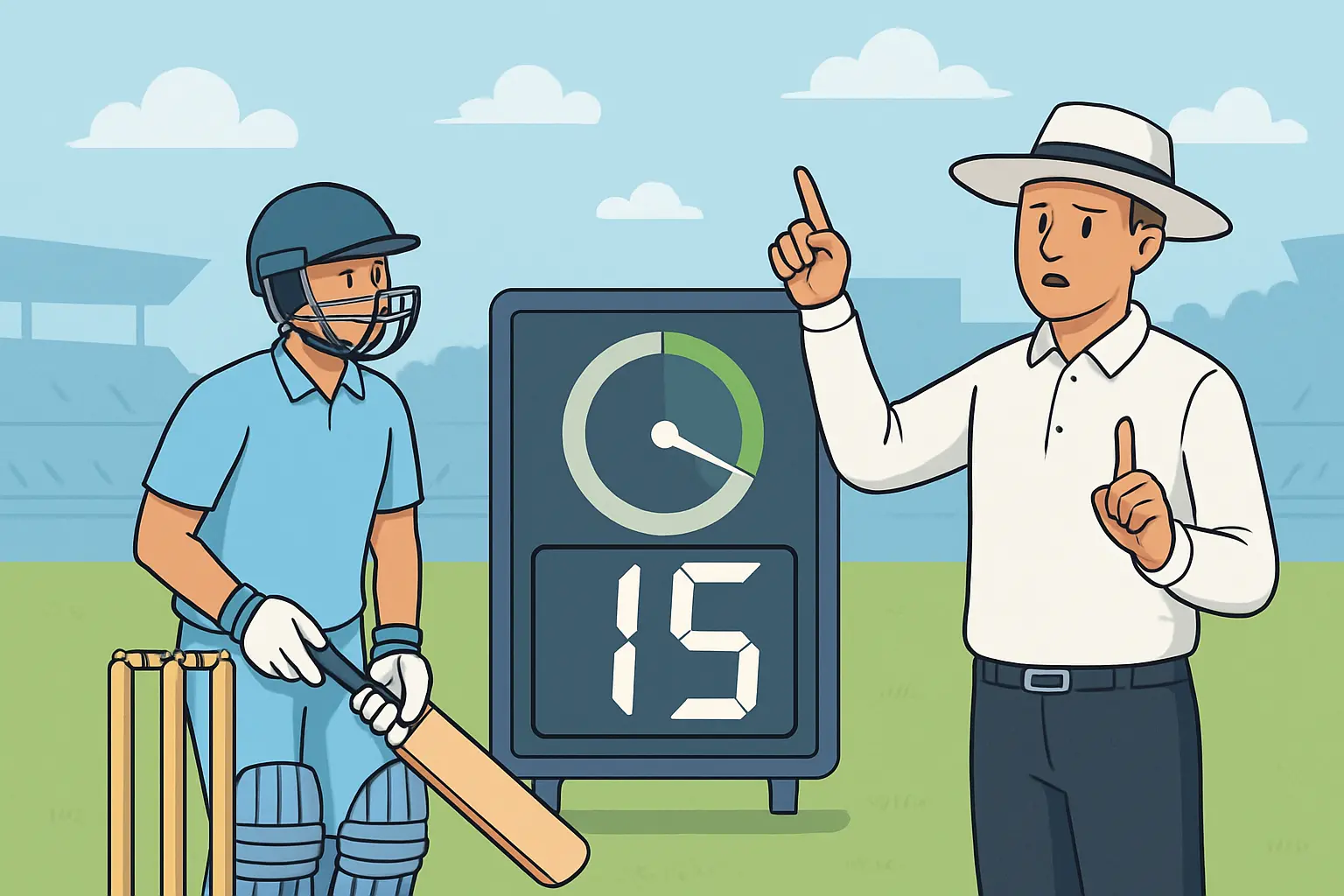
Fifteen seconds can feel like a lifetime when 40,000 people are screaming and eleven heads are swivelling toward a single umpire. The bowler thinks he’s got his man. The keeper swears he’s heard a feather. Slip one is convinced it’s pad-first. The captain’s eyes flick to the scoreboard timer, down to ten, nine, eight. And then, with a flick of the wrists, the famous T-sign slices through the noise. Review called. Nerves on ice.
That clock is the DRS timer, the most misunderstood little number in modern cricket. It looks simple on television — a countdown graphic and a dramatic pause — but on the field it governs communication, decision-making, strategy, and occasionally chaos. Here’s the unvarnished, expert view on how the DRS time limit really works, what the laws expect, what the umpires look for, how teams game the window, and why a late T is almost never forgiven.
One-sentence definition for the ages: In cricket, teams generally have 15 seconds from the on‑field umpire’s decision to signal a DRS review by making a clear ‘T’ sign; if time runs out, the decision stands unless the umpire initiates their own review.
The sections that follow bring the timer to life — as a rule, as a habit, as a weapon.
What the DRS Timer Actually Is
- The DRS timer is the official window a team has to request a Player Review after an on-field decision of out or not out.
- It applies in international cricket and is mirrored by most major leagues; the default is 15 seconds.
- The clock lives with the on-field umpires. The TV graphic you see is for viewers; it’s not the authoritative stopwatch. If there’s ever a discrepancy, the umpire’s timing wins.
- A Player Review is different from an Umpire Review. The player-initiated T-sign is governed by the DRS timer. The umpire-initiated referral (for things like a clean catch, run-out, or a no-ball check) is not bound by the 15-second limit; it sits within the umpire’s own jurisdiction of “I want to be sure.”
When the DRS Timer Starts — The On‑Field Reality
The practical rule is this: the DRS countdown starts when the on‑field umpire communicates his decision. That means the instant the finger goes up for out, or the sweeping arms signal not out. It is not the end of the appeal and it is not the start of any huddle; it’s the moment of the decision.
Because cricket is a moving conversation, umpires exercise common sense. If the decision is drowned out by the roar, if players genuinely can’t see the signal, or if the umpire himself delays the signal because he’s conferring with his colleague about whether the ball hit bat or pad first, he will adjust the start point in his head. But once he’s given the decision clearly, the sand in the glass is dropping.
A clean way to visualize it is as a short, tight timeline.
| Event | How it affects the DRS countdown |
|---|---|
| Umpire gives decision (Out or Not Out) | Countdown begins here. Ball is dead. |
| Players consult quickly | Consultation is allowed within the 15 seconds. |
| Captain/batter makes T-sign | Review is accepted if made within time. |
| Time expires with no T-sign | No Player Review possible; only an Umpire Review can follow if the umpire chooses. |
Two things routinely confuse fans and players:
- The length of the appeal does not delay the timer once the decision is given. Appeals can be theatrical; the law is not.
- The review must be signalled; intent is not enough. Saying “we’re thinking about it” doesn’t stop the clock. Only the T-sign, acknowledged by the umpire, does.
Who Can Ask for DRS — And Who Actually Does
There’s a clean split: batting-side reviews and fielding-side reviews.
Batting side
- The batter who has been given out can request a review. In practice, either batter at the crease may signal the T after a short consultation, and the umpire accepts it as a batting-side Player Review.
- For a not out decision, the batting side cannot review. Only the fielding side can challenge a not out.
Fielding side
- The captain has the formal authority to request a review of a not out decision.
- In the modern game, umpires routinely accept the T-sign from the wicketkeeper or the bowler if the captain is clearly engaged in the decision and signals assent. What matters is that the request reflects the captain’s will; nobody wants to waste a team review because a bowler got carried away.
- If the captain is off the field, the acting captain carries the authority.
Two fine-print details that matter in real matches:
- The T-sign must be clear to the umpire. Half-gestures, vague waves, or late signals that slip in as the umpire turns to walk to square leg almost always get rejected.
- Consultation is part of the sport’s theatre and its logic. The keeper looks at the bowler, the bowler glances at first slip, point gestures pad or bat. All of that is permitted inside those 15 seconds — and it’s the heartbeat of good reviewing.
What Happens If the Timer Expires
- If the T-sign hasn’t been made in time, the decision stands. Full stop.
- There is no additional penalty beyond losing the chance to review that ball. No runs deducted, no disciplinary sanction. The punishment is the opportunity lost.
- The umpire cannot accept a late Player Review unless he deems that the signal actually came within time but was not seen or heard because of circumstances out of the players’ control. Expect that bar to be high and rarely used.
- The umpire can still initiate his own review for matters within his purview (e.g., a fair catch, a run-out check, ball touching the ground). This is not a backdoor Player Review; it’s an Umpire Review and it does not cost the team a review.
The T-Sign Itself — Don’t Fumble the Gesture
- The signal is made by forming a “T” with the hands or with a bat and arm. Umpires are taught to look for this distinctive shape.
- A verbal “review please” isn’t enough; the signal is the contract.
- Players sometimes point at the big screen or mimic a telephone to the truck. It’s theatre, and umpires indulge the show if the T is clearly made. But without the T, nothing happens.
How the Third Umpire Review Proceeds After the T
Once the T-sign is accepted:
- The on-field umpire sends a soft indication of his decision and the reason for the referral to the third umpire. Since the removal of soft signal in catches, the umpire no longer ties the third umpire to a prior judgment on catch cleanliness; the third umpire judges the evidence afresh for that aspect.
- The third umpire first checks the fairness of the delivery: front foot no-ball, potentially also height or waist-high on-field calls in white-ball, depending on playing conditions.
- Then the third umpire assesses edge/no-edge using UltraEdge or Snicko, bat-pad sequences with split-screen replays, and ball-tracking for LBWs (three components: pitch in line, impact in line, hitting the stumps).
- The standard of proof is “conclusive evidence.” If it’s not conclusive to overturn, the original decision stays — the famous “Umpire’s Call” on ball-tracking retains the on‑field call for marginal predictions.
- The outcome is relayed back, review retained or lost depending on the result, and play resumes.
This process is not constrained by the 15-second DRS timer. That clock is only for asking; accuracy is the point once the review is under way.
International vs League Rules — The Timer and the Quotas
Timer
- International cricket under the ICC playing conditions runs on a 15-second DRS time limit. That’s the default expectation across Test matches, ODIs, and T20Is.
- Nearly all major domestic leagues mirror the same 15-second DRS timer in their competition regulations. When players move from country to country, they carry the same habit.
Quotas and review retention
- Test cricket typically allows more unsuccessful Player Reviews per innings than white-ball cricket. The logic is simple: more overs, more decisions, more at stake per innings.
- White-ball internationals generally carry fewer reviews per innings to keep the game flowing.
- In most leagues, teams have one or two reviews per innings in T20 competitions.
- Reviews are retained if a decision stays with the on-field call because of Umpire’s Call on ball-tracking. This retention rule is fundamental to the sport’s risk calculus around marginal LBWs.
Because administrators adjust quotas from time to time, focus on the part that doesn’t move: the DRS timer is 15 seconds in international cricket and almost always the same in domestic leagues, and Umpire’s Call retains the review.
A simple league-by-league snapshot of the usual landscape
- ICC Tests: DRS timer 15 seconds. Reviews per innings: typically higher than white-ball; reviews retained on Umpire’s Call.
- ICC ODIs: DRS timer 15 seconds. Reviews per innings: typically limited; retention on Umpire’s Call.
- ICC T20Is: DRS timer 15 seconds. Reviews per innings: typically limited; retention on Umpire’s Call.
- IPL: DRS timer 15 seconds. Reviews per innings: commonly two. Competition permits review of certain wides/no-balls.
- WPL: DRS timer 15 seconds. Reviews per innings: commonly two. Similar scope to IPL for wides/no-balls.
- PSL: DRS timer 15 seconds. Reviews per innings: commonly two in the standard playing conditions for televised matches.
- BBL: DRS timer 15 seconds. Reviews per innings: usually one in many seasons, with adoption expanding over time.
- The Hundred: DRS timer 15 seconds. Reviews per innings: usually one, adjusted as broadcast capability allows.
Competition regulations evolve. The timer rarely does.
When Consultation Becomes a Skill
The most underrated talent in a cricket team might be the keeper’s shoulders. They send signals as crisp as any algorithm. In those 15 seconds, a world happens:
- The wicketkeeper cues the team with an instant yes/no on edges. Great keepers pick seam wobble and deflections that most eyes miss.
- The bowler judges his own radar — late movement, angle in, drift, whether it straightened enough. Spinners often sense the three LBW components instinctively.
- Slip cordon players read the micro-details: did the ball deviate post-impact, where did it travel, did it carry?
- The captain becomes a curator. He listens to the loudest conviction and filters for bias. Some captains always ask the fielder who never shouts. Some demand a number: “How sure?” If the answer is “sixty,” the answer is often “no review.”
You will see certain patterns:
- Spinners and keepers often decide LBWs; they live within the flight path.
- Fast bowlers lean on slips for nicks; edges feel different off the seam than off the pad.
- In bat-pad mayhem, the close-in fielder at short leg might be the only one who saw glove before thigh.
This is why that 15 seconds isn’t just a rule; it is a forcing function for clarity. Good teams rehearse it. They build the habit of eye contact, of one voice. The cost of confusion is a burned review.
Edge Cases That People Argue About — And How They’re Resolved
- Late signal at the last fraction of a second: Umpires train to be consistent. If the T-sign came in time, it’s in. If it didn’t, it isn’t. Television clock graphics might make it look otherwise; the on-field umpire’s sense of time prevails.
- Batter walking off then signaling: If the batter has already left his ground under the assumption he’s out but the team decides to review inside the 15 seconds, it can still be accepted — as long as the T-sign is made in time and the umpire has not called time or signaled the next ball ready. But if the clock has run out, there’s no lifeline for second thoughts.
- Crowd noise drowning the decision: Umpires can restart the count in their heads if they believe players didn’t see or hear the decision. Expect a calm chat and clear acknowledgement before proceeding.
- Long run-up to the huddle: If the captain is at mid-off and jogs in to consult, that eats the clock. Teams know this and delegate the call to the keeper or bowler if necessary.
- Injury or equipment delay: If the batter is struck and needs immediate attention, the umpire uses discretion to pause the game, and the 15-second window is applied fairly from when play meaningfully resumes around the decision.
- Tech outage right after the T-sign: If the review has been requested in time, the third umpire will wait for systems to stabilize. The timer is irrelevant once the review is accepted.
- Simultaneous T and over signal: If an umpire has already called “over” and players have left their positions, a late T is almost always declined. Timing and match control matter; that’s why teams hustle the call before the umpire moves on.
Umpire’s Call — Why It Matters to the Timer
Umpire’s Call is the sport’s acknowledgement of prediction error in ball-tracking. It tells us that for marginal LBW predictions, the original decision remains because the technology isn’t infinitely precise at the last millimeters of the stumps. Two consequences link back to the timer:
- Teams take more time for LBWs because the bar for overturning is high on borderline calls. That’s why you’ll often see the clock run to a heartbeat before zero on spin-heavy pitches.
- Because reviews are retained on Umpire’s Call, captains are slightly more willing to gamble if their keeper and bowler are convinced it’s close.
In other words, the DRS timer compresses the thinking; Umpire’s Call shapes the risk.
The DRS Timer in Tests, ODIs, and T20Is — Rhythm and Risk
- In Tests, the cadence is patient. Two batters will convene calmly on an out decision. The fielding side often huddles slower; the captain can afford to burn a review or two across a long innings. You’ll see teams take every one of those 15 seconds.
- In ODIs, pace rises. White-ball angles and fine edges around the powerplay make for quick, decisive reviews. Captains manage a smaller review budget and often default to the keeper’s first call.
- In T20Is, the timer seems even tighter. Situations are binary; stakes per ball are extreme. Teams set a threshold: only if the keeper is certain or the bowler is adamant at eight or nine out of ten. The best sides don’t waste time past ten seconds unless the scoreboard, the match-up, or the phase screams “take the punt.”
League Nuances — IPL, WPL, PSL, BBL, The Hundred
What really varies by league is scope and quota; the DRS time limit nearly always stays at 15 seconds.
- IPL: The timer is 15 seconds. The competition allows challenges of certain wides and no-balls via DRS, which has introduced a fresh brand of brinkmanship. Keepers and captains sometimes hold their nerve down to the last second on high full-tosses or wide yorkers, especially in final overs. Two Player Reviews per innings is the common allocation. You’ll often see the keeper and bowler take the lead, with the captain’s palm up to the umpire as the T-sign lands exactly on time.
- WPL: A mirror approach to the IPL on timer and scope. Reviews of wides and no-balls are part of the tactical mix. The pace of the women’s game through the middle overs puts a premium on quick keeper reads; teams rarely dawdle to the buzzer.
- PSL: Timer at 15 seconds, and two reviews per innings is standard in fully DRS-enabled matches. Broadcasters produce a clear countdown graphic, but it’s the on-field umpire’s acceptance that seals a late call.
- BBL: The timer is 15 seconds. The league’s adoption of DRS has grown with broadcast capability; matches with full DRS operate with a limited quota per innings. Captains in the BBL tend to be decisive — it’s a cultural trait of the league — and you seldom see last-flick T-signs.
- The Hundred: Timer is 15 seconds; the format’s brisk over rate and the count of balls rather than overs compress player huddles even more. Quotas are typically one per innings where full DRS is in place.
For every competition, remember: the authoritative clock is the umpire’s, not the TV. And umpires do not indulge theatrical time-wasting to beat the buzzer.
Behind the Scenes — Who Actually Tracks the Time
- The on-field umpire carries the official mental stopwatch. He’s trained through repetition, and almost every decision sequence is captured by the broadcast feed and the third umpire’s comms, which assists consistency.
- The third umpire doesn’t start a literal clock for the DRS window; he’s notified when a review has been accepted and then starts the technical process.
- Broadcasters paint a visible countdown. It’s an excellent guide, it builds drama, and it keeps crowds in the loop. But it can be a frame or two out of sync with the umpire’s gate. Players know not to live by the TV seconds.
The Strategy of the Last Second
There’s a reason why a few captains – keepers in particular – have become folklore for last-second reviews. Sliding to the edge of the timer serves a purpose:
- It buys a second replay on the big screen. Even a single angle can nudge a gut feel from 60 to 80 percent.
- It gives the least-involved fielder time to speak. The quiet slip or short leg who is right once in a game but never raises his voice might just save a review.
- It forces a truth test. If the bowler, keeper, and slip are all still adamant at fourteen seconds, conviction has passed the group filter.
But the risk is obvious: one late flinch, one step back by the umpire, one miscommunication — and the window slams shut. Teams that live by the buzzer die by it too. The best captains manage to wait without faffing, to invite clarity without turning the huddle into a parliament.
Common Myths, Debunked
- Myth: The DRS timer starts when the appeal ends.
Reality: It starts when the umpire communicates his decision. - Myth: Only the captain can make the T-sign for the fielding side.
Reality: The captain holds the authority, but umpires accept a clear T from the keeper or bowler when it plainly reflects the captain’s intention. - Myth: The TV clock is gospel.
Reality: The umpire is the timekeeper of record. - Myth: A late T can be accepted if the decision was terrible.
Reality: The timer is blind to quality; it cares only about time. Only an Umpire Review can override the lack of a Player Review request. - Myth: The timer pauses for noise.
Reality: Noise doesn’t pause the laws. Umpires account for it in fairness, but the principle remains: fifteen seconds from the decision.
Late Drama and Famous Moments
Cricket lovers can picture them: the keeper peeling off his glove to carve a T with bat and forearm at the final blink; the captain glancing up to the screen as the crowd gasps; the bowler screaming “Pad first!” as if volume could bend the laws. Many careers have been nudged by a last-gasp DRS — batters recalled after a phantom edge, bowlers rescued by a tracker than bent one more degree than first thought.
Those scenes share one quality: control inside chaos. The players who thrive at the DRS timer are calm communicators. They’ve pre-agreed who speaks in what scenario. They trust their sensory experts — the keeper on edge, the spinner on angle, the slip on carry. When time slows down, they don’t.
The DRS Time Limit and Tech: What the Third Umpire Needs From You
Once a review is in, the third umpire becomes a conductor:
- He wants clarity of the on-field decision: out or not out, and why.
- He syncs broadcast angles, isolates audio spikes, and lines up bat-pad sequences. The modern toolkit — UltraEdge for edges, ball-tracking for LBWs — has matured to deliver consistent outputs when the inputs (camera frames, ball pick-up) are clean.
- He is comfortable with uncertainty where the laws intend it: marginal ball-tracking is Umpire’s Call, low-confidence sound spikes with no visual corroboration remain inconclusive.
The timer’s job is done here. Players who try to argue about when they signaled as the third umpire is checking the front foot only invite stern reminders over the stump mic. The on-field umpire decided that already. The third umpire is only about the substance of the decision.
How Teams Train the Timer
Good teams practice their DRS routine. It looks odd from the outside — a bowler running in, a nick simulation, a chorus of appeals, and then a mock huddle — but the habit counts on match day. They train:
- Role clarity: who has first and last say for each bowler, each type of dismissal.
- Signals: a thumb flick for edge, a palm for pad-first, forearm down for impact outside the line.
- Thresholds: the percentage of certainty required to spend a review in each game situation.
- The fallback if the captain is out of position: keeper leads, or bowler leads if a particular bowler and keeper disagree often.
They also review tape. Teams track which fielders are most accurate about edges, which bowlers are overconfident about inswing LBWs, which keepers undercall faint nicks. Self-awareness saves reviews, and the timer rewards teams who don’t pretend on the field.
League-Specific Quirks That Touch the Timer
- Wides and no-balls in franchise T20: Where leagues allow DRS to challenge wides or high full-toss no-balls, the late T has a new friend: the replay on the big screen that shows the ball’s starting line or its height at the point of contact. Fielding sides in death overs watch those replays with hawk eyes; batting sides do too when a marginal wide is denied. Fifteen seconds never felt shorter.
- Hybrid DRS set-ups: Some competitions implement full DRS only at broadcast-ready venues. At others, every game has it. Timer rules remain the same, but the presence or absence of, say, UltraEdge will influence whether teams even consider a review on feathered nicks.
- Communications culture: A league’s umpiring panel can influence how brave players are about late signals. Panels that are sharp and consistent about time inspire cleaner habits. Panels that indulge messy signals create grey zones that ultimately collapse back to strictness in big games.
Penalty and Discipline Around the Timer
There is no formal penalty for failing to review in time beyond losing the opportunity. But there are behavioural expectations:
- Umpires won’t accept a review if the T-sign is made with dissent or excessive animation after the clock is plainly dead. Players who try to bully the moment risk disciplinary attention, not for the timer itself but for conduct.
- Captains are expected to keep their teams under control at the end of a tight countdown. The best do this with pre-agreed protocols: one voice speaks, the rest accept it.
What the Timer Means for the Batting Side
For a batter given out:
- The instinct is to trust yourself on caught behinds and gloved bat-pads; you feel your own feather far better than anyone else can hear it.
- On LBW, you lean on non-striker and on memory of your movement: were you outside the line? Did the ball pitch outside leg? Did you press or did it skid? Those thoughts must compress into seconds, not minutes.
- There’s a human tug-of-war. Pride says you middled it; video says maybe not. The timer refuses overthinking. It makes you commit.
For a batting pair with a review left late in an innings, the pressure flips. You don’t want to carry a review unused into the pavilion when an umpire error nudged you into a collapse. But you can’t spend it frivolously either. The timer adds urgency to honesty.
What the Timer Means for the Fielding Side
For a fielding captain, the timer chases you all day:
- Do you save reviews for your trump bowler? Or do you spend one on a 50/50 for your fourth seamer early because it breaks a partnership?
- Do you let the keeper lead on all edges? Yes, usually. But a keeper with a scratchy reputation on thin nicks should not dominate your calls.
- Do you use the clock to buy a second replay on the big screen? Sometimes — but beware of umpires who bridle at theatrics that dance on time.
Great fielding sides treat the timer as part of the plan, not an interruption to it. The worst treat it as television entertainment and leave it to fate.
DRS Timer and the Law of the Game
Under the playing conditions:
- A Player Review must be requested within a short, specified time frame after the on-field decision. Internationally that is fifteen seconds.
- The request must be a clear T-sign made to the umpire by the appropriate player (captain for fielding side; batter at the wicket for batting side).
- The umpire is the judge of time. The TV graphic and the crowd countdown are aids, not rules.
- Once a Player Review is accepted, the third umpire conducts a structured process. If the result is inconclusive or marginal where the laws intend it, the on-field decision remains and the team generally retains the review.
That framework keeps the game fair, fast, and transparent. Nobody wants a world in which appeals stretch to a minute of argument and every wicket is a half-hour trial.
Short Multilingual Guide to the DRS Timer
- Hindi:
- DRS timer ka matlab — umpire ke faisle ke turant baad team ke paas lagbhag pandrah second hote hain T ka ishara karke review maangne ke liye.
- Tamil:
- Umpire thiruppi mudivu koduthathudan, DRS review ketkavathu 15 naimishangal kulla T kuriyidam seiyanum.
- Urdu:
- Umpire ke faisle ke baad team ke paas taqreeban 15 seconds hote hain T ka ishara karke DRS review mangne ke liye.
- Bengali:
- আম্পায়ারের সিদ্ধান্তের পর প্রায় ১৫ সেকেন্ডের মধ্যে ‘টি’ সাইন করে ডিআরএস চাওয়া যায়.
- Malayalam:
- അമ്പയറുടെ തീരുമാനം കഴിഞ്ഞ ഉടന് ടീംക്ക് ഏകദേശം 15 സെക്കന്ഡിനകം ‘ടി’ സൈന് ചെയ്ത് റിവ്യൂ ആവശ്യപ്പെടണം.
These aren’t legal texts; they are the heartbeat translations players and fans trade on the terraces.
A Brief Note on DRS in F1 — Different Sport, Different Meaning
Searches for “DRS timer” sometimes tumble into Formula 1, where DRS means Drag Reduction System. It’s a rear-wing flap drivers can open in designated zones to reduce drag and gain speed when within a set gap to the car ahead, measured at detection points. There is no review timer in that world. Enabling rules depend on race control — DRS is disabled under safety car or yellow flag conditions, typically enabled only after a short number of racing laps after a start or restart, and withheld in wet conditions for safety. If you came here for overtakes on Kemmel or the blast to Turn 1, remember: the DRS in cricket and the DRS in F1 share three letters, nothing else.
How Broadcast and Social Media Shape the Perception of the Timer
Television likes drama, and the DRS timer is a producer’s dream. A few realities sit behind the sizzle:
- The on-screen countdown is synced to the moment the director judges the umpire’s decision to have been made. That can be off by a beat from the umpires’ real-world communication and acknowledgement on the field.
- Replays fed to the big screen inside the ground are sometimes delayed. Players might look up at the screen and see a loop that begins a second or two late. That’s why captains who rely on the big screen alone for their late call sometimes get burned.
- Viral clips of “last-second DRS” often imply that a team stole a moment. More often, the umpire judged correctly that the T-sign came within the window. The camera angle makes it feel closer than it was.
Practical Scenarios: Late Reviews That Worked, and Those That Didn’t
- The keeper with ice in his veins: Edge heard, bowler unsure, slip says pad. The keeper holds everyone’s gaze, counts to twelve, raises the T. UltraEdge blooms with a faint spike. That’s what the timer is for — to privilege the best-placed witness.
- The captain who waits too long: Big screen shows something tempting. He hesitates, signals as the umpire steps away. Too late. No review. The lesson is eternal: TV is a guide, not a gavel.
- The batter who trusts the non-striker: Given out LBW sweeping hard. The non-striker, dead in line, says impact outside. T-sign with two seconds left. Ball-tracking agrees. Certain non-strikers are worth their weight in gold during those fifteen seconds.
- The fielding side groupthink: Bowler and keeper both want it. First slip quietly shakes his head; no one asks him. T made at ten seconds. Replay shows clear gap between bat and pad, impact outside line. Review burned. The timer exposes poor listening as brutally as it rewards calm authority.
Why the Timer Makes Cricket Better
- It preserves flow. Without a hard window, every wicket becomes a courtroom. The 15-second DRS countdown forces decisiveness.
- It rewards expertise. Keepers, slips, and spinners who read the ball well become more valuable in marginal moments.
- It penalizes panic. Teams that cannot communicate in pressure waste reviews or miss chances.
- It adds theatre without distortion. The clock brings fans into the decision; the third umpire’s method keeps the law intact.
That is a rare balance in any sport: pressure and procedure, emotion and exactitude.
Key Takeaways for Players and Fans
- The DRS timer is 15 seconds in international cricket and almost always the same in major leagues.
- The countdown starts when the umpire gives his decision, not when the appeal ends.
- The on-field umpire is the official timekeeper; TV graphics are guides.
- Fielding captain (or clearly on his behalf) and batter at the wicket are the people who can signal the T.
- If time runs out, the decision stands unless the umpire himself initiates a review.
- Umpire’s Call retains reviews and shapes the risk on LBWs, which in turn shapes how teams use their 15 seconds.
- Calm, rehearsed communication beats adrenaline every time.
Conclusion: Fifteen Seconds That Define a Team
Cricket is full of long stretches where patience is the virtue and time feels elastic. The DRS timer is the opposite: a hard edge inside a soft game. It has turned keepers into signal callers, slips into truth tellers, captains into curators of conviction. It has forced teams to practice honesty at speed. And it has given the sport a ritual that is pure modern drama — the T-sign at the cliff edge of the clock.
Strip away the noise and the rule is simple: from the moment the umpire says out or not out, you have a breath and a half to decide. Believe your eyes, trust your experts, make your call. Fifteen seconds. That’s it. That’s everything.