
The low thrum of the heavy roller, the sweet-sharp smell of cut grass, a strip of earth that decides whether a quick’s opening spell fizzes or a spinner’s last-session grip bites—every cricketer’s day begins and ends with the surface beneath their spikes. Pitches set the tone for matches, shape careers, and expose plans that looked perfect on whiteboard and hopeless on turf. Get the pitch right and the game makes sense. Misread it and you’ll spend the day chasing the ball or your tail.
This is a deep, field-tested guide to cricket pitch types, preparation, and strategy. It blends curator practice with player tactics, modern pitch technology with old-school reading of soil and grass. Whether you prefer calling them pitches or wickets, this is the long-form handbook to understand conditions, master the toss, and adjust skills across formats and regions.
Cricket Pitch Explained: Dimensions, Strip, and Terminology
The pitch is the 22-yard, 10-foot-wide strip in the middle of the square where the ball is bowled and bounces. It is distinct from the outfield and is regulated by Laws of Cricket, with the MCC defining the essentials for preparation, markings, and fairness. Pop the mental image of the entire ground out of your mind; tactics are decided by that slender ribbon of earth from bowling crease to popping crease.
Pitch versus wicket is a persistent confusion. In strict terms, wicket refers to the set of stumps and bails at each end, and sometimes to a batter’s dismissal. In common speech across regions, wicket is also used to mean the pitch itself. For clarity in analysis, pitch will refer to the playing surface, and wicket will refer to dismissals or stumps unless a context note is made.
Cricket pitch dimensions and markings that influence play:
- Length: 22 yards end to end, measured between the bowling creases.
- Width: 10 feet minimum prepared width; more in multi-use squares.
- Creases: bowling crease, popping crease, and return creases define legal delivery, front-foot no-balls, and the batter’s safe zone.
- Surface: prepared soil and grass layer on a compacted clay/loam base, rolled to a specific hardness.
Pitch rating frameworks exist at elite level. Governing bodies assess surfaces from very good to unfit, and those ratings influence curatorial practice. A balanced pitch—offering movement for fast bowlers early, pace and bounce for shot-making, and later rough for spin—is typically praised. A poor, unsafe, or excessively one-sided surface invites scrutiny and sanctions.
Core Cricket Pitch Types and Conditions
Cricket pitch types are not static labels. They are behaviors—how a strip plays through overs and sessions, not just how it looks at the toss. Still, some archetypes recur often enough to be useful scouting categories.
Green top pitch
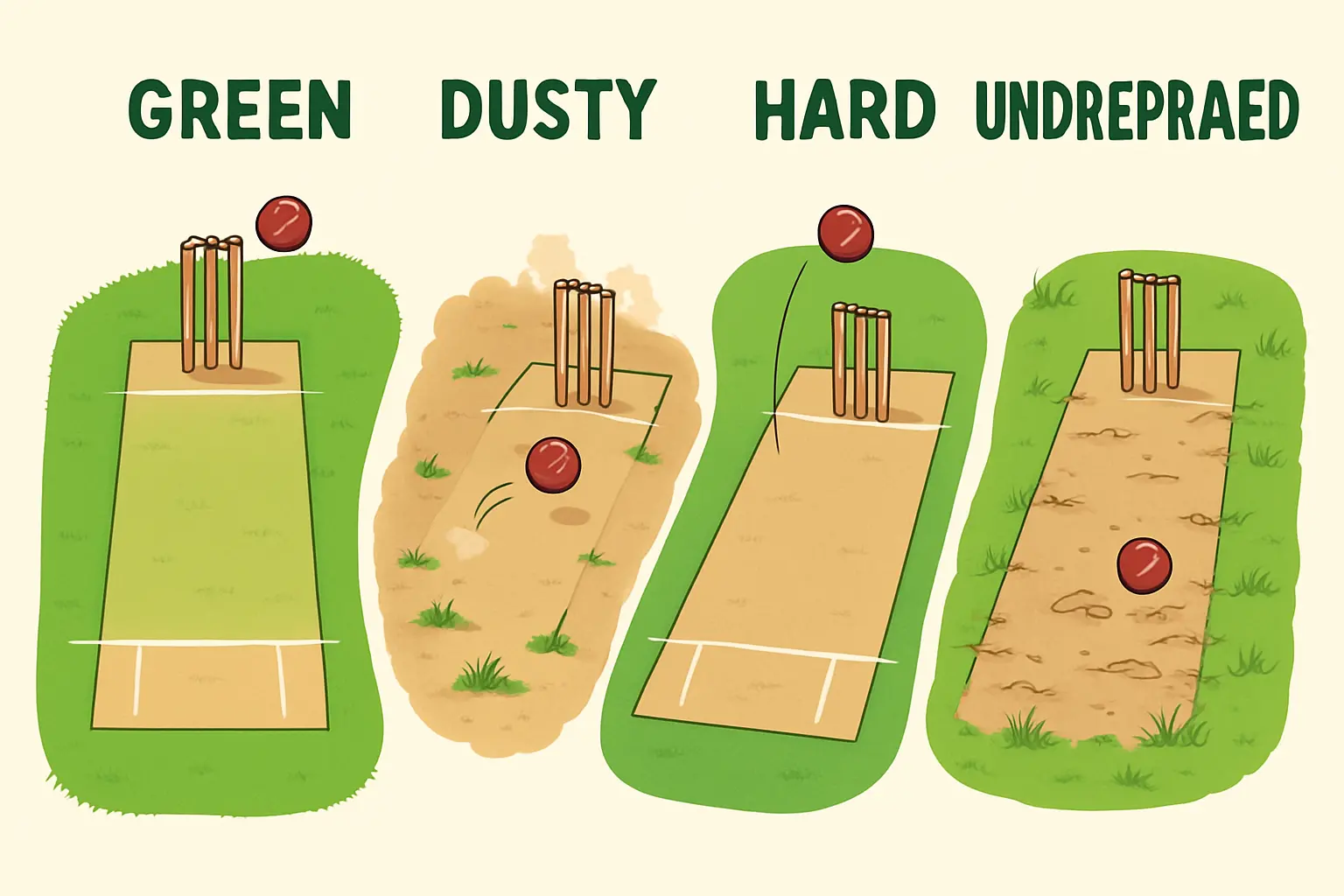
A green top shows live grass on the surface and is usually prepared with high moisture content and firm compaction. The visual is simple: a green hue that blends with the square and looks fresh, sometimes with a hint of sheen. The ball grips that grass, the seam bites, and lateral movement—both off the seam and in the air under overcast skies—becomes the first-session headline.
Characteristics:
- Seam movement and swing-friendly conditions.
- Good carry to the cordon when hardness is high.
- Becomes more benign as grass blades fold and moisture evaporates.
Player notes:
- Best pitch for fast bowlers early; target fourth-stump channel, upright seam, and bring bat-pad catches into play.
- Batting plan pivots on patience and compactness. Play late under the eyes, leave well, trust the bounce only after a few overs. The first thirty balls are an examination; passing it unlocks scoring.
Ground examples:
- English early-season strips and some New Zealand venues often fit this description.
- At Lord’s, the famous slope adds lateral nuance; nibble away from the Pavilion End can behave differently from the Nursery End because of angles.
Dry or dusty pitch (spin-friendly, rank turner potential)
A dry pitch is straw-colored, with minimal live grass and a flaky or dusty top once brushed. It’s baked by sun and curated with less watering, commonly seen across subcontinental venues and some UAE squares. As the game progresses, the surface scuffs and small cracks open; spinners find bite and variable bounce. A severe version earns the nickname rank turner—on these, even the new ball can grip, and left-arm orthodox or leg-spin attacks become match-winners.
Characteristics:
- Early slowness but predictable bounce when fresh.
- Accelerating assistance to spinners by middle to late phases.
- Abrasiveness, encouraging reverse swing if the square and outfield are dry.
Player notes:
- Spinners vary seam position and speed through the air; overspin to get bounce, sidespin to hit the rough. Bowling into footmarks becomes a method late in the game.
- Batters commit to using the depth of the crease, smothering the ball, and sweeping selectively. Strike rotation is gold because boundaries recede when pace off dominates.
Dead pitch or flat track
A dead pitch is flat, hard, and lacks grass and visible cracks at the start. It offers minimal lateral movement and true pace and bounce, making it paradise for set batters and a grind for bowlers. Many high-scoring limited-overs matches live here, and some Tests settle into long hauls on such surfaces.
Characteristics:
- Low deviation and consistent bounce.
- Fast outfield often compounds runs.
- Bowlers require patience and variation—cross-seam, cutters, and relentless discipline.
Player notes:
- Batters cash in once set; risk management shifts toward accelerating between over-spells.
- Seamers hit the top of off stump with immaculate control and mix lengths. Spinners hunt for drift, drop, and changes of pace more than turn.
Hard and bouncy pitch
Bounce is a function of hardness, compaction depth, and soil composition. The archetypal Australian quick’s dream offers steep, lively bounce and pace. Edges carry to a deep slip cordon, and upper body techniques—chest and shoulder alignment—are fully tested.
Characteristics:
- High, consistent bounce and true pace when prepared right.
- Bouncers and chest-high length are weapons; horizontal-bat shots can become risky.
- Spinners who get overspin extract kick and top-edge catches.
Player notes:
- Fast bowlers use the middle length more than full, exploiting splice and shoulder-of-the-bat dismissals. Short balls become strike options, not just set-ups.
- Batters trust the bounce after an assessment phase; back-foot punches and pulls pay off once timing clicks.
Damp or underprepared pitch (soft pitch)
A soft surface shows darker patches, often through the good length, sometimes with tackiness when pressed. It can result from recent rain, sweating under covers, or insufficient rolling and drying. The ball sticks, stops, and lifts unevenly. Curators avoid this outcome, but weather and scheduling can occasionally force it.
Characteristics:
- Variable bounce and tennis-ball feel.
- Stopping behavior that suits cutters and grip-oriented slow bowling.
- Deterioration into two-paced play as the top compresses unevenly.
Player notes:
- Seamers bowl cross-seam to leverage stickiness or pitch the ball into dents. Off-cutters and back-of-the-hand slower balls grab.
- Batters avoid hard hands. Soft hands with a late glide to third, or committed movement to the pitch, cuts down on inside edges and pop-ups.
Slow and low pitch
On a slow, low surface, the ball dies after pitching, rarely rising above knee height through back-of-a-length. Timing the drive is tricky, back-foot strokes feel cramped, and spinners—especially finger spinners—thrive on patience and angles more than sharp turn.
Characteristics:
- Low bounce and sluggish pace off the deck.
- Cutters and carrom variations excel in white-ball games.
- Reverse swing becomes a cheat code if the ball roughens early.
Player notes:
- Batters pace the innings through placement and sharp singles. Bottom-hand-dominant power often misfires; cleaner extension and still head help.
- Bowlers use the surface as their slower ball. Back-of-a-length into the pitch, cutters and undercut leg-breaks, and fielders packed on the leg side suffocate runs.
Swing-friendly conditions and seaming conditions
Pitch types and atmospheric conditions often get bundled together. The pitch alone does not generate swing—that’s predominantly an aerodynamics story influenced by humidity, cloud cover, wind, and ball condition. But a pitch with live grass, a tacky surface, and white-ball dew can extend or reduce swing windows.
Seaming conditions describe off-the-deck lateral movement post-pitch. Grass density, thatch integrity, and the angle of roll influence seam bite. A green, firm surface can be both swing-friendly and seaming early; a shaved, hard deck can offer zip without seam bite.
Abrasive surfaces and reverse swing conditions
A dry pitch, coupled with a coarse outfield, roughens one side of the ball quickly. Add hot, dry air and rigorous ball management from the fielding side, and the conditions ripen for reverse swing—late movement that looks like it breaches physics. Full lengths at the stumps, a scrambled seam, and subtle wrist control bring wickets in the back half of an innings.
Modern Variants: Drop-In Pitch and Hybrid Cricket Pitch
Drop-in pitch meaning and behavior
A drop-in pitch is grown and prepared off-site—often in a controlled nursery—inside a steel or concrete tray. When the game approaches, the tray is craned into the stadium’s pitch pit, leveled, and finished. Multi-use venues embrace this technology to switch quickly between cricket and other sports without damaging the square.
How drop-in pitches are made:
- A tray is filled with layered base, selected loam/clay, and turf.
- The surface is cultivated, watered, and rolled for months.
- Curators fine-tune grass species, clay percentages, and compaction to deliver pace and bounce suited to the venue’s identity.
- Transport and installation occur days out from the match, followed by final grazing and rolling.
Pros:
- Stadium flexibility and consistent, repeatable soil profiles.
- Potential for lively pace and bounce with modern loam mixes.
- Protects the square in multi-sport venues.
Cons:
- Early generations felt sterile, with less subtle deterioration.
- Seam movement and spin development can be conservative unless deliberately engineered.
- Integration with ground moisture and microclimate requires experience.
Hybrid cricket pitch
Hybrid pitches stitch natural grass with a small percentage of artificial fibers injected into the root zone. The idea is reinforcement: the grass canopy stays intact longer, the surface resists shearing, and the playing characteristics remain more uniform across heavy schedules. Hybrids are increasingly common for practice pitches and are making inroads into domestic limited-overs competitions.
Traits and implications:
- Better surface stability and reduced scuffing in the first half of the game.
- Slightly truer bounce and less crumb on repeated use.
- Spinners may see less early bite but can work with pace off and angles. Pacers enjoy reliable carry.
Soil Matters: Red Soil vs Black Soil, Clay, and Loam
You cannot read a pitch without reading its soil. Soil type governs how the surface compacts, how it holds or releases moisture, and how it cracks. Curators talk clay percentage the way coaches talk bat grips.
Clay and loam basics:
- Clay content drives binding strength and shrink-swell behavior. Higher clay can compact harder but also crack more when dried aggressively.
- Loam is a mix of sand, silt, and clay. Cricket loams are formulated for firmness, resilience, and root health.
- Sand content improves drainage but can reduce cohesive strength if overused.
- Organic matter supports grass but is minimized on the upper profile of match strips to avoid softness.
Red soil vs black soil pitch tendencies in India and beyond are famous among players, especially in coastal and western zones versus inland belts. Red-soil strips, common in many Mumbai maidans and parts of Maharashtra and Gujarat, produce bounce and quick drying. Black-soil strips, with higher clay and water-holding capacity, often play slower and lower, especially as matches progress.
Red vs black soil comparison
| Factor | Red soil pitch | Black soil pitch | Tactical notes |
|---|---|---|---|
| Moisture retention | Low to moderate; dries quickly under sun and breeze | High; holds water and releases slowly | Red needs delicate watering close to match; black needs longer lead time to dry |
| Hardness potential | Can be very hard when rolled right; lively bounce | Very hard when compacted, but surface can feel damp longer | Timing of heavy vs light roller crucial on black soil |
| Cracking behavior | Hairline cracks open earlier but often superficial | Deeper crack potential if over-dried after heavy saturation | Cracks bring late movement and spin; management avoids unsafe fissures |
| Pace and bounce | Good carry and shoulder-high bounce at best | Often lower bounce, especially late | Seamers aim fuller on black to hit stumps; back-of-length works on red |
| Spin | Later bite; overspin rewards bounce | Earlier grip once surface dries; slower off deck | Finger spinners love black late; wrist spinners relish red with overspin |
| Reverse swing | Encouraged by dryness and abrasiveness | Arrives later if surface stays tacky | Outfield coarseness and wind amplify reverse on both |
Ground textures illustrate these tendencies. Wankhede Stadium’s red-soil strips often offer pace and carry with quick deterioration of sheen, aiding reverse swing later. Chepauk’s clay-rich surfaces, coupled with humidity and sea breeze, nurture turn as days roll by. Ahmedabad’s modern square showcases both red and black blocks at different times, a curator’s palette that can tune behavior to format.
How Curators Prepare a Pitch: Rolling, Watering, Grass Cover
If you have never watched a square wake up, visit a ground at dawn. Curators and their teams run a ritual that blends soil science with artistry. They read the week’s weather, schedule, and intended format, then nudge the pitch to a planned personality.
Preparation timeline overview:
- Selection and scarification: A match strip is selected weeks out. Old thatch is scarified, surface leveled, and low spots filled with compatible loam.
- Consolidation and growth: Grass is encouraged to knit. Mowing heights are gradually lowered to the desired canopy length.
- Watering and drying cycles: Irrigation wets the profile to a target depth. The surface is then allowed to dry in cycles that consolidate clay and tighten the top.
- Rolling: Light rollers early to knit and level; heavier rollers closer to match to compact and smooth. Rolling direction and passes matter—across and along the strip to ensure uniformity.
Light roller versus heavy roller:
- Light roller promotes surface smoothing without deep compaction. It preserves some seam bite and early life.
- Heavy roller compresses the profile, reduces early seam movement, and can create a faster, truer deck for batters—at least temporarily. Overuse can seal the surface too much, trap moisture, and later lead to low, two-paced bounce.
Grass cover and mowing:
- Live grass—fine-leaf, low thatch—is a curator’s lever for seam and bounce. Leaving more grass favors fast bowlers early; shaving it favors batting and later spin.
- Mowing height and timing define friction at the point of contact. Too short, and the pitch bakes too quickly; too long, and unevenness creeps in.
Moisture management:
- Moisture meters help assess the profile. The aim is even moisture to the batting ends’ good lengths, tapering slightly near popping creases to avoid cupping.
- Covers are used to shield from rain but can cause sweating. Ventilation and timely removal prevent tackiness.
- On nights with expected dew, curators and support staff use anti-dew sprays on outfields; on the strip, extra rolling and a shaved canopy reduce moisture absorption.
Finish and marking:
- Final mowing patterns reduce the chance of grass grain sending the ball in unintended directions.
- Chalk and paint mark creases; the surface is brushed and lightly rolled to settle.
Reading a Cricket Pitch: Toss, Weather, and Day-by-Day Changes
Reading a pitch is partly habit, partly humility. The most experienced captains still get surprised. Yet a consistent method reduces the odds of being duped by a shiny surface or a theatrical crack.
A practical reading framework:
- Color and sheen: Rich green with upright blades suggests seam movement. A matt straw color hints at dryness. A glossy dark stripe can hide tackiness.
- Grass length and density: Short, even grass gives truer bounce; tuftiness creates variable bounce and cutter-friendly grip.
- Hardness test: Press with fingertips or the edge of a coin. Springy firmness is good for carry. A spongy give points to softness.
- Surface dust: A light brush with the palm or shoe toe that produces dust signals dryness and potential turn later.
- Cracks and lines: Fine hairlines early are rarely decisive. Cracks across good length that you can trace with a nail can widen under sun and foot traffic.
- Footmarks: On previously used strips, look at landing areas. Rough patches promise late spin, especially from round-the-wicket angles.
- Under the covers smell: A musky, damp scent after a long cover spell hints at sweat and cling. Expect the first hour to be tacky.
- Weather overlay: Overcast amplifies swing; bright sun bakes moisture and accelerates crack development. Wind direction affects swing and carry.
Toss decision logic:
- Bat first when the surface is dry and likely to break up, or when a green tint is superficial and the forecast is clear.
- Bowl first when live grass and cool conditions align, or when morning sweat is likely to make the first hour mischievous.
- Format and dew alter the equation. In night T20s and some ODIs, chasing on a dew-laden outfield is often advantageous because the ball skids on and grip vanishes for spinners.
Day-by-day Test match changes
| Day | Surface state | Batting approach | Bowling approach | Toss lens |
|---|---|---|---|---|
| 1 | Fresh, compact; possible seam early | Play late, leave well; cash in once new ball softens | Fuller lengths, upright seam; tidy fields | If green and humid, bowl; if dry and firm, bat |
| 2 | True bounce on good pitches; grip begins on dry ones | Build big scores; accelerate late | Spinners start probing; pacers use cutters in last session | Bat if shape holds; otherwise chase early wickets |
| 3 | Transition day; cracks warm; reverse swing window opens | Adjust to variable bounce; ride reverse by defending stumps | Mix lengths, go at stumps, exploit footmarks | Bat first looks good if 1 and 2 were stable |
| 4 | Wear shows; rough visible; bounce can spike or die | Commit to positive defense; sweep and use feet | Spin to win periods; pacers cross-seam into patches | Bat first ideally reaps dividends |
| 5 | Rank turner scenarios possible; uneven bounce likely | Decisive strokeplay, trust scoring zones | Attack fields for spinners; pack close catchers | Early bat first often justified unless weather intervened |
Format Differences: T20 vs ODI vs Test Pitches
Across formats, pitch preparation balances fairness, spectacle, and logistical load. The same ground can present three personalities in a single season.
T20 pitch tendencies:
- Even, hard surfaces to enable strokeplay.
- Shorter grass for speed off the bat; minimal live grass in the good length for seam movement.
- Dew management becomes critical for night matches; slightly drier strips can be chosen to offset wet balls.
Bowling plans:
- Pace off is currency on used pitches. Cutters into the pitch, back-of-length, and wide yorkers deny leverage.
- Wrist spinners with subtle variations thrive in the middle overs, especially if the square is abrasive.
Batting plans:
- Target straight boundaries with lofted drives early against new ball skidders.
- On slow, low pitches, delayed bat swing and placement beat muscle.
ODI pitch tendencies:
- Similar to T20 in white-ball needs but stretched over longer spells.
- First innings often crafted for a par-plus total with carry for new ball and later grip for spinners.
Test pitch tendencies:
- Intentional evolution over days is ideal: seam early, truer middle, spin late.
- Grass retained more generously where local identity values bounce and carry; shaved and baked where spin is the tradition.
Construction details that change by format:
- Rolling frequency and weight are adjusted to pace up white-ball games.
- Grass species and height are tuned to ensure one ball per innings in one-dayers behaves predictably early but doesn’t dull outfield speed.
- Square rotation is more aggressive in cramped calendars, increasing the role of hybrid and drop-in solutions.
Regional Nuance and Ground Profiles
No two countries grow their cricket the same way. Climate, soil, and curatorial tradition imprint venues with distinct signatures.
England and the UK
- Seaming conditions are frequent, with live grass and cool air. Early-season strips at northern venues can be especially green and soft beneath, demanding discipline from batters and skill from seamers.
- Lord’s slope remains a tactical quirk. Bowling from the Pavilion End can see the ball slope away from right-handers even without swing. Left-armers exploit angle across the slope to lure edges.
- The Oval trends toward flatter, truer decks later in the season, aiding batters and traditional off-spin late.
Australia
- The Gabba in Brisbane is shorthand for hard, bouncy pitch with strong carry. Good-length balls climb to splice height; batters play with high elbows and watch for glove traps.
- Perth’s heritage is extreme bounce and pace; modern stadium shifts have kept much of that DNA. Cutters are less effective here; hit-the-deck fast bowling shines.
- MCG uses drop-in pitches with evolving character. Early criticisms of blandness have given way to improved pace and carry after curators adjusted clay mixes and grass management.
- Adelaide’s day-night Tests add a twilight session with exaggerated swing. Even on truer decks, that session is a mini-match within the match.
India and the subcontinent
- Variety reigns. Mumbai’s red soil generates brisk scoring and later reverse swing. Chennai’s clay-heavy surfaces encourage spin and tactical grind. Kolkata’s black-soil history leans slower, particularly with humidity.
- Rank turners appear for tactical reasons in some series; however, balance with bat carries weight. Finger spinners often dominate late, but high-pace reverse swing remains a potent counter.
- Sri Lanka’s Galle is coastal, wind-swept, and famously spin-conducive after day two. Sea breeze shapes swing late in afternoons. Colombo’s humidity and slower decks require patience.
Pakistan
- Surfaces range from flatter, batter-friendly strips in Rawalpindi to slower, lower Karachi tracks where spin and reverse swing decide games.
- Hot, dry conditions and abrasive squares invite reverse swing earlier than in many countries. Bowling attacks plan entire spells around ball age.
UAE
- Abu Dhabi, Dubai, and Sharjah tilt toward slow, low play. Dew transforms night games—seamers motor through powerplays with skidding new balls, then slower balls lose bite later as the ball turns to soap.
- White-ball tournaments in the region revolve around cutters and defensive fields, while totals swell when dew flatters grip.
South Africa
- Centurion and Johannesburg give pace and bounce, a stern test for batters. Newlands in Cape Town swings with coastal breeze, rewarding consistent lengths and late movement.
- Spinners support rather than lead in many venues, though fifth-day footmarks can bring them decisively into play.
New Zealand
- Green tops and grass banks are clichés because they are often true. Hamilton and Wellington can be seamers’ paradises under cloud. When sun bakes them, they become fair and fast for strokeplay.
- Eden Park in Auckland uses a drop-in due to its multi-sport nature, producing consistent carry when curated well.
West Indies
- A generation ago, many Caribbean pitches were hard and fast year-round. Now, character varies widely. Barbados can offer pace and bounce; Guyana and St. Lucia often skew slower and lower, making spinners more prominent than in the past.
Player and Strategy Advice by Pitch Type
Green top survival and success
- Batting: Play the ball under your eyes. Trigger movement small and precise. Own the leave—shoulder arms on length outside off rather than fiddling. Wait for the half-volley. When in doubt, straight bat and down the ground scores.
- Fast bowling: Upright seam, kiss the deck. Fourth-stump line to right-handers, channel patience. Bring keeper and slips into play with lengths that draw batters forward. If the ball won’t swing, try scrambled seam to keep edges from dying.
Rank turner or dry pitch masterclass
- Batting: Get to the pitch with decisive feet or play as late as you can off the back foot; indecision gets you nicked or trapped. Sweeps—conventional, paddle, and slog—are tools, not compulsions. Pre-select zones, not shots.
- Spin bowling: Control speed relentlessly. Slower through the air pulls batters out; quicker darts squeeze singles. Target rough patches. Wrist spinners hunt with the googly to right-handers; off-spinners use drift and dip to draw bat-pad.
Dead or flat track ingenuity
- Batting: Big runs live here. The risk is boredom. Rotate relentlessly, punish width, and be ruthless with balls on your pads. Keep your scoring rate ahead of field adjustments.
- Bowling: Treat the pitch as a partner, not a savior. Cross-seam to scuff, cutters to deny pace, and bouncer-yorker combos in white-ball death overs. Spinners shift fields constantly to nudge batters into errors.
Hard and bouncy pitch combat
- Batting: Keep the head still and hit under your eyes. Back-foot punches, compact pulls, and high-elbow drives pay. Gloves up for rib-cage balls; leave horizontal-bat swats until you read the bounce.
- Bowling: Live a foot shorter than your subcontinental length. Chest-high is a wicket ball. For spinners, overspin to get glove catches and short-leg chances.
Damp or soft pitch navigation
- Batting: Drop the ego with the drive. The ball can stop and take the splice. Nudge singles, hit with the breeze, and wait out the stickiness. Soft hands are your best defense.
- Bowling: Off-cutters and leg-cutters talk. Use wobble seam and heavy back-of-a-length. Invite the bat to close early; take the leading edge to cover.
Slow and low pitch pragmatism
- Batting: Shape for straighter hits and field-manipulation. Late cuts and deft nudges beat brute force. Target the bowler’s off-pace deliveries with stillness, not speed.
- Bowling: Think baseball sinker. Hit the top of the stumps. Alter grip and finger pressure to get the ball to land seam-down and hold. Pack leg-side catchers for miscues.
How Dew, Weather, and Time of Day Change Pitch Behavior
- Dew effect on pitch and ball: A wet ball becomes heavier and skids; seamers see zip off the turf but struggle to grip for cutters and yorkers. Spinners lose revolutions and bite. Captains often prefer chasing under lights because boundaries come easier and totals shrink psychologically.
- Overcast conditions and swing: Cloud cover reduces thermal spikes on the surface but, more importantly, supports conventional swing. Bowlers who keep seams proud and wrists behind the ball get movement even with a relatively new ball.
- Heat and wind: Heat bakes moisture away, opens fine cracks, and accelerates reverse swing. Wind aids swing in one direction and retards it in the other; bowlers match ends to the breeze.
Pitch Construction, Preparation Science, and Tools
Curators lean on instruments alongside instincts:
- Clegg hammer or impact tester estimates surface hardness by measuring deceleration.
- Moisture meters probe depth hydration.
- Shear vane testers gauge surface shear strength, indicating how likely the turf will scuff.
Clay percentages and loam blending:
- High-clay loams (often above half clay content) compact harder and suit premium bounce decks when curated by experts.
- Loams are blended for region-specific moisture and temperature profiles—what gives pace in a dry inland venue may give stickiness in a humid coastal one.
Rolling regimes fine-tune behavior:
- Rolling when the pitch is at field capacity moisture compresses clays best. Rolling too wet creates plastic deformation and long-term softness; rolling too dry risks hairline cracking without cohesion.
Grass species and thatch:
- Fine fescues and ryegrasses are common, chosen for wear tolerance and leaf fineness. Thatch is minimized on the playing surface because it acts like a sponge.
- Grain direction is controlled with mowing patterns; uneven grain can subtly alter lateral movement.
Drop-in pitch versus natural pitch trade-offs:
- Natural pitches are integrated into the square, with deeper moisture profiles and organic microclimates. They wear more character across days.
- Drop-ins deliver consistent profiles but require sophistication to mimic organic deterioration.
Quick Definitions and Fundamentals
- Types of pitches in cricket: Broad categories include green tops, dry or dusty spin tracks, dead or flat tracks, hard and bouncy surfaces, damp or underprepared strips, and slow, low wickets. Each type signals different tactics for batting and bowling.
- Types of wickets in cricket (surface sense): Same as pitch types above, plus two-paced wickets where pace varies unpredictably across spots due to uneven consolidation or prior use.
- Rank turner meaning: A dry, abrasive pitch offering significant spin from early in the match, often making batting against quality spin extremely difficult.
- Green top pitch meaning: A surface with live grass that favors seam and swing early through extra grip and reduced friction.
- Drop-in pitch meaning: A pre-grown pitch housed in a tray, prepared off-site and installed at the venue for the match to serve multi-use stadiums and ensure repeatable soil profiles.
- Hybrid cricket pitch: A natural turf pitch reinforced with a small percentage of synthetic fibers stitched into the root zone for durability and consistency.
- Red soil vs black soil pitch: Red soil dries faster and produces lively bounce and quicker reverse swing windows; black soil retains moisture, tends to slower, lower bounce and aids spin as it dries.
- How is a cricket pitch prepared: Curators select, scarify, level, water, roll (light and heavy), mow, brush, and mark to achieve targeted moisture, hardness, and grass cover.
- Pitch hardness, cracks, and footmarks: Hardness governs bounce; cracks introduce lateral deviation and variable bounce late; footmarks from bowlers become rough for spinners to exploit.
- Swing-friendly and seaming conditions: Swing arises from ball aerodynamics and weather; seaming requires a surface that grips the seam. Overcast skies and live grass raise potency.
- Reverse swing conditions explained: Dry, abrasive surfaces and coarse outfields roughen one side of the ball, enabling late movement in the opposite direction of conventional swing at fuller lengths.
- Pitch report versus weather report: Pitch report focuses on surface traits—grass, hardness, moisture—while weather report covers cloud, wind, temperature, and dew that modulate behavior.
- Toss decision based on pitch: Bat first on dry, deteriorating pitches; bowl first on green, seaming strips under cloud or where morning sweat lingers; account for dew in night games.
- Cricket pitch dimensions and 22 yards meaning: The pitch runs 22 yards between bowling creases and shapes line and length tradition—good-length zones vary by bounce profile.
- Flat track versus green top: Flat tracks are batter-friendly with minimal movement; green tops help seamers and swing early. Strategy flips accordingly.
- ICC and MCC references: MCC Law on the pitch sets preparation and fairness principles. ICC pitch ratings range across performance tiers, encouraging balance over extremes.
Comparisons and Grounded Insights
The best pitch for batting is a hard, true surface with consistent bounce, minimal lateral movement, and quick outfield—commonly called a flat track or dead pitch. Yet batting brilliance often blooms on truer versions of hard and bouncy pitches, where pace into the bat rewards clean swings and shot-makers feel alive.
The best pitch for fast bowlers is green and firm, with live grass that kisses the seam and consistent carry. Cloud cover and morning sessions lower the scoring rate and add wickets to new-ball spells.
The best pitch for spinners is dry, dusty, and slightly cracked across the good length by the third or fourth day of a red-ball game, or a tired white-ball surface with footmarks and scuffed areas. Subtle changes in speed through the air are decisive.
Is a green pitch good for batting once the sheen goes and grass lies flat? Absolutely, provided batters survive the first hour. Many of the best hundreds on English soil were built by batters who absorbed that early examination and cashed in against an older ball on a firm base.
Why pitches crack has a simple physical core. Clay shrinks as it loses moisture. If surface and subsurface dry at different rates, tension lines form. Heat, wind, and compaction patterns turn lines into cracks. Not all cracks are harmful; some are cosmetic and never misbehave. Deep, open cracks across good length can introduce variable bounce and late-game jeopardy.
A slow versus fast pitch framework helps bowlers choose lengths. Fast pitches reward back-of-length for steep bounce and surprise batters with lift. Slow pitches punish that length; bowlers aim fuller, at the stumps, using cutters and wobble seam to make the ball grip and slide.
Anatomy of Wear: Cracks, Footmarks, and Two-Paced Behavior
- Cracks appear across the strip, often perpendicular to the line of play. Fine hairlines are neutral. Wider cracks demand a change in batting plan—playing straighter and later reduces inside edges; lofted drives risk hitting the seam and slicing.
- Footmarks arise from the bowler’s landing and follow-through. Left-arm spinners love right-armers’ rough outside the right-hander’s off stump when bowling round the wicket.
- Two-paced behavior stems from uneven compaction and moisture. One patch grips; another slides. Batting adjustments include waiting fractionally longer, playing with softer hands, and avoiding blind through-the-line swings.
Mini Ground Profiles That Teach Pitch Behavior
- Gabba, Brisbane: High, true bounce and excellent carry. Test of courage and technique. The best back-foot players feast; seamers who hit the deck hard rule early.
- Lord’s, London: Slope dictates angles. Seamers get assistance without needing much grass. Batters adjust to the ball leaving them more at one end and coming in at the other.
- MA Chidambaram Stadium, Chennai: Clay-rich surfaces favor spinners as days pass. Batters get value for straight driving early; late, it becomes a game of feet and wrists.
- Wankhede, Mumbai: Red soil, sea air, and an electric outfield. Early pace and bounce, later reverse swing. White-ball totals can soar when dew sneaks in.
- Newlands, Cape Town: Lively early movement and sea breeze swing. Batting is rewarding once set but punishes loose early technique.
- Abu Dhabi: Slow, low, and dew-laden at night. Cutters and unglamorous lines win games. Spinners bowl more for dots than for dip-and-rip.
Practical Checklists That Travel Well
Pre-game pitch read checklist:
- Color: Green or straw
- Grass: Even carpet or tufted
- Hardness: Springy or spongy
- Dust: Present or absent
- Cracks: Fine lines or opening
- Footmarks: New strip or used
- Weather: Overcast, humid, windy, or baking sun
- Dew window: Evening start time and local microclimate
Batting adjustments by condition:
- Green and seaming: Play late, leave boldly, score straight.
- Dry and spinning: Use feet, sweep selectively, rotate relentlessly.
- Flat and hard: Expand scoring areas, keep tempo high.
- Damp and two-paced: Soft hands, delay swing, minimize drives on the up.
Bowling adjustments by condition:
- Green: Fuller, upright seam, attacking fields in catching cordon.
- Dry: Tight lines to rough, speed variation, bat-pad traps.
- Flat: Cross-seam, cutters, patience, and field traps for miscues.
- Damp: Back-of-length grip balls, into the pitch, exploit stickiness.
Common Myths and Sharp Truths
- Pitch versus wicket is not a pedant’s debate. Distinguish the strip from the dismissal. Clarity helps in planning and communication.
- A dead pitch does not always mean a draw. Skill with reverse swing and perseverance with spin can break stalemates.
- Leaving grass does not guarantee bowler-friendly play if the surface beneath is soft. A sticky green carpet can be a batting graveyard in the first hour and a featherbed later.
- Drop-in pitches are not inherently bland. Modern loams and refined curation have introduced bite and evolution, especially where venue identity demands it.
Table: Format and Strategy Snapshot by Pitch Behavior
| Format | Typical pitch preparation | Likely behavior | Batting plan | Bowling plan |
|---|---|---|---|---|
| Test | Grass retained or shaved per local identity; evolution planned | Seam early, truer mid, spin late | Pace innings, play conditions not reputation | New-ball discipline, reverse swing, and late spin |
| ODI | True and even with some carry; later grip possible | Runs early, grip for spinners middle, death overs skid or grip by venue | Build through middle, power at death | Hard lengths early, choke middle, variations at death |
| T20 | Hard, true, fast outfield; often used strips later in events | Skid under lights, used strips slow and low | Target powerplay, adapt to pace off, place over power late | New-ball wickets, middle-over spin pressure, death mix of yorkers/cutters |
Crib Sheet for Broadcasters and Analysts
- Core headline terms to deploy with accuracy: green top, rank turner, dead pitch, hard and bouncy, slow and low, two-paced wicket, swing-friendly, seaming conditions, abrasive surface for reverse swing, drop-in pitch, hybrid pitch, red soil, black soil.
- Curator levers to mention credibly: grass height, watering schedule, rolling regime (light vs heavy roller), mowing patterns, moisture profile, and the square’s rotation.
Safety, Fairness, and Ratings
The game values balance. Dangerous variable bounce on day one, ball stopping unpredictably across a good length, or extremes that remove contest between bat and ball get flagged. Governing bodies categorize pitches—very good, good, average, below average, poor, unfit—and those tags guide future preparation. The ideal competitive pitch offers the quicks a sniff up front, controls scoring without strangling it, and then opens a door for spinners later.
Closing Thoughts: The Art Behind the Science
A pitch is memory and intent pressed into clay. It remembers last week’s rain, last afternoon’s roller pass, and the curator’s decision to shave a millimeter more off the grass canopy. It remembers every stud that stomped its good length and every spinner’s pivot near the crease. Intent arrives from captains and coaches, who dream of fields set exactly for the wicket they imagined at the toss.
Mastery lies in marrying the science with nerve. Read the color and the cracks, but also read the sky. Feel the hardness, but also feel the breeze. Ask the square what it wants today, not what it gave last month. On green tops, courage and judgment trump swagger. On rank turners, humility and craft outlast force. On dead tracks, endurance and imagination make bowlers relevant again.
These twenty-two yards are cricket’s truth serum. They punish lazy thinking and reward those who keep learning. The best players and teams build a vocabulary for surfaces and conditions, then rewrite their sentences session by session. Learn the language of pitches and you unlock the story the game is desperate to tell.