
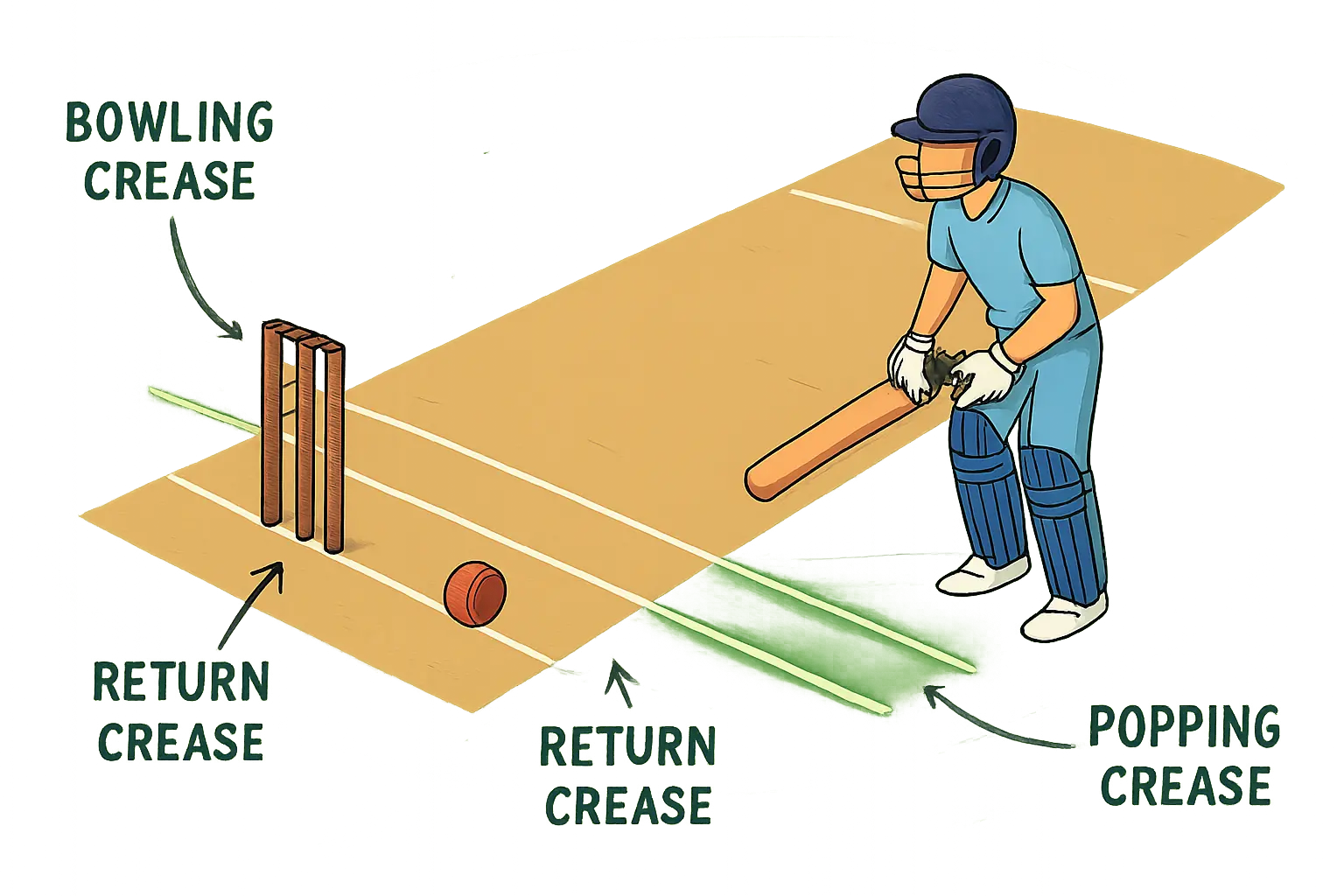
There are four creases in cricket. At each end of the pitch you’ll find one bowling crease and one popping crease, with two return creases rising at right angles. Together they frame the legal space for bowlers, define a batter’s “safe ground,” and give umpires the visual grammar to interpret no-balls, run-outs, and stumpings with confidence.
- Bowling crease: the horizontal line through the stumps, 8 ft 8 in (2.64 m) long.
- Popping crease: a parallel line 4 ft (1.22 m) in front of the bowling crease, unlimited in length but marked a minimum distance either side of the wicket.
- Return creases (two): lines at right angles to the popping crease, one on each side of the wicket, extending back past the bowling crease at least 8 ft (2.44 m).
Those three names give you the count—four creases total—yet they do far more than decorate the pitch. The story of cricket’s creases is about margins: inches that decide history, lines that orchestrate where a bowler can launch and where a batter is safe, and paint that carries more law than it appears to.
What Each Crease Does, In Plain Language
- Bowling crease: anchors the stumps and defines the legal “front” for where the ball is released.
- Popping crease: defines each batter’s ground for run-outs and stumpings, and governs the front foot in the no-ball law.
- Return creases: fence in the bowler laterally and govern the back foot in the no-ball law.
Cricket Crease Dimensions and Layout (feet and meters)
Pitch overview
- The pitch is 22 yards (20.12 m) long between the wickets.
- Each end has an identical set of creases: one bowling crease, one popping crease, and two return creases.
Bowling crease
- Length: 8 ft 8 in (2.64 m).
- Position: runs through the center of the three stumps at each end.
Popping crease
- Distance from bowling crease: 4 ft (1.22 m) in front, running parallel.
- Length: unlimited in law; marked to at least 6 ft (1.83 m) on each side of the wicket.
Return creases (two at each end)
- Orientation: drawn at right angles to the popping crease and the bowling crease.
- Lateral placement: each return crease sits 4 ft 4 in (1.32 m) to the left and right of the center stump line.
- Length: extends from the popping crease back past the bowling crease, at least 8 ft (2.44 m), unlimited in law.
The line belongs to the crease. In practical terms, that means the painted line itself is part of the crease. But many decisions hinge on the phrase “behind the popping crease.” For those situations—front-foot no-balls, run-outs, and stumpings—being on the line is not behind it. A bat on the line with nothing grounded behind is out. A front foot landing on the line is a no-ball. The paint counts as the crease; the word “behind” decides the verdict.
A Simple Table to Keep It Straight
| Crease | Where It Is | Key Measurements | Governs |
|---|---|---|---|
| Bowling crease | Under the stumps, horizontal | 8 ft 8 in (2.64 m) long | Anchors wicket positions; reference for popping crease distance |
| Popping crease | 4 ft (1.22 m) in front, horizontal | Unlimited length in law (marked at least 6 ft/1.83 m either side) | Batter’s ground for run-outs/stumpings; front-foot no-ball; non-striker ground |
| Return crease (left) | 4 ft 4 in (1.32 m) from center line, vertical | Extends at least 8 ft (2.44 m) back from popping crease | Bowler’s back-foot no-ball; lateral limit for angle of delivery |
| Return crease (right) | 4 ft 4 in (1.32 m) from center line, vertical | Extends at least 8 ft (2.44 m) back from popping crease | Bowler’s back-foot no-ball; lateral limit for angle of delivery |
The Four Creases, Deeply Explained
Bowling crease: the quiet authority
At a glance, the bowling crease is the least dramatic line on the pitch. It rarely stars in a highlight reel. Yet everything is framed off it. The stumps stand astride the bowling crease; the popping crease is measured from it. When curators paint the pitch on a training morning, they start by striking this line through the wicket’s center. Get this wrong, and every other line drifts with it.
For umpires, the bowling crease is a fixed anchor. For bowlers, it’s a reference they rarely look at yet always obey; it’s where the wicket begins, where angles start to matter, and where the return crease fence posts gain meaning. It has a constant presence in the peripheral vision of the back-foot landing area. Old pros talk about “owning the crease.” Often, they mean the space just behind this line—because that’s where a bowler’s rhythm meets the law.
Popping crease: the life raft for batters
This is the crease that makes or breaks a run, the line a batter dives for. It defines the “ground” at each end. If any part of the bat (held in hand) or person is grounded behind this line when the wicket is put down, the batter is home. If not, they are out. The line belongs to the crease, but the key is “behind.” An extended bat on, but not behind, the popping crease is a heartbreak waiting to happen—safe in many imaginations, out in the law.
The popping crease does double duty for the bowler. It’s the front-foot checkpoint. For a delivery to be fair, some part of the bowler’s front foot must land with grounded contact behind that popping crease. Step on it or over it, and the penalty is a no-ball. In white-ball formats with real-time TV oversight, the third umpire now checks the front foot almost every ball. Margins have always mattered; now they’re measured in pixels.
Return creases: the guardrails for angles
Two vertical lines, quietly authoritative, fence in the bowler’s approach. They run up the pitch at right angles to the popping crease, each 4 ft 4 in (1.32 m) from the midpoint of the stumps. They extend back past the bowling crease, at least 8 ft (2.44 m). These are the guardrails for wide-angle bowling.
Why do they matter? Because cricket cherishes a fair contest. Without return creases, a right-armer could release from impossibly wide positions to sling the ball around the batter, or a left-armer could carve extreme angles that start somewhere near square leg. The law is simple: the bowler’s back foot must land with some part of it grounded inside (and not touching) the return crease. Touch the line or land outside it and the umpire calls no-ball. At elite level, coaches and bowlers study these margins; side-on releases that flirt with the return crease can be devastating, but only if they’re legal.
The Line Belongs to the Crease, and What “Behind” Actually Means
Paint matters, but phrasing matters more. Two truths live together:
- The line itself is part of the crease. When you hear “line belongs to the crease,” that’s correct across the board.
- For decisions that hinge on “behind” the popping crease (front-foot no-balls, run-outs, stumpings), being on the line is not behind it.
This is where match-day chaos often arises. The striker charges down, misses, the keeper whips off the bails. Broadcasters zoom in: the bat tip is kissing white paint. The law asks a plain question: is any part of bat or person grounded behind the popping crease? If no, out. The same clarity applies to bowlers. If your front foot lands on the line, there is no part behind it; that’s a no-ball. If your back foot kisses the return crease line, that’s a no-ball too—because the back foot must not touch or cross that line.
Front-Foot No-Ball, Explained With Field Reality
Every fast bowler has lived a version of this: knees pumping, crowd buzzing, a perfect yorker detonates the base of off stump. Then the square-leg umpire twitches to the earpiece. Up on the big screen: heel on the line. One tiny misjudgment, and the ball becomes a free hit. The rules are clinical, but the lived experience teaches clear habits.
What matters on landing
- Some part of the front foot must land with grounded contact behind the popping crease.
- If the landing foot is on or beyond the popping crease, it’s a no-ball.
- The back foot’s role is separate; it must land within the return creases without touching them.
Practical footwork cues bowlers use
- Start a touch shorter and rise into the crease, rather than stretching. This keeps the heel anchored.
- Land with the heel behind and roll forward. Flatter landings invite trouble because even slight drag can carry the contact patch onto the line.
- Practice under match-movement: approach speed, angle, and stress make front-foot habits degrade.
In high-pressure overs—end-game death bowling in particular—bowlers build trigger routines. A deep breath at top of mark, a mental “heel behind,” a fixed eye on a spot. Not superstition, just disciplined margin management. That’s how you keep your yorker legal when the adrenaline wants to push you an inch too far.
Return Crease Rule, Wide-Angle Bowling, and the Back Foot
Not all no-balls are born equal. The one that bites bowlers who attack from squarer angles is the back-foot return crease infraction. A classic case is the right-arm bowler coming around the wicket, hunting a rough patch outside a left-hander’s off stump. The approach widens, the back foot glances the line at touchdown, and the umpire’s arm goes outstretched. No ball.
The essentials
- The back foot must land with some part grounded inside the two return creases.
- The back foot must not touch the return crease line. Contact equals no-ball.
- The law applies regardless of over or around the wicket.
Coaching detail that matters
- Map your run-up to your favorite release angle but rehearse it in the actual crease channel. Many bowlers calibrate a half-skip or micro-adjustment two steps before takeoff to re-center the back foot.
- On skiddy, hard pitches, the back foot can “slide” on landing. Even if you land legal, a slide onto the line can draw the call. Shoe choice, foot angle, and surface moisture become tactical variables.
Watch seasoned pros operate and you’ll see careful choreography: a back-foot strike that’s inside, a front-foot plant that’s safely behind, and a release point that sells a dangerous angle—but never at the expense of the line.
Non-Striker’s Ground and Run-Out at the Non-Striker
At the non-striker’s end, the popping crease serves the same purpose: it defines the ground. The bowler is legally entitled to run out the non-striker if that player leaves their ground before the ball would be expected to be delivered. The phrase “in their ground” is the same standard used everywhere else: some part of bat (if held) or person must be grounded behind the popping crease.
Two practical truths live together on the field
- Non-strikers often back up to gain a running advantage. The game accepts this as part of sharp running, but it comes with a responsibility to stay home until the bowler’s action commits to release.
- Bowlers and teams vary in how they enforce it. Some warn; others take the wicket. The law recognizes the dismissal without moral qualifiers.
The crease doesn’t care about etiquette debates. The popping crease simply asks: was the non-striker grounded behind it? Teams have become more vigilant in recent seasons. Coaches set drills where the non-striker watches the bowler’s back foot and holds ground until that foot lands. That one-beat delay barely dents a quick single but keeps you clear of a lawful, if polarizing, dismissal.
Wicketkeeper and the Lines
The wicketkeeper’s placement relates to the stumps rather than the popping crease, but in practice the keeper’s alignment dances with these painted lines. The keeper must remain wholly behind the wicket (the line of the stumps at the striker’s end) from the moment the ball comes into play until it either touches the striker or passes the wicket. If the keeper steps in front early—no part of their body behind the wicket when it counts—the penalty is a no-ball.
This is why keepers who stand up to the stumps, especially to medium pace, are so precise with their starting crouch. They work in relation to the popping crease visually, but the reference that matters in law is the wicket line through the stumps. Smart keepers use the popping crease as a depth cue and sweep up behind the stump line only after the ball passes the bat. It’s a narrow dance. Get it wrong, and a sharp stumping becomes a wasted no-ball.
Common Mistakes Players Make With the Crease
- Reaching the bat onto the popping crease rather than over it. A toe of wood kissing paint looks safe on TV but isn’t legally “behind.”
- Front-foot drag. Landing legal and then sliding the foot onto the line during delivery still triggers a no-ball.
- Ignoring the return crease on wide-angle lines. Side-on bowlers who chase extreme release points need to calibrate their back-foot strike relentlessly.
- Ball-watching at the non-striker’s end. Backing up on the bowler’s load-up instead of on landing invites a run-out.
- Confusing “crease” with “line” in language. The line is part of the crease, yes—but many decisions judge “behind,” not “on.”
Popping Crease vs Bowling Crease: Practical Differences That Matter
Think of the bowling crease as the stumps’ doorstep, and the popping crease as the home’s threshold. The bowling crease marks where the wicket stands; it rarely decides dismissals on its own. The popping crease is the threshold for batters—a literal do-or-die frontier. It also polices the bowler’s front foot. If you’re a young cricketer trying to memorize which is which, stand at the striker’s end and look down: the popping crease is the one you’ll sprint to make your ground. The bowling crease is the one with the stumps planted through it.
Batting Crease vs Popping Crease: local wording
In many dressing rooms, you’ll hear “batting crease” used conversationally. In law, the correct term is popping crease. In practice, when coaches tell a player to “get back in your crease,” they mean “get something grounded behind the popping crease.”
Where a Bowler Should Stand On the Crease
The visual you see on TV—chalk dust exploding under a front heel—is the end of a much longer conversation a bowler has with the pitch and the lines. There are three variables:
- Alignment to target. Off-stump yorker? Set your back-foot strike just inside the return crease and drive through the inside shoulder. Bouncers that climb from a wider angle? Approach slightly wider but rehearse the back foot landing legally inside the line.
- Length and landing. Map your run-up so the last stride sets your heel comfortably behind the popping crease at match pace. In practice, overstride by a fraction to stress-test the margin.
- Over vs around the wicket. Around the wicket to a left-hander invites back-foot return-crease risks. Shift your run-up starting point by a shoe length or two toward mid-off to give your back foot more room inside the line at touchdown.
Where a Batter Should Set Up in the Crease
There’s personality to this. Openers often plant deep toward the stumps to buy time against pace; aggressive stroke-makers sometimes stand outside the popping crease to smother spin. The only non-negotiable is awareness: know where the popping crease lies under your toes. When advancing, commit and get something over the line. When retreating, drag the bat with a conscious tap behind the line as the keeper gathers. A feathered nick on the gloves with your bat hovering on the line is the stuff of nightmares—your crease craft should prevent that.
Cricket Pitch Creases Diagram: a clear mental picture
Imagine the wicket at one end. Through the bases of the stumps runs the bowling crease, 8 ft 8 in (2.64 m) long. Four feet (1.22 m) in front of it lies the popping crease, parallel, stretching left and right beyond the pitch markings as far as you care to paint. Now drop two vertical lines: each one 4 ft 4 in (1.32 m) from the center stump line, rising from the popping crease back past the bowling crease and beyond—those are the return creases. Duplicate the exact pattern at the other end of the pitch. That’s your legal canvas.
Alt text for an image of this would read: “Cricket pitch creases labeled: bowling crease through the stumps, popping crease 4 ft in front, and two return creases at right angles 4 ft 4 in either side of middle.”
Cricket Crease Rules in Real Scenarios
-
The last-frame run-out at striker’s end
Think of a non-striker sprinting home for a tight two. The throw hits the stumps; the TV umpire freezes on the crucial frame. A shard of bat blade is hovering over the popping crease, not touching the turf. The back toe is stretched, but the boot is mid-air. Out. Hovering over the line is not grounded behind the line. That’s the law distilled to its bare bones. -
The drag-down no-ball that everyone missed but the third umpire didn’t
Fast bowler tears in, front foot lands a comfortable inch behind the popping crease, but as the hip clears, the boot slides forward and compresses onto the line. The on-field umpire doesn’t flinch; the third umpire buzzes it as no-ball before the next delivery. It’s painful, but correct. Grounded contact can migrate during the landing phase; the law reads where it ends up at the instant of release. -
A left-armer around the wicket hunting footmarks outside off
He widens his approach. From square-leg, the umpire trains on the back foot. At touchdown, the boot grazes the return crease. No-ball. A tiny re-aim—shifting the beginning of the run-up half a shoelace toward mid-off—saves the angle and the legality. That’s the craft. -
A keeper standing up to a lively medium pacer
The ball zips; the batter misses a little shimmy at the crease. The keeper collects cleanly—starting crouch behind the wicket, glide forward only after the ball passes the bat—and whips the bails. Stumping given. That entire ballet references the wicket line, but in practice keepers use the popping crease and the base lines as spatial cues. The art, always, is to stay behind until you’re allowed to move. Get it wrong, and a sharp stumping becomes a wasted no-ball.
Cricket Pitch Markings Explained for Coaches and Groundskeepers
Marking a pitch is precision work. A few practical guardrails help:
- Start with the center line through the stumps. From there, strike the bowling crease 8 ft 8 in (2.64 m) long so that the stumps will sit in the middle.
- Measure 4 ft (1.22 m) toward the outfield from the bowling crease to set the popping crease. Mark it parallel and extend it well beyond the pitch width. The law says unlimited; in practice, mark at least 6 ft (1.83 m) on each side of the wicket.
- From the midpoint between the stumps, measure 4 ft 4 in (1.32 m) left and right to set the return crease positions. Paint them at right angles to the popping crease, running back a minimum of 8 ft (2.44 m) from the popping crease. In matches, many curators run them longer for clarity to umpires and cameras.
- Use a consistent, high-contrast white paint. Line thickness is typically about an inch; the inside edge of the line matters for “behind” judgments, so paint carefully with crisp edges.
Crucially, rolling and watering after painting can soften lines. Re-touching between innings keeps those edges sharp. Umpires will do their own checks, but a great ground crew saves everyone argument by keeping white bright and geometry exact.
LBW and the Popping Crease: small but real connections
LBW laws don’t directly hinge on creases. They ask where the ball pitched, whether it struck in line, and whether it would hit the stumps. Yet there’s an indirect link: when a striker steps outside the popping crease to smother the ball, they can change impact points, shift their pads into or out of danger, and open the door to stumpings if beaten. The crease doesn’t decide LBW, but it frames the striker’s theater of movement that shapes the LBW story.
Is the Line Part of the Crease?
Yes—the painted line is the crease. That’s the general rule. The crucial nuance is the role of the word “behind.” For any law that requires a bat, person, or foot to be “behind” the popping crease, on the line is not behind. For the return crease in the back-foot law, touching the line constitutes a no-ball. With that mental model, you’ll avoid almost all on-field misunderstandings.
Distance Between Popping and Bowling Crease
It’s a clean 4 ft (1.22 m). That distance is measured parallel to the pitch length and sits the popping crease further toward the outfield than the stumps’ base line (the bowling crease). From a batter’s perspective, it’s the room you have to dance down without walking into a stumping trap. For a bowler, it’s exactly how far back your front heel needs to be when it hits the turf at release.
Return Crease Distance From the Stumps
Each return crease lives 4 ft 4 in (1.32 m) from the center of the middle stump, left and right. If you’ve ever seen a right-arm quick sling from miles wide and get pinged with a no-ball, this is the measurement they abused. From a camera high behind the bowler’s arm, the return creases look like guardrails climbing the pitch; the back foot must land in that channel, not on its walls.
How Wide Is the Cricket Crease Line?
In practice, grounds use a line roughly an inch (about 25 mm) in width. The exact figure can vary by conditions and paint systems, but the key for decision-making is always the inside edge of the line—the edge nearest the pitch’s center for the popping crease, and the inner edge for the return creases. That’s why you’ll see umpires peer at the margin where boot rubber meets the inside edge, not the outside fuzz of overspray.
Cricket Creases for Beginners: a mental cheat-sheet
- Four total: one bowling crease, one popping crease, and two return creases, at each end.
- The popping crease is the “safe” line for batters and the “front-foot” line for bowlers.
- The return creases police the bowler’s back foot and extreme angles.
- The line belongs to the crease, but “behind” is stricter: on the line is trouble for batters and bowlers alike.
- All distances are mirrored at both ends.
Tactical Stories That Reveal the Creases’ Power
-
The free-hit heartbreak
Death overs. A brilliant slower ball smacks the toe of middle. Field erupts—until the scoreboard flashes no-ball for overstepping. One inch too bold, and the delivery becomes a free hit. You’ll see batters swing with zero fear next ball, and sometimes that one infraction decides the contest. The crease polices the most volatile moments. -
The wide-angle wizard reined in
A right-armer around the wicket to a left-hander, searching rough outside off, is a devilish plan. But watch closely: the umpire’s eyes go to the back foot. The return crease is the policeman. The bowler who can thread their back foot inside that guardrail while stacking revs or skidding seam will win a day’s play. The one who brushes paint will hand freebies. -
The sprint home that wasn’t
You can feel the tension: two batters scrambling for a second. The ball ricochets to midwicket, a return hums into the keeper. The slide from four yards out looks perfect until the freeze-frame shows the bat blade hovering millimeters above the turf, right on the line. The crowd’s groan carries a lesson you never forget. The popping crease is a ground line; gravity must help you. Drag the bat. Tap it down. Always. -
The keeper’s ballet
Standing up to an energetic seamer is high art. The keeper’s first position is disciplined: wholly behind the wicket line. Soft hands, later shuffle. If they creep early and gain that tempting extra foot to take the bails, it’s a no-ball. The best keepers live on the edge of this law. They read the batter’s movement, ride the ball late, and explode only when the law says go. It’s why skill behind the stumps feels both feline and fierce.
How to Read Crease Craft on TV Like a Pro
- Watch the back foot on wide-angle deliveries. If it lands parallel to the return crease rather than inside it, an infraction is coming.
- On front-foot checks, look for where the heel first grounds and where it finishes. Rolled-heels onto the line often trigger reviews.
- For tight run-outs, search for a shadow or dust puff. A grounded bat will leave a scuff or a visible contact patch behind the line.
- When a batter strides out to a spinner, clock where their front foot lands in relation to the popping crease. If it’s on the line and the bat doesn’t make it back, stumpings come alive.
International and Language Notes
- In many coaching circles across regions, “batting crease” is used to mean “popping crease.” In law, popping crease is the formal term.
- The markings are universal in layout and dimension; local grounds may vary in how long they extend the lines past the statutory minimum, especially for clarity to umpires, players, and broadcast.
Cricket Pitch Creases PDF and Diagram (what a good one includes)
A strong printable diagram for teams and schools should label:
- Bowling crease through the stumps, 8 ft 8 in (2.64 m).
- Popping crease, 4 ft (1.22 m) in front of the bowling crease, unlimited length in law, marked to at least 6 ft (1.83 m) either side.
- Return creases at right angles to the popping crease, 4 ft 4 in (1.32 m) either side of middle, extending at least 8 ft (2.44 m) behind the popping crease.
- Clear arrows showing “behind the popping crease” area where a bat/person must be grounded to be “in”.
- Back-foot landing box illustrated between the return creases.
Coaching Tips That Turn the Lines Into Habits
- Batters: drag the bat with a gentle, deliberate scrape when running. Practice finishing with the bat grounded well past the line; make “past the line” a muscle memory.
- Spinners: if you use a skip or jump, rehearse your footfall on the popping crease for rhythm but never risk landing on it. Margins don’t need to be tight for spin; don’t donate no-balls to generosity.
- Pacers: film your feet from square-leg in practice. Many front-foot and return-crease errors are invisible to your own eyes from behind the arm but obvious from the side.
- Keepers: set your ready position with a mental “rail” that keeps your body wholly behind the wicket line. Moving early feels fast; it only buys you a no-ball.
Quick Facts People Search For, Answered Straight
- How many creases are on a cricket pitch
Four total: one bowling crease, one popping crease, and two return creases at each end. - Purpose of the popping crease
Defines a batter’s ground for run-outs and stumpings; sets the front-foot no-ball line for bowlers. - Is the line part of the crease in cricket
Yes, the line counts as part of the crease. However, for requirements that say “behind the popping crease,” being on the line is not behind it. - Distance from stumps to popping crease
Four feet (1.22 m) in front of the bowling crease, which runs under the stumps. - What happens if the bowler’s foot crosses the popping crease
It’s a no-ball for overstepping. If the foot lands on or beyond the line, the call is made. - Return crease use
Polices the bowler’s back foot and limits the angle of delivery. Touching or crossing the return crease with the back foot is a no-ball. - Can a batter be out if the bat is on the line
Yes, if no part of bat or person is grounded behind the popping crease, “on the line” is out.
Related Rules and Their Crease Links
- LBW and the popping crease: Indirect link only. The crease doesn’t decide LBW, but stepping outside it can influence stumping chances and change impact points.
- Foot-fault no-ball: Two types—front-foot (popping crease) and back-foot (return crease). Both are policed by crease contact at the instant of release.
- Wide-angle bowling: Perfectly legal within the return creases. The art is to approach wide but land the back foot safely inside.
- Run-out at the non-striker: Ground is defined by the popping crease; leaving early exposes the batter to a lawful dismissal.
- Striker’s end vs non-striker’s end creases: Identical geometry at both ends; the names change with perspective.
A Short Glossary to Make the Creases Conversational
- Bowling crease: the line under the stumps and the base reference for all other creases.
- Popping crease: the “ground” line for batters and the front-foot check for bowlers.
- Return crease: the vertical line limiting the bowler’s back-foot angle; there are two, left and right of the wicket.
- Behind the crease: for run-outs, stumpings, and front-foot checks, means beyond the inside edge of the popping-crease line toward the outfield.
- In his/her ground: any part of the bat (if held) or person grounded behind the popping crease.
Why These Four Lines Endure
Cricket’s geometry is compact but potent. Twenty-two yards of turf, three stumps at each end, and four creases. Out of that spare blueprint emerges a game infinitely rich in variation. The creases hold that system together. They create a common language across levels—nervy school fixtures, grand internationals, community matches on sunburnt ovals. Umpires carry that language in their fingers; players carry it in muscle memory.
The creases reward craft. Bowlers who ride the return creases like rails develop angles that feel unfair but stay gloriously legal. Batters who marry ambition with crease awareness—charging spinners but resetting behind the line in a flash—own tempo. Keepers who respect the wicket line and explode at the perfect moment turn close calls into dismissals and no-balls into footnotes.
When you next watch a match, take a split second each ball to check the feet. You’ll start to notice the invisible chess around those white marks. That’s where pressure tests discipline, where rhythm meets rule, and where the thinnest paint sometimes carries the heaviest consequence.
Key Takeaways You Can Trust On Any Ground
- There are four creases in cricket: one bowling crease, one popping crease, and two return creases at each end.
- Bowling crease length is 8 ft 8 in (2.64 m). The popping crease lies 4 ft (1.22 m) in front of it. The return creases sit 4 ft 4 in (1.32 m) either side of the wicket and run back at least 8 ft (2.44 m).
- The line is part of the crease, but “behind” is stricter: on the popping-crease line is not behind it and leads to run-outs, stumpings, and front-foot no-balls. Touching the return crease with the back foot is a no-ball.
- The popping crease defines every batter’s ground at both ends, including the non-striker’s end.
- Bowlers manage two margins every ball: heel behind the popping crease and back foot inside the return creases. Get both right, and the angles open; get them wrong, and free hits follow.
Conclusion: Four Lines, Endless Margins
You could strip cricket’s scoreboards, remove broadcast graphics, and mute the crowd. Leave only the pitch and those white marks. You’d still have the same sport, the same drama. Every delivery, those four creases adjudicate a private contest: did the bowler respect the guardrails, did the batter claim their ground, did the keeper dance within the law. It’s why cricketers at every level develop an intimate relationship with paint. They learn to feel, almost without looking, where their toes, bats, and balance are in relation to those lines.
Master the creases and the game expands. You’ll find angles you didn’t know you had, steals of a single that no longer feel risky, stumpings that glide from possible to inevitable. Four creases create a universe of possibility—clear, fair, and unforgiving in the best way. That’s cricket at its most elegant: boldness measured against a coat of white, and greatness found by respecting exactly where that white begins.