
The crack of leather on willow, a roar from the crowd, and the commentator purring, “That’s a peach of a yorker at the death.” If you’re new to cricket, it can sound like a different language. Even seasoned fans stumble when a pundit tosses out “silly mid-off,” “doosra,” “umpire’s call,” and “power surge” in a single breath. This is your expert-driven, plain-language cricket glossary: a field guide to the sport’s vocabulary from village green to World Cup final, from red-ball grind to T20 blaze.
What follows blends the formal laws with the real ways players, coaches, and broadcasters use cricket terminology. Expect short definitions built for quick answers, expanded context for beginners, and the modern T20/league terms traditional glossaries often miss. No gatekeeping—just the language of the game, demystified.
The Map Before the Journey: Formats and the Language They Shape
Cricket’s grammar changes with its format. A captain in a Test match may talk of “wearing them down,” “setting fields for the long game,” and “bowling dry.” In T20, you’ll hear “match-ups,” “powerplay squeeze,” and “finishers.” It’s the same sport, but priorities—and therefore vocabulary—shift.
- Test cricket: The long form. Sessions are currency; patience is a weapon. Terms like “follow-on,” “nightwatchman,” “reverse swing,” and “second new ball” dominate.
- One-Day Internationals (ODIs): Fifty overs each. White-ball strategies rule—“middle overs,” “death bowling,” “strike rotation,” “powerplays,” and “net run rate.”
- T20: Twenty overs each. Compresses the sport into high-intensity bursts. “Impact player,” “power surge,” “free hit,” “match-up bowling,” “anchor vs finisher,” and “par score” are everyday phrases.
- Domestic leagues: IPL, BBL, PSL, The Hundred. Introduce innovations and local slang: “strategic timeout,” “X-factor sub,” “power surge,” and broadcasting-friendly shorthand like “balls remaining” in The Hundred.
Fielding Positions in Cricket Explained (with off side vs leg side)
Quick definition: The field is divided along the batter’s body line. The off side is the half in front of the bat’s face as the batter stands to receive; the leg side (or on side) is behind their legs. For a right-hander, off side is to the right of the bowler’s straight line; for a left-hander, it flips.
Think of the field as a clock face around the striker:
- Straight ahead is long-off (off side) and long-on (leg side).
- Square of the wicket includes point (off) and square leg (leg).
- Behind the batter are third man (off, now often called third) and fine leg (leg).
Slip, Gully, Point — What’s the Difference?
- Slip: Close catcher(s) behind the batter on the off side, angled for edges off pace or spin. First slip stands nearest to the keeper; numbers increase outward.
- Gully: A deeper, squarer catcher on the off side. Catches thick edges cut into the air.
- Point: Square off-side fielder, typically on the ring. Stops square cuts; with a “backward point” set slightly behind square.
Silly Point vs Short Leg
- Silly point: Very close on the off side, almost under the batter’s armpit. Elite reflexes and bravery required; used against spinners to catch bat-pad chances.
- Short leg: Equivalent close-in catcher on the leg side, traditionally in a helmet and shin pads, hunting deflections onto pad or glove.
Deep Midwicket and Cow Corner
- Deep midwicket: Boundary-rider between midwicket and square leg. Prime target for slog-sweeps and heaves against pace off and spin.
- Cow corner: Colloquial name for the wide midwicket boundary, where agricultural—i.e., unorthodox—swings often land. Modern pros also target it with calculated power.
A Practical Fielding Positions Table
| Position | Zone | Typical Use | Bowling Context |
|---|---|---|---|
| Slip (1–3) | Close off side | Catch edges | New ball pace, attacking spin |
| Gully | Off side, squarish | Thick edges | Seam, bounce |
| Point/Backward Point | Off side, square | Cut shots | Pace on/off, spinners with width |
| Cover/Extra Cover | Off side, in front | Drives | Control singles, cut off fours |
| Mid-off/Mid-on | Straight | Control drives, save singles | Any phase |
| Midwicket | Leg side, in front | Flicks, on-drives | Pace/spin containment |
| Square Leg/Backward Square | Leg side, square | Pulls, glances | Short balls, fine deflections |
| Fine Leg/Long Leg | Leg side, fine boundary | Glances, hooks | Short balls, leg glances |
| Third (formerly Third Man) | Off side, fine boundary | Edges, ramps | Short third for protection against scoops |
| Long-off/Long-on | Straight boundary | Big hits down the ground | Death overs |
| Deep Cover/Deep Extra Cover | Off side boundary | Lofted drives | Spinners, endgame fields |
| Deep Point | Off side boundary square | Cut lofts | Left-arm angle vs right-handers |
| Short Leg/Silly Point | Close catchers | Bat-pad | Spinners attacking |
| Short Third/Short Fine | Inside circle, fine angles | Ramps, paddles | T20 powerplay control |
Coach’s tip: Don’t memorize names in isolation. Learn angles from the batter’s stance. Flip the map when a left-hander is on strike.
Umpire Signals and Rules — From No Ball to Free Hit
Cricket Umpire Signals Explained (core set)
- Four: One arm outstretched, moved back and forth.
- Six: Both arms raised overhead.
- No ball: One arm extended horizontally.
- Wide: Arms extended sideways.
- Out: Finger raised.
- Leg byes: Hand tapped on knee.
- Byes: Hand raised open above head.
- Dead ball: Arms crossed and then uncrossed in front.
- Review (T-sign): Hands forming a T to indicate DRS.
- Short run: Hand touching shoulder.
No Ball Types and the Free Hit Rule
Definition: Any illegal delivery is a no ball. Common types:
- Front-foot overstep (bowler’s front foot lands beyond the popping crease).
- High full toss above waist (dangerous).
- Breaking the stumps in delivery stride.
- More than the allowed number of fielders outside the circle in limited-overs.
- Throwing violations (very rare, relates to bowling action).
- Dangerous short-pitched balls exceeding the allowance.
Free hit: After most no balls in limited-overs cricket, the next ball is a free hit. The batter cannot be out bowled, caught, LBW, or hit wicket from that delivery. Run-out, obstruction, and handling of the ball still apply. If the free hit is a wide or no ball, it continues to the next legal delivery.
LBW Rule Explained for Beginners
Plain answer: LBW (Leg Before Wicket) occurs when the ball would have hit the stumps but hits the batter’s body first, and the batter isn’t struck outside the line of off stump while playing a genuine shot. Conditions:
- Ball must be legal (not a no ball).
- Ball must pitch in line with the stumps or outside off stump (but not outside leg stump).
- Impact must be in line with the stumps unless no shot offered (then even outside off can qualify).
- Ball must be projected to hit the stumps.
DRS overlay: Ball-tracking predicts the path. “Umpire’s call” retains the on-field decision when the projection is marginal.
Can You Be LBW on a No Ball?
No. LBW is not possible on a no ball. You can still be run-out, obstruct the field, or hit the ball twice illegally.
Umpire’s Call, Soft Signal Removed, and DRS Nuance
- Umpire’s call: A margin-of-error concept for DRS. If the predicted impact or hitting zone is marginal, the on-field decision remains. Reviews are not lost when umpire’s call applies.
- Soft signal removed: On-field umpires no longer give a soft on-field decision on tricky catches sent upstairs. The TV umpire adjudicates without being anchored by a soft call, using available replays.
Follow-On Rule in Test Cricket
If the team batting second trails by a large first-innings margin (commonly 200 runs in the longest format), the fielding side may enforce the follow-on, making the opposition bat again immediately. It’s a tactical lever: go for the win while the pitch deteriorates, or rest your bowlers and bat again.
Super Over Rules
If a limited-overs match ends in a tie, teams play a one-over shootout. Each side picks three batters and one bowler; two wickets end the innings. Fielding restrictions mirror the death overs. If still tied, boundary countbacks or additional Super Overs can apply depending on playing conditions.
Stop Clock Rule in White-Ball Cricket
The fielding side must be ready to bowl the next over within a set time (commonly sixty seconds) from the previous over ending. Repeated breaches attract five-run penalties after warnings. It keeps tempo high, especially in T20 and ODI.
Concussion Substitute
If a player suffers a suspected concussion, a like-for-like replacement is allowed following medical assessment. The match referee ensures the sub mirrors the replaced player’s role to prevent tactical abuse.
Run-Out at the Non-Striker’s End (formerly “Mankad”)
It’s legal to run out the non-striker if they leave the crease early before the bowler releases the ball. It’s no longer stigmatized in the laws; coaches now tell non-strikers: watch the ball, not just the striker.
Bowling and Batting Jargon — The Tools of the Trade
Yorker, Bouncer, Beamer
- Yorker: A delivery that lands at the batter’s toes or base of the stumps. Kills room for a swing. Jasprit Bumrah, Lasith Malinga, and Waqar Younis turned it into an art form at the death.
- Bouncer: Short-pitched ball rising near the head or chest to unsettle the batter. With two short balls per over allowance in some formats, it’s a modern chess piece.
- Beamer: A high, full toss above waist height, dangerous and illegal. Unintentional beamers happen, but repeated or malicious ones bring sanctions.
Spin Mysteries — Googly, Doosra, Carrom Ball, Knuckleball
- Googly: Leg-spinner’s ball that turns the opposite way (into a right-hander). Wrist position disguises the spin.
- Doosra: Off-spinner’s ball turning the other way (away from a right-hander). Controversial due to action mechanics, but devastating when legal and subtle.
- Carrom ball: Pinched between thumb and a bent finger and flicked out—deceptive revolution; think of Sunil Narine and Ravichandran Ashwin variations.
- Knuckleball: Pace bowler’s slower ball delivered off the knuckles. Dips late, ruining the batter’s swing timing.
Swing — Conventional vs Reverse
- Conventional swing: New ball physics. Seam angled, polished side and air pressure differences move the ball through the air.
- Reverse swing: Older ball, rough one side, delivered at higher speeds. The ball veers late the “wrong” way. It wins Test sessions and late-innings ODIs.
Switch Hit vs Reverse Sweep
- Reverse sweep: Right-hander sweeps to off side by changing the bat swing path, not the stance.
- Switch hit: Batter fully reverses stance at point of delivery (right-hander becomes left-hander). Fielding restrictions and LBW interpretations still apply to the new stance at contact.
Over the Wicket vs Around the Wicket
- Over the wicket: Bowler delivers from the traditional side (right-arm over to the left of the umpire; left-arm over to the right).
- Around the wicket: Bowler crosses to the other side of the stumps, changing angles to a right- or left-handed batter. It’s a tactical ploy against set players and for rough exploitation in Tests.
Strike Rate vs Average (Batting and Bowling)
- Batting average: Runs per dismissal. Measures consistency.
- Batting strike rate (SR): Runs per 100 balls. Measures scoring tempo—vital in T20.
- Bowling average: Runs conceded per wicket.
- Economy rate (ER): Runs conceded per over. T20 bowlers live by this.
- Strike rate (bowling): Balls per wicket. Threat level quantified.
Scoring, Abbreviations, and How to Read a Scorecard
Common Cricket Abbreviations
- DRS: Decision Review System
- NRR: Net Run Rate
- SR: Strike Rate
- RPO: Runs Per Over
- ER: Economy Rate
- BB or BBI: Best Bowling in an innings
- B: Balls faced
- S/R or SR: Strike Rate (context tells batting or bowling)
- R: Runs; W: Wickets; Ov: Overs; Md: Maidens; NB: No balls; WD: Wides
- MoM/PoM: Player of the Match
- DLS: Duckworth–Lewis–Stern method for rain-affected chases
How to Read a Cricket Scorecard (in thirty seconds)
- Top panel: Team score: runs/wickets in overs. Example: 176/6 in 20 overs.
- Batting card: Each batter’s runs, balls, 4s, 6s, dismissal type.
- Bowling analysis: Overs–Maidens–Runs–Wickets (O–M–R–W), economy.
- Fall of wickets: Partnerships and momentum.
- Extras: Wides, no balls, leg byes, byes.
- Result line: Runs or wickets margin; DLS if applied.
Net Run Rate Meaning and Calculator
Definition: NRR is the difference between a team’s run rate and its opponents’ run rate across the competition.
- Team run rate = Total runs scored / Total overs faced
- Opponents’ run rate = Total runs conceded / Total overs bowled
- NRR = Team RR − Opponents’ RR
Worked example:
- Your team scores 320 in 50 overs (RR = 6.40) and concedes 300 in 50 overs (Opp RR = 6.00).
- NRR = 6.40 − 6.00 = +0.40
Rain rules adjust overs for innings closed early. In all calculations, wickets don’t directly affect NRR; overs and runs do.
Economy Rate Calculator
- Economy rate (ER) = Runs conceded / Overs bowled.
- If a bowler concedes 34 runs in 4 overs: ER = 8.50.
- In T20, ER under 7 is gold; 7–8 is steady; above 9 demands wickets to compensate.
Powerplay Rules in T20 and ODI
- T20 powerplay (overs 1–6): Only two fielders allowed outside the thirty-yard circle. Post powerplay: up to five outside.
- ODI powerplays:
- Overs 1–10: Two outside.
- Overs 11–40: Four outside.
- Overs 41–50: Five outside.
- The Hundred/BBL variants: The Hundred uses five-ball sets and ten-ball overs; BBL’s power surge gives a two-over window later with only two outside.
Impact Player, Strategic Timeout, X-Factor, Power Surge
- Impact Player (IPL): Each team names substitutes; at specific points, one can be brought in to replace someone to alter balance. Often used to swap a batter for a bowler depending on chase/defend scenario.
- Strategic timeout (IPL): Short coaching interval allowing tactical recalibration, data relay, and hydration.
- X-Factor sub (BBL): A sub can come in after a set threshold of overs to replace an underutilized player. Scope varies with playing conditions.
- Power Surge (BBL): Batting side can call a two-over surge after the initial powerplay; only two fielders outside the circle. Timed well, it flips a game.
Beginner Building Blocks — Ducks, Maidens, Hat-Tricks, and More
What Is a Duck? Golden Duck? Pair?
- Duck: Out without scoring.
- Golden duck: Out first ball.
- Diamond duck: Out without facing a ball (run-out at non-striker, timed out).
- Pair: Out for zero in both innings of a multi-day match.
- King pair: Golden ducks in both innings.
What Is a Maiden Over?
An over in which no runs are scored off the bat and no extras are conceded. In T20, a maiden is a momentum crusher; in Tests, it’s pressure in pure form.
What Is a Hat-Trick in Cricket?
A bowler dismisses three batters in three consecutive legal deliveries across overs or innings. Fielding brilliance often assists the second wicket; the third is pure theater—slip cordon crouched, keeper chirping, batter’s heartbeat audible.
Tie vs Draw in Cricket
- Tie: Scores level with all overs or wickets exhausted in limited-overs, or both sides all out in a Test.
- Draw: Only in multi-day cricket—time runs out before a result even if one side would likely win with more time.
Nightwatchman
A tailender sent in near stumps to protect a top-order batter from a short and dangerous spell. It can backfire if the nightwatchman stays too long and slows the innings.
Byes and Leg Byes
- Byes: Ball misses bat and body; runs scored by the batters.
- Leg byes: Ball hits the batter’s body (not bat), and they run. Umpire signals by tapping the knee.
Slang and Regional Terms — The Soul of the Cricket Glossary
Indian Cricket Slang
- Gully cricket: Street or lane cricket with improvised rules—one bounce catch, hit to auntie’s balcony is out.
- Jugaad: Makeshift fix; a taped tennis ball, a brick for a stump, or a batting stance tailored to a pothole.
- Tappa: Bounce; “zyaada tappa” means lively bounce.
- Chak de: Cheer, go for it.
- Dhappa/chap: Sound of a ball smacking the bat; also used humorously for a miscued hit.
- Mankad: Now formally “run-out at the non-striker’s end,” but still used colloquially.
Australian and UK Slang
- Bazball: Ultra-positive Test strategy—an ethos of taking the game forward, not just big hitting.
- Sledge: Verbal gamesmanship, sometimes witty, sometimes abrasive.
- Ton: A hundred. A daddy hundred? A huge one.
- Nibble: Seam movement; “it’s nibbling about.”
- Plum: LBW so obvious even the batter walks.
- Snick/nick: Edge to the keeper or slips.
Shared Global Phrases
- Anchor: Batter who bats long, rotates strike.
- Finisher: Batter designed for death-overs chaos.
- Match-up: Batter vs bowler micro-contest based on data (e.g., off-spin to left-hander).
- Death bowling: Overs at the end of an innings; yorkers, slower balls, and premeditated fields.
- Engine room: Middle-order core.
People-Also-Ask Style Answers — Snippet-Ready, Field-Tested
What Is a Free Hit in Cricket?
A free hit is awarded after most no balls in limited-overs. The striker cannot be out bowled, caught, LBW, or hit wicket on the free hit. Dismissals like run-out still apply.
Why Is It Called a Yorker?
Historians aren’t unanimous. One theory links it to bowlers from Yorkshire; another says “to york” was old slang for deceiving someone. What matters tactically: it hits the base of the stumps or toes and is devilish to hit if you’re not set early.
How Many Fielders Are Allowed Outside the Circle in the Powerplay?
- T20: Two during overs 1–6, up to five thereafter.
- ODI: Two during overs 1–10, four during 11–40, five during 41–50.
Can You Be LBW on a No Ball?
No. LBW is off the table on a no ball. Other dismissals remain in play.
What Is Umpire’s Call?
A DRS concept keeping the on-field decision when the ball-tracking margin is too close to call definitively. Reviews aren’t lost for umpire’s call on LBW.
What Is a Nightwatchman in Cricket?
A lower-order batter sent late in the day to protect a specialist batter from a tough spell, aiming to survive till stumps.
A–Z Cricket Terminology: Short, Clear, and in Context
A
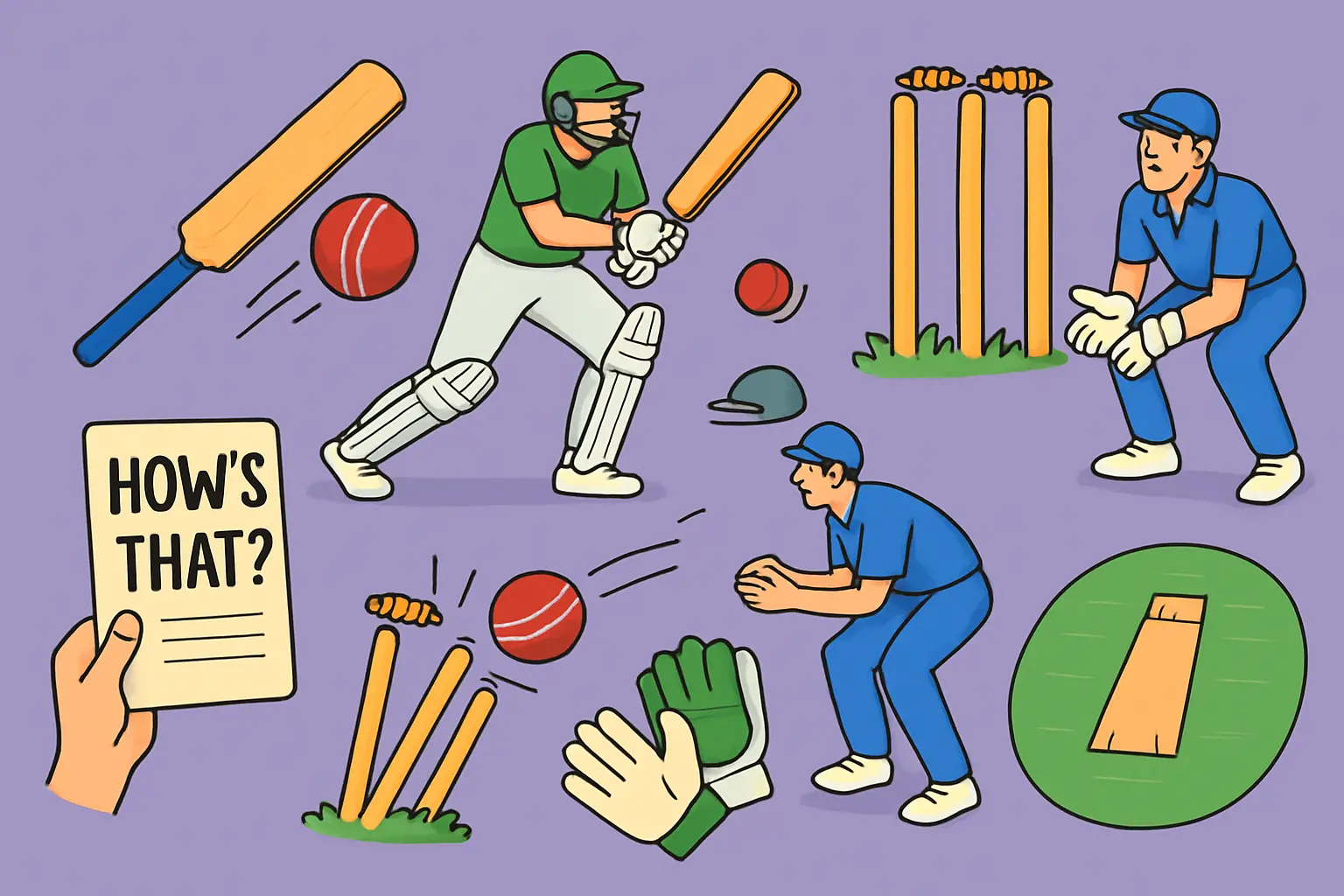
Appeal: Fielding side’s request for a decision. Expanded: Bowlers and fielders must appeal (“How’s that?”) to trigger an out verdict. Umpires can’t assume intent.
Arm ball: Off-spinner’s delivery that goes straight on. Expanded: Skids with seam upright; traps an over-committing batter LBW or bowled.
Around the wicket: Bowling from the opposite side of the stumps. Expanded: Changes angles, creates rough use, and targets pads.
B
Bails: Two small wooden pieces atop the stumps. Expanded: A wicket is broken when a bail is dislodged or stump struck.
Ball-tampering: Illegally altering the ball. Expanded: Contravenes the laws; penalties range from runs awarded to suspensions.
Bazball: Positive red-ball philosophy. Expanded: Aggressive intent with bat, ball, and field; prioritizes speed of play over draw safety.
Beamer: High waist-above full toss. Expanded: Dangerous and penalized; bowlers often warned or removed.
Blockhole: Area at the batter’s toes. Expanded: Yorkers aim here.
Bodyline: Bowling at the body with a packed leg-side field. Expanded: Historically infamous; modern laws restrict dangerous use.
Bowled: Ball hits stumps and dislodges bails. Expanded: Can deflect off bat or body.
Boundary: Rope or line marking the field’s edge. Expanded: Four if ball bounces before reaching; six if it clears on the full.
Bouncer: Short ball rising towards head. Expanded: Used to intimidate, test technique, and create mistakes.
C
Captain’s challenge: Team review via DRS. Expanded: Each side gets limited unsuccessful reviews.
Carrom ball: Finger-flicked delivery. Expanded: Deceptive dip and swerve; works well with subtle fields.
Carry: When a nick reaches the keeper. Expanded: Low bounce pitches lead to non-carries and frustration.
Chinaman: Outdated term for left-arm wrist-spin; prefer “left-arm wrist-spin.” Expanded: Modern usage avoids the old term.
Collapse: Quick cluster of wickets. Expanded: Momentum swings; smart teams stabilize with low-risk rotation.
Consolidation: Period of risk management post-wickets. Expanded: Trims dot balls, builds base for acceleration.
Cow corner: Deep leg boundary between midwicket and long-on. Expanded: Common T20 target.
D
Death overs: Final overs of an innings. Expanded: Yorkers, slower balls, and funky fields rule here.
Dead ball: Ball not in play. Expanded: Signaled when action stops for reasons like injury or sightscreen issues.
Declaration: Captain ends innings voluntarily. Expanded: A tactical gambit in multi-day cricket to chase a win.
Doosra: Off-spinner’s opposite-turner. Expanded: Must be legal action; used sparingly to surprise.
Dot ball: Delivery yielding no run. Expanded: In T20, dots are gold dust; dot pressure triggers loose shots.
DRS: Decision Review System. Expanded: Tech aids—ball-tracking, UltraEdge, Hot Spot—support umpire calls.
E
Economy rate: Runs per over conceded. Expanded: A key metric in white-ball roles.
Edge: Ball glances the bat’s side. Expanded: Caught behind is the default dismissal in seaming conditions.
Extra cover: Off-side field in front of point. Expanded: Great place for ring-fielders to choke scoring.
F
Feeder: Friendly pace or length; also used for ball feeder in practice. Expanded: In commentary, implies a bowler’s line is predictable.
Feilder’s choice: Informal phrase; real law covers how catches near boundary must be completed. Expanded: Balance, awareness, and footwork are essentials.
Fine leg: Leg-side boundary, fine angle. Expanded: Captures glances and errant hooks.
Follow-on: Forcing the opposition to bat again. Expanded: Relies on large first-innings lead.
Free hit: Post no ball “can’t be out” delivery (except run-out, etc.). Expanded: Tactical field adjusts accordingly.
G
Golden duck: Out first ball. Expanded: Brutal for openers; bounce back demands nerve.
Googly: Leggie’s wrong ’un. Expanded: Wrist and finger showings are disguises; batters read from hand or seam.
Green top: Grass-heavy pitch aiding seamers. Expanded: Bat first only if brave and well-padded with technique.
Gully: Catcher between slip and point. Expanded: Caters to cuts and thick edges.
H
Half-volley: Fuller length, easy to drive. Expanded: Mistimed half-volleys disappear through the covers.
Hat-trick: Three wickets in three balls. Expanded: Fielders crouch; crowd hushes; theatre ensues.
Heavy ball: Pace that feels faster than the speed gun shows. Expanded: Comes from late kick or skiddy release.
Helmet: Protective headgear. Expanded: Mandatory close-in and for short-ball threats.
Hit wicket: Batter dislodges bails with body/bat after ball delivered. Expanded: Back-foot slips or deep-crease scoops cause it.
I
Impact player: Substitute changing balance mid-game. Expanded: Swap batter/bowler for phase-specific roles.
In-ducker: Seam ball moving into the right-hander. Expanded: New ball terror when it late-swings.
Inside edge: Ball hits bat’s inner edge, often onto pads. Expanded: Saves LBW; can also lead to bowled.
J
Jaffa/peach: Perfect delivery. Expanded: Late nip, ideal length, top-of-off; batter beaten all ends up.
Juggling catch: Fielder bobbles but controls the ball without it touching the ground. Expanded: Must not step on/over boundary until the ball is released.
K
Knuckleball: Slower pace ball held on knuckles. Expanded: Dips late; best deployed sparingly at death.
L
Leading edge: Ball hits the bat’s front edge, flying to off side unintentionally. Expanded: Often from a mistimed flick against movement.
Leg byes: Runs off the body, not bat. Expanded: Allowed if a shot is attempted or the batter tries to avoid the ball.
Leg gully: Catcher on leg side behind square, close in. Expanded: Great position for strangling glances.
Leg slip: Close catcher on leg side near keeper. Expanded: Attacks batters who glance regularly.
Leg spin: Wrist spin turning away from a right-hander. Expanded: The art of drift + dip + turn.
Long-on/Long-off: Straight boundary riders. Expanded: Protect lofted drives.
M
Maiden over: No runs or extras in an over. Expanded: Pressure cookers in any format.
Mankad: Colloquial for non-striker run-out pre-release. Expanded: Legal; best prevented by staying in the crease.
Match-up: Specific batter-bowler plan. Expanded: Data-heavy; left-arm orthodox vs right-hand big hitter, for example.
Middle stump line: Target for bowlers aiming to hit top-of-off with movement. Expanded: The old coaching mantra endures.
Midwicket: Leg-side field in front of square. Expanded: Magnet for slog-sweeps.
N
Nail the yorker: Execution phrase for death overs. Expanded: Under pressure, practice lines win games.
NRR: Net run rate tiebreaker. Expanded: Influences tactics late in group stages.
Nightwatchman: Tailender protects a top-order batter near stumps. Expanded: Tactically conservative, psychologically sharp.
O
Obstruction: Batter deliberately impedes fielding side. Expanded: Rare; intent is key.
Off cutter: Seamer’s ball gripping and moving into the right-hander. Expanded: Useful on slow pitches.
Off spin: Finger spin turning into a right-hander. Expanded: Allied with arm ball, carrom, and drift tricks.
Off side: Batter’s bat-face side. Expanded: Covers, point, third—definitions pivot from this axis.
Out-swinger: Ball moving away from right-hander. Expanded: Tempts the drive, finds the edge.
P
Pair: Two ducks in a multi-day match. Expanded: A batter’s nightmare.
Paddle scoop: Fine deflection over keeper/short fine. Expanded: Uses pace, not power.
Par score: Expected total for conditions. Expanded: Informs chase tempo and resource planning.
Pie chucker: Slang for ordinary bowler. Expanded: Teasing banter; sometimes sticks even with success.
Powerplay: Fielding restrictions window. Expanded: Shapes both batting aggression and bowling discipline.
Q
Quick single: Risky run to rotate strike. Expanded: Best used to disrupt lengths.
Quadrant: Coaches split the field into zones. Expanded: Dictates field placements based on hitting arcs.
R
RPO: Runs per over. Expanded: Used for pacing a chase.
Reverse sweep: Sweeping to the off side from a right-hander’s stance. Expanded: Safer vs spin with practice.
Reverse swing: Late movement with older ball at pace. Expanded: Needs rough/smooth asymmetry and skill.
Review: DRS invocation. Expanded: Captain, keeper, and bowler decide within seconds.
Run-out: Dismissal before making the crease. Expanded: Fielding accuracy and composure decide it.
S
Scoop/ramp: Shot over keeper or short third. Expanded: High-reward if bowler misses yorker.
Second new ball: Fresh ball option in long format after a threshold of overs. Expanded: Re-energizes seamers; spinners can also benefit with bounce.
Sightscreen: White/black background for batter visibility. Expanded: Must stay still; movement triggers dead ball.
Silly point/short leg: Close-in catchers. Expanded: Specialists with helmet, shin pads, and courage.
Sitter: An easy catch. Expanded: Dropping one changes matches and psyches.
Skipper: Team captain. Expanded: Field settings, bowling changes, and declaration calls.
Slog: Hard, often cross-batted hit. Expanded: Pejorative once, now a necessary part of range hitting.
Soft hands: Gentle grip for edges landing short. Expanded: Essential in seaming conditions.
Split finger: Variation for slower ball grip (cousin to knuckleball). Expanded: Late drop deceives sloggers.
Sticky dog: Old slang for a tacky, damp pitch. Expanded: Ball grips; batting unforgiving.
Strike rate: Scoring rate for batters; balls per wicket for bowlers. Expanded: Modern metric king.
T
Tail: Lower-order batters. Expanded: Some tails wag and win matches; others fold quickly.
Tea: Session break in long format. Expanded: Captains plot micro-targets around intervals.
Third (formerly third man): Fine off-side boundary. Expanded: Protects edges and ramps.
Throwdown: Practice delivery from a coach. Expanded: Groove shots, simulate match-ups.
Tie: Scores level with innings complete. Expanded: Tie-breakers vary by format.
Ton: Hundred runs. Expanded: Milestones change field and bowler behavior.
Top edge: Ball hits the bat’s top edge, often skying. Expanded: Fielders circle under high balls with nerves humming.
U
Umpire’s call: Marginal DRS zone retaining on-field decision. Expanded: Reduces overturn noise.
Unplayable: Delivery virtually impossible to hit. Expanded: Context matters—pitch, match situation.
Uppercut: Slashed late cut over point/third. Expanded: Risky unless pace and width align.
V
V: V between mid-off and mid-on. Expanded: Classic straight driving channel; low risk if pitch true.
Variation: Change of pace, seam, or length. Expanded: The art of deception in white-ball spells.
W
Wagon wheel: Graphic charting scoring areas. Expanded: Reveals strengths, gaps, and plan adjustments.
Waft: Loose drive away from body. Expanded: A seamer’s best friend.
Weighted ball: Training aid to build speed/strength. Expanded: Used carefully under coach guidance.
Wide: Ball deemed out of reach to hit. Expanded: Stricter lines in T20; fine margins at death.
Wrong ’un: Another term for googly/wrist-spinner opposite-turner. Expanded: Dressed in disguise.
Wrist spin: Leg-spin craft. Expanded: Drift, dip, and revolution create magic.
X
X-factor: Player or substitution rule in leagues; also descriptor for game-changing skills. Expanded: Think finisher with a sixth gear.
Y
Yorker: Base-of-stump delivery. Expanded: Most effective with late tail or seam wobble.
Yard: Distance slang. Expanded: “Beat him in the air by a yard.”
Z
Zooter: Slang for a spinner’s skidder. Expanded: Goes on with the arm or holds straight.
Zing bails: LED-lit bails that flash when dislodged. Expanded: Aid for close-run-out adjudication.
Field Tactics Through the Lexicon — Real-World Scenarios
Powerplay squeeze in T20
- Objective: Two outside the circle demands in-ring precision. The captain parks a short third and short fine to stop the scoops, stacks off-side with point and cover for hard lengths outside off.
- Bowler’s brief: Hit top-of-off with cross-seam, slide in a surprise bouncer. Save the knuckleball for the batter’s premeditated swing.
- Batter’s response: Pierce the ring with hard square drives and dabs to third; loft straight only after reading length early.
Old ball in Tests with reverse swing looming
- Field: One slip, a leg gully, short midwicket, and a square leg catching for glances. Fine leg back. Mid-off tighter to cut singles.
- Plan: From around the wicket, tail the ball into the pads at high pace. For the set batter, hang one outside off, then step back in to trap LBW.
- Batter counter: Bat across the line at your peril. Play late, under the eyes. Soft hands and an off-stump guard keep you alive.
Spin strangle in middle overs of an ODI
- Field: Deep cover, long-off, long-on, deep midwicket, and deep square—five out. In-ring: short third and short fine leg.
- Plan: Off-spinner to right-handers: dart in at middle and leg, threaten stumps, bait the slog-sweep to the big side. Leg-spinner to left-handers: googly early, then stock leg-breaks once feet freeze.
- Batter counter: Sweep both sides to loosen fields; take singles early in over, target last ball with a calculated risk.
Death over calculus with NRR on the line
- Captain’s lever: Do you protect the boundary or hunt wickets? Against a hitter, wickets throttle scoring. Against a tail, ring infielders for singles but concede nothing straight.
- Bowler’s mix: Two yorkers, slower-ball bouncer, wide yorker, hard length into the pitch. Communicate the plan; fields must match the line.
- Batter’s 3-shot plan: Pre-decide options—scoop if fine up, slice over point if width, hack across to cow corner if the length is missed.
Multilingual Cricket Terms: Quick Reference (English–Hindi–Urdu)
Note: Transliteration varies by region; pronunciation hints included.
| English | Hindi | Urdu |
|---|---|---|
| Off side | Off side (ऑफ साइड, “off side”) | آف سائیڈ (off side) |
| Leg side | Leg side (लेग साइड) or On side (ऑन साइड) | لیک سائیڈ / آن سائیڈ |
| Slip | Slip (स्लिप) | سلپ |
| Gully | Gully (गली) | گلی |
| Point | Point (पॉइंट) | پوائنٹ |
| Midwicket | Midwicket (मिडविकेट) | مڈ وکٹ |
| Fine leg | Fine leg (फाइन लेग) | فائن لیک |
| Yorker | Yorker (यॉर्कर) | یارکر |
| Googly | Googly (गुगली) | گوگلی |
| Doosra | Doosra (दूसरा) | دوسرا |
| LBW | LBW (एलबीडब्ल्यू) | ایل بی ڈبلیو |
| Free hit | Free hit (फ्री हिट) | فری ہٹ |
| Powerplay | Powerplay (पावरप्ले) | پاور پلے |
| Wicketkeeper | Wicketkeeper (विकेटकीपर) | وکٹ کیپر |
| Umpire | Umpire (अंपायर) | امپائر |
| Review | Samiksha/Review (समिक्षा/रिव्यू) | ریویو |
Modern League Jargon — What Traditional Glossaries Miss
- Impact Player (IPL): Tactical sub who can be injected based on the toss result, target, or powerplay outcome. Captains often hold the trigger till the innings pivot.
- Strategic Timeout (IPL): Coaching and data infusion moments. Bowling sides reset fields for new match-ups; batting sides identify a bowler to attack when surge batters are set.
- Power Surge (BBL): Two overs with only two fielders outside the circle, called after the initial powerplay. Timing is art—call it when set batters face a weak fifth bowler, not when a new batter is sussing bounce.
- X-Factor Sub (BBL): A mid-innings swap to rescue poor early selections. Has reimagined the value of flexible all-rounders.
- The Hundred vocabulary: Five-ball sets, with a bowler allowed to deliver ten successive balls. Talk tracks emphasize “balls remaining” not “overs left,” changing endgame math.
Umpire Signals: Visual Memory Hooks
- No ball: Think “horizon”—arm flat like a horizon line.
- Wide: Think “airplane wings”—both arms spread.
- Six: Think “goal”—arms up like a football referee’s signal.
- Out: The classic finger; the stadium holds breath before it rises.
Score Sense: Reading Momentum Without a Scorebug
A trained eye can smell trouble or dominance:
- Dots clustering at one end while singles rotate at the other? Bowling side winning micro-battles but not the war.
- Wickets in clusters often follow maidens. Monitor the “dot-to-boundary” ratio; in T20, dot-to-four under 3 often means batters are on top.
- Spinners conceded 15 in the over after a wicket? Classic post-dismissal loose over—captain missed a field change, or bowler missed length hunting quick strikes.
Regional Nuances in Field Names and Commentary
In South Asia, “third man” is now widely “third,” acknowledging inclusive language trends. In Australia, shorthand rules commentary: “two out” means two boundary riders in the powerplay; “heavy leg-side field” often implies a leg gully lurking. In the UK, chatter tilts technical—“he’s fallen over himself” diagnoses a batter’s head falling across, not a trip. The underlying grammar is consistent; the accents and metaphors give it color.
Special Situations and Edge Cases
- Timed out: New batter fails to reach the crease in the allotted time. Rare, but on the books.
- Short run: Batter fails to make good their ground on a run; umpires reduce the total accordingly.
- Handling the ball: Now part of obstructing the field in the laws; batting gloves are part of the bat if still in contact with it.
- Boundary fielder control: A catch is legal if the fielder first contacts the ball from within the rope and releases it before any subsequent grounded contact beyond the rope. Mid-air juggling allowed; awareness of toes is everything.
Commentary Cues — What Phrases Usually Mean
- Top of off: The gold standard length; imagine a plumb line to off stump’s top.
- Scrambled seam: Bowler hides the shiny side; seam wobbles for unpredictable deviation.
- Drag on: Inside edge or bat-pad deflection onto stumps.
- Playing with soft hands: Absorbing pace to keep edges down.
- “One brings two”: A belief, not a law, but often prophetic—after a wicket, batters reset and vulnerability spikes.
The Captain’s Glossary — Decisions Shaped by Words
- Attacking fields: More catchers in front of the wicket; risk trade-off for wickets.
- Run-saving fields: Sweepers and straight riders; deny boundaries, concede singles.
- Bowling dry: Starving batters of runs to force rash shots.
- Choking one end: Your best bowler at one end, aggressive ring. From the other, an enforcer bowler hits bodies and lengths to harvest the error.
Umpire Etiquette and the Vocabulary of Spirit
- Walking: Batter leaves before the decision if certain of an edge. Not mandatory; debated endlessly.
- Spirit vs letter: Laws allow the non-striker run-out; “spirit” arguments are cultural, not legal. Modern consensus is tilting toward legality and responsibility at the non-striker’s end.
- Respecting signals: Don’t move sightscreens mid-run-up; don’t encroach dangerously at short leg without proper gear; captains manage their team’s tone.
Quick Tables for On-Field Reference
Table: Differences — Silly Point vs Short Leg
| Silly Point | Short Leg | |
|---|---|---|
| Side | Off side, very close | Leg side, very close |
| Ideal vs | Right-hander, off-spin | Pace into body and leg-spin |
| Hunts | Bat-pad to the off | Gloves and pad deflections |
Table: Scoring Abbreviations Snapshot
| Abbreviation | Meaning |
|---|---|
| SR (batting) | Runs per 100 balls |
| SR (bowling) | Balls per wicket |
| ER | Economy rate |
| BBI | Best Bowling in an Innings |
| NRR | Net Run Rate |
| RPO | Runs per over |
| DLS | Rain adjustment method |
| Ov | Overs |
| Md | Maidens |
| NB | No balls |
| WD | Wides |
Table: Off Side vs Leg Side Examples
| Category | Off Side | Leg Side |
|---|---|---|
| Shots | Cover drive, square cut, late cut | Flick, pull, slog-sweep, glance |
| Fielders | Slip, gully, point, cover, extra cover, third | Short leg, square leg, midwicket, fine leg, leg slip |
Cricket Terms for Beginners — A Mini-Glossary Within the Glossary
- Over: Six legal deliveries.
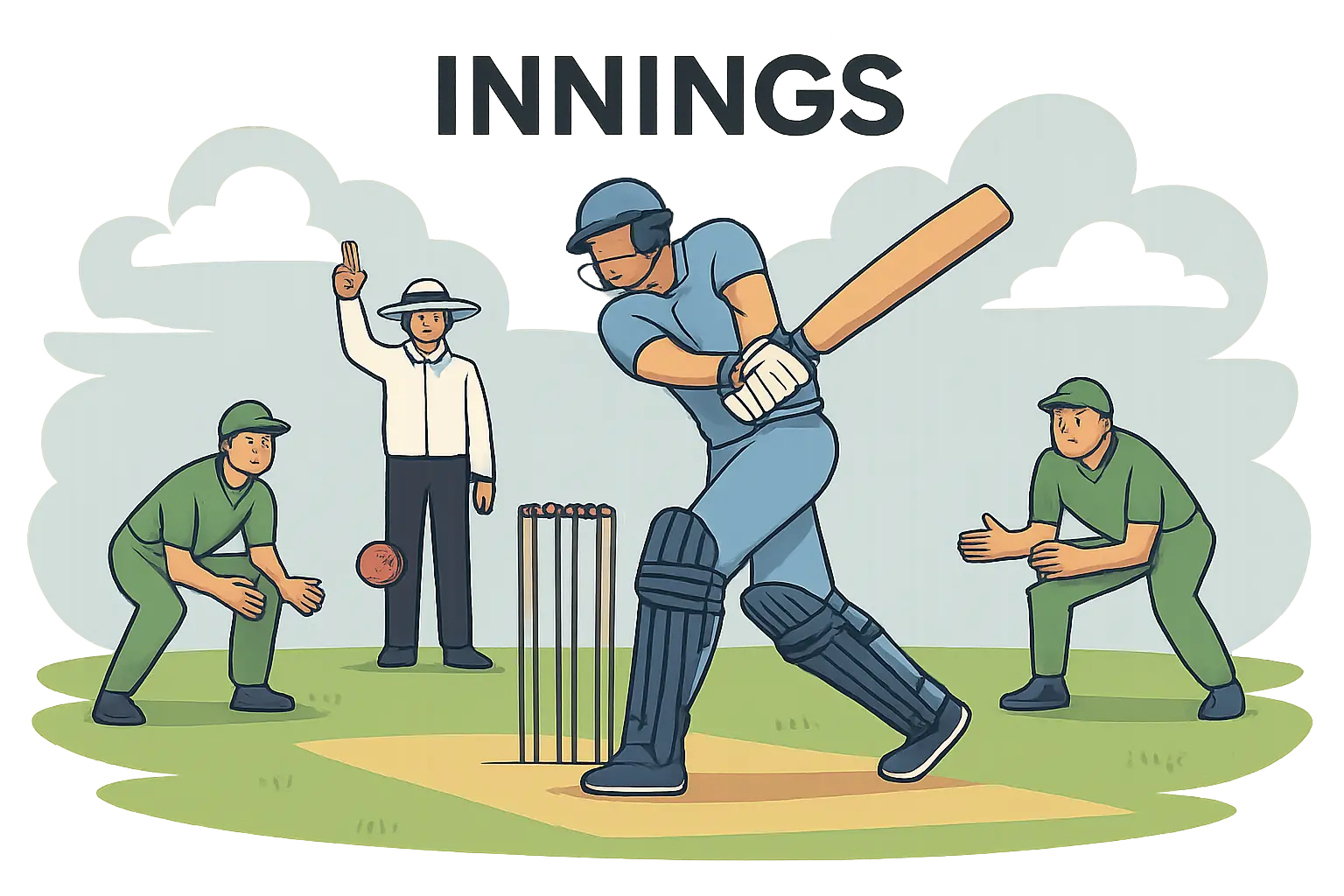
- Innings: A team’s turn to bat.
- Wicket: The stumps and bails; also a dismissal; also the pitch itself. Context reveals which—welcome to cricket.
- Pitch: The 22-yard strip where bowling occurs.
- Crease: Lines that define safe zones and no ball adjudication: popping crease, return crease, bowling crease.
- Stump: One of the three vertical posts.
- Keeper: Wicketkeeper, the team’s gloves specialist behind the stumps.
- All-rounder: Contributes significantly with bat and ball.
- Tailender: Lower-order specialist in bowling, weaker batter.
- Slip cordon: Cluster of close catchers behind the bat on off side.
- Session: Block of play in long-format cricket, separated by lunch and tea.
Strategy Words That Win Matches
- Windows: Phases to attack—final two overs of the powerplay, post-timeout lulls, after a wicket.
- Density: Fielders packed in scoring zones to deny angles.
- Lines and lengths: The two axes of control. Line = outside off, at the body, etc.; length = short, good, full.
- Change-ups: Slower balls, cutters, bouncers; change of angle around the wicket.
- Risk budget: Batting units plan a set number of high-risk shots per over; conditions adjust the budget.
The Feel of It — Where Language Meets Instinct
A proper cricket glossary doesn’t just define; it sings with the rhythm of the game. A seamer who “hits the splice” over and over forces mis-hits to midwicket. A leggie who earns the right to bowl the googly by spending three overs on a teasing stock ball is using the oldest kind of deception there is—patience. A finisher who eyes deep midwicket and long-on, then flips a knuckleball fine over short third, is reading the field as language: commas for pauses, exclamation points for sixes.
Cricket terms, at their core, are codes to communicate plans under pressure. “Two more dots, then the wide yorker.” “Extra cover up, bowl cutters into the pitch.” “One slip out, leg gully in, we hunt the glance.” The best teams speak this language fluently—tight, clear, purposeful.
Closing Perspective — Owning the Vocabulary, Owning the Game
Once you have the lexicon, cricket unspools with new clarity. You’ll hear the captain move “square leg a touch finer” and see why the ramp suddenly vanishes. You’ll recognize when a bowler’s “hard length into the wicket” makes a boundary look close but never quite reachable. You’ll grin when the commentator says, “Perfect top-of-off, the old story,” because you know the story—of angles and patience, of pressure and nerve.
Keep this cricket glossary handy. Use it to decode a Test chess match stretching deep into a fourth innings. Use it on a Friday night when a T20 chase turns manic and an impact player sprints in with a fresh blade. When someone at the ground mutters, “We’re one wicket away,” you’ll know what’s in the captain’s head: fields, variations, and a dozen small words that bend a match. That’s the language of cricket—living, evolving, and now firmly yours.