
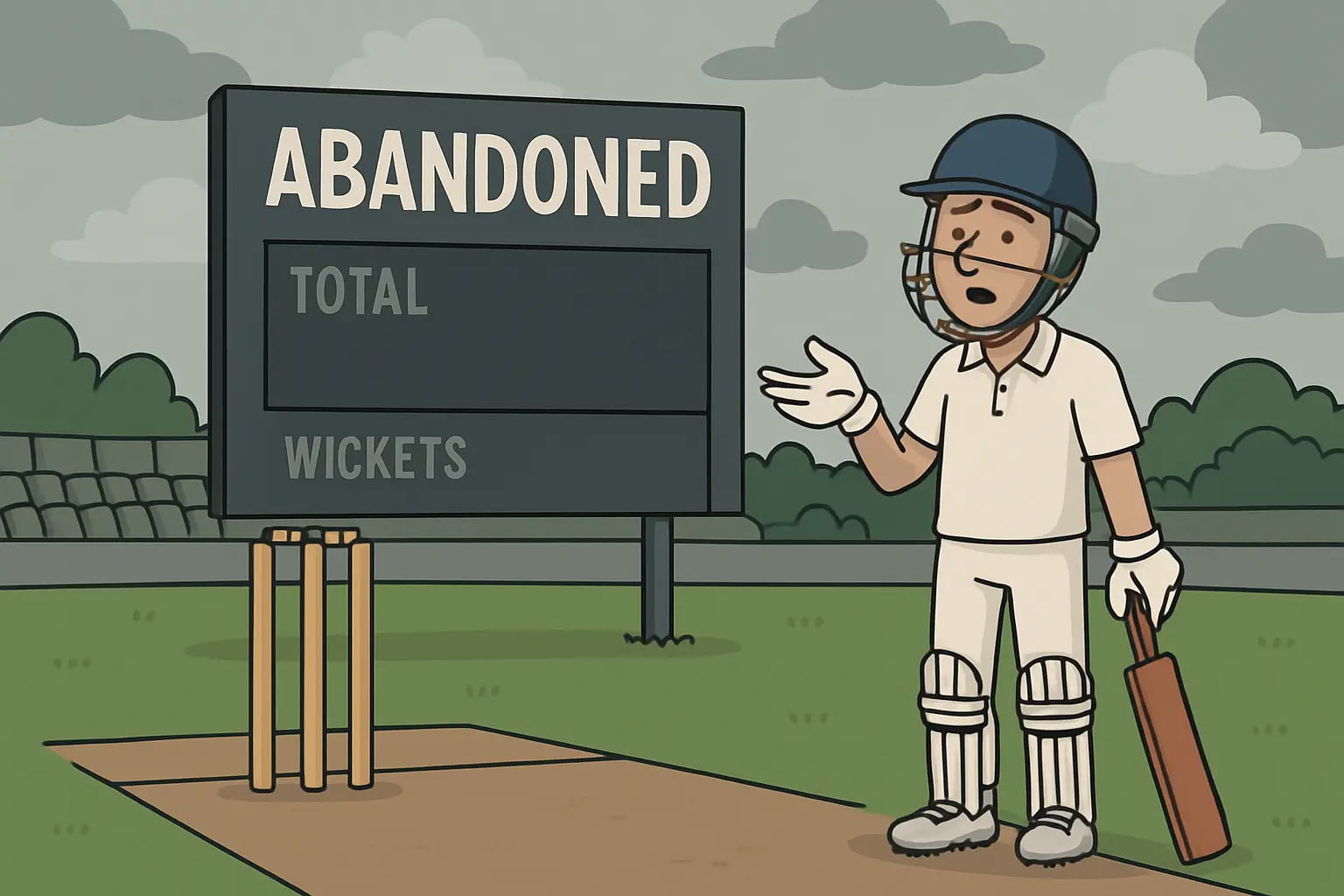
The loneliest sound in cricket isn’t the death rattle of a stump. It’s the heavy drone of a Super Sopper circling an outfield while spectators pull up hoods and a thousand phones search rain radars. I’ve stood on enough boundary lines as a reporter, watching umpires pick at damp turf with studded shoes, to know the moment when optimism dies. A match isn’t always “over” because a wicket falls or a run is scored. Sometimes, it’s over because the game itself becomes impossible to play.
Snippet Definition
Abandoned in cricket means the match is called off permanently before a result can be reached, usually due to unfit or unsafe conditions such as rain, a wet outfield, bad light, or other disruptions. In limited-overs cricket, abandoned usually leads to “no result.” Difference in one line: abandoned describes the decision to stop; no result is the final outcome recorded.
Why this matters—beyond one ruined evening
Abandonment is not just a wet-weather footnote. It shapes league tables, tournament strategies, player statistics, fantasy points, ticket refunds, even how broadcasters fill air time. It is not a synonym for no result, cancelled, or suspended. Each term carries specific consequences under the Laws of Cricket and competition playing conditions. If you care about points, overs thresholds, DLS triggers, reserve days, or whether your wicketkeeper gets a cap when no ball is bowled, the distinctions are everything.
Abandoned: the clean definition
- What it means: The umpires decide that play cannot continue and will not resume. The match is terminated.
- When it’s used: At any time—before the toss, after the toss but without a ball bowled, during play, or during an interval—if conditions are unsafe or unfit or if an external event prevents continuation.
- Typical causes: Rain and a saturated outfield; dangerous pitch; bad light; floodlight failure; crowd trouble or security incidents; extreme heat or smoke; acts of God that make play unreasonable or unsafe.
- What is recorded: In limited-overs cricket, abandonment generally leads to the official result line “No result” unless a Duckworth–Lewis–Stern (DLS) decision is possible. In Tests, an abandoned Test is recorded as such; if substantial time is lost without a finish, the outcome may be a draw rather than an “abandoned” match, but in rare cases a Test has been abandoned entirely due to conditions.
The vocabulary that confuses everyone (and the one-page decoder)
Broadcasters and scorecards sling around a family of terms—abandoned, no result, cancelled, forfeited, suspended, draw, tie. They aren’t interchangeable. Here’s the crisp breakdown you can keep in your back pocket.
Comparison table: Result terms and what they actually mean
| Term | What it means | When it’s used | Consequences |
|---|---|---|---|
| Abandoned | Match is called off permanently before conclusion | Unsafe/unfit conditions or external events; can be pre- or post-toss | In limited-overs, usually ends as No result unless DLS yields a winner; points split in leagues |
| No result | No legal way to determine a winner due to insufficient overs | Limited-overs only; often after rain interruptions | Each team typically gets one point in leagues; NRR normally unaffected |
| Cancelled | Match never starts and is struck off, often before toss | Venue shutdown, scheduling disruption, or pre-match decision | Not counted in statistics; usually full ticket refund |
| Suspended | Play is halted with intent to resume | Rain delay, bad light, floodlight outage being fixed | Not a result; if resumption impossible by cut-off time, match becomes abandoned |
| Forfeited | A team refuses to play or cannot take the field; opposition awarded game | Extremely rare; disciplinary or protest scenarios | Opposition wins; points and NRR consequences per playing conditions |
| Draw | Neither team can complete the win in allotted time | Multi-day/Test cricket only | No winner; series points allocated as per series rules |
| Tie | Scores level at the conclusion of a match | All formats | In limited-overs, Super Over may decide if conditions/playing terms allow; otherwise tie stands |
Simple takeaway
- Abandoned is the decision.
- No result is the record that appears for limited-overs when you can’t get a legal winner.
- Cancelled is pre-match; suspended is mid-match.
- Forfeited awards a win to the other side.
- Draw and tie are actual outcomes, not interruptions.
Format rules that decide whether you get a result
Here’s where the rubber meets the road. The difference between a scoreline and a soggy shrug often comes down to minimum overs and DLS.
Minimum overs and result thresholds by format
| Format | Minimum overs required for a result | Can DLS decide a winner if play stops? | Notes |
|---|---|---|---|
| T20 | 5 overs per side (in most professional competitions) | Yes, once 5 overs are bowled in the second innings | Knockouts/finals often have reserve-day provisions; Super Overs possible if tie and conditions permit |
| ODI | 20 overs per side (international standard) | Yes, once 20 overs are bowled in the second innings | Domestic one-day leagues may use different thresholds; always check local rules |
| Test | Not overs-limited | DLS not used in Tests | Light, rain, or pitch issues can suspend or, rarely, abandon play; outcomes are win, loss, draw, or abandoned in exceptional cases |
Two points that trip people up
- The second-innings threshold matters most: In T20 and ODI cricket, a DLS result can only be declared once the chasing side has faced at least the minimum overs required. If the second innings hasn’t reached that mark and play can’t resume, you cannot conjure a winner. That’s your classic “No result.”
- Reserve days are not universal: High-profile finals and some knockouts have reserve days. Group matches in most leagues and many ICC events do not. If your final washes out and the reserve day is used but still no play, rules determine whether the trophy is shared or awarded based on seeding or earlier performance.
DLS rules explained simply—only as far as abandonment goes
DLS exists to set fair targets when overs are lost. Think of it as a calculator that measures how much batting resource each team has had or will have, blending overs remaining and wickets in hand to produce par scores.
- Before abandonment: If rain hits during a chase, umpires wait to see whether enough time remains to bowl the minimum overs. Ground staff race; officials recalculate the target when a restart time is known.
- At the moment of no return: When the latest permissible restart time passes, umpires abandon the match. If, by then, the chasing team has faced the minimum overs, DLS can decide the result on the spot by comparing the current score to the par score. If not, it’s “No result.”
- Can DLS apply after the umpires call it off? Yes—but only if the second innings has reached the overs threshold. The match may be declared with a DLS result even though no more balls will be bowled.
- Super Over and DLS: DLS doesn’t decide tied matches; a Super Over does—if the playing conditions and the weather allow. If conditions prevent a Super Over in a group game, the tie stands. In a knockout or final, the reserve-day rules kick in. If a Super Over can’t be played even across the reserve options, the tournament regulations dictate the fallback (often shared title or higher-ranked team advancing).
Why umpires abandon a match—reasons you don’t always see on TV
Every reason for abandonment flows from one principle in the Laws: the umpires must not allow play in conditions that are dangerous or unreasonable. That’s not a vague idea; it’s grounded in practice and equipment, and it’s more conservative than most fans appreciate.
- Rain and wet outfield: Even after the rain stops, two things can keep cricket from restarting—surface water and subsurface saturation. The top looks dry, but the spongy turf yields underfoot, making sliding and sudden changes of direction hazardous. Fielders can twist ankles or worse; bowlers can lose footing at delivery. Umpires test with studded shoes, checking whether a heel leaves standing water. Ground staff use Super Soppers to lift moisture and rope the outfield to draw out water. If the bowlers’ run-ups remain unsafe, the umpires won’t resume, even in bright sunshine. This is why you sometimes see a match abandoned when the sky is blue.
- Bad light: Umpires carry a light meter to establish a benchmark for “acceptable” light early in the day. If levels fall beneath that benchmark and visibility is unsafe—think fast bowling at the body, high catches skied against a dark background—play is suspended. In limited-overs, the batting side’s option to continue is not offered; it’s purely a safety call. If the light never improves before the cut-off, the match is abandoned.
- Dangerous pitch: Cricket requires a predictable enough surface to be safe. Extreme variable bounce, delivery foot-holes creating ridges, or crumbling patches that send the ball at head height from a length can lead to an abandonment. A famous instance involved a Test curtailed after just a fraction of a session because the surface was judged unfit; an ODI at a major venue once met the same fate with balls rearing alarmingly from short of a length. These are ultra-rare but serve as strong precedent.
- Floodlight failure: Night games depend on uniform lighting standards. If one tower fails and creates uneven illumination, catching and batting can become unsafe. The crew will try to restore power; if the fault can’t be fixed before the time window closes, the match is abandoned.
- Crowd trouble and security: When objects are thrown, fences are breached, or a serious security incident unfolds, the umpires and match referee, in consultation with police and tournament officials, may remove players and ultimately abandon the game. In some regulations, a team can be awarded a forfeited win if the other side’s supporters or actions cause the stoppage; in others, it is declared abandoned or no result. The specific sanction depends on the competition rules and the report of the match referee.
- Other extraordinary reasons: Toxic smoke from nearby fires, extreme heat flags, earthquakes, or structural damage at a venue can trigger abandonment. Again, safety first, and the Laws empower officials to stop play immediately and permanently.
Who actually decides to abandon a cricket match?
- The umpires are the guardians of fitness for play. Under the Laws, they alone determine whether conditions are safe and reasonable. You’ll often see them conferring with head ground staff, inspecting run-ups, and referencing their light meter. They set inspection times and issue updates through the fourth umpire and the stadium announcer.
- The match referee oversees adherence to playing conditions, timings, code of conduct, and reports, and will be part of conversations in unusual circumstances—dangerous pitches, crowd trouble, security incidents. But the final call on whether it is safe to play rests with the on-field umpires.
- The process: Inspections are announced publicly; if conditions improve, a revised start/restart time and overs reduction are communicated. Every competition has a “latest restart time” for a five-over game in T20 or a twenty-over chase in ODI. Pass that point without acceptable conditions and the umpires will abandon the match.
Abandoned vs no result in action—how it appears on a scorecard
- Abandoned without a ball bowled: Rain from the get-go, no toss, ground never fit. Result line will say exactly that. No caps, no statistics, points split where relevant.
- Toss happened but no ball bowled: Still appears as “match abandoned” or “no result” depending on competition; the toss winner may be listed on scorecards. Players named in the XI receive a cap/appearance. No batting/bowling stats, obviously.
- Overs bowled but no threshold reached: Umpires abandon the match after waiting to the final window; the result is “No result.” All statistics accumulated until stoppage count (runs, wickets, economy, strike rates).
- Threshold reached but no further play possible: DLS compares the chasing team’s score to the par score at the last completed over. If above par, chasing team wins; if below, fielding team wins. Result line may read “Team X won by DLS.” You will sometimes hear “abandoned” used in commentary, but the official outcome is a completed match with a DLS decision.
Minimum overs detail that fans argue about (so you don’t have to)
- T20: You need five overs in the second innings to get a result. If it’s a knockout and five overs cannot be played, you go to a reserve day if one exists. A Super Over requires a completed tied game; if you never reach the minimum overs, there’s no Super Over to play.
- ODI: You need twenty overs in the second innings for a result. Again, there are oddities in domestic one-day competitions—some require fewer overs—so if you’re following a local league, check the playing conditions. In internationals and global tournaments, twenty is the rule of thumb.
- Tests: There is no minimum for a result. The game ebbs and flows around stoppages; umpires suspend and resume. An entire Test can be abandoned for safety reasons, but far more common is a draw due to time lost.
Reserve days in big tournaments—what you should realistically expect
- Finals almost always have a reserve day: The schedule expects that a showpiece match might need a second bite. If the match begins on the scheduled day but is unfinished, it can carry over with all the original conditions applying—same playing XIs, same target if the first innings is complete, and DLS managing interruptions across both days.
- Knockouts vary: Some semifinals have reserve days; others do not. Tournament regulations often specify that in case of washouts without play, the higher-ranked team from the group stage advances. If there is partial play and thresholds are reached, DLS can determine a winner on either day.
- Group stages rarely have reserve days: So abandonment usually equals no result. That’s where title races turn—when one team collects a free point and another loses momentum to weather.
Points for abandoned matches in leagues and World Cups
Points systems are remarkably consistent at the elite level:
- Win: 2 points
- Tie or No result: 1 point each
- Loss: 0 points
Applications you care about:
- IPL: An abandoned or no-result fixture earns one point apiece; net run rate (NRR) is unaffected when no result is recorded. Rain-affected DLS wins and losses will affect NRR differently depending on margin; only completed matches feed NRR calculations.
- BBL and PSL: One point each for no result is standard; some leagues have bonus-point innovations, but those don’t apply when the match is abandoned without a result.
- World Cup group stages: No result equals one point for each side. That can be pivotal in qualification tables.
- Net Run Rate nuance: A true “No result” does not change NRR. If a DLS result is declared, that completed match does impact NRR, because it’s a result with recognized overs and margins.
Money talk—ticket refunds when a match is abandoned
Refund policies vary by tournament and venue, but a few consistent rules appear across the cricket world:
- If no ball is bowled at all: Most organizers offer a full refund of the face value of the ticket. Hospitality and booking fees may be treated differently.
- If play occurs but not enough for a result: Policies split here. Some leagues give a full or partial refund if fewer than a set number of overs are bowled in the entire match. Others declare “event delivered” as soon as the first ball is bowled and do not refund. Read the fine print on your ticket and the FAQ on the event website.
- Reserve day caveat: For matches with a reserve day, your original ticket usually grants access for both days if play is carried over. If you cannot attend the reserve day, refund eligibility depends on terms and conditions.
Fantasy, betting, and the abandonment headache
The sporting outcome is one thing; what your app or bookmaker does is another.
Fantasy platforms
- If no ball is bowled: Most fantasy platforms cancel the contest and refund entry fees.
- If play starts but ends in No result: Many platforms void the contest, refunding entries. A few will allocate points for what occurred, but not declare winners outside of head-to-head formats; check the rules for your specific contest.
- If DLS declares a winner: Points stand, because the match is officially completed. Late adjustments can occur if statistical providers reconcile score events after abandonment.
- Super Over: Some fantasy games don’t count Super Over stats; check the scoring rules.
Betting markets
- Match winner bets: If the match is abandoned and no official result is declared, most bookmakers void match winner bets and return stakes. If DLS declares a winner, those bets are settled normally.
- Player props: If markets require a minimum number of overs and the match is abandoned before that, bets are usually void. If the props are already determined before abandonment (e.g., first over boundaries), they often stand.
- Ties and Super Overs: If rules specify a Super Over and it isn’t played, some markets settle as a tie; others as void. Read the market rules; they differ more than fans think.
Timing nuances that matter more than you expect
- Match abandoned before toss: Not an official match. No caps or appearances, and it’s generally recorded as “cancelled” or “match abandoned without a ball bowled.” In many competitions this still triggers shared points, but in some domestic fixtures cancellation means rescheduling instead.
- After toss, no ball bowled: The game counts in career tallies for the named XIs. You’ll see players credited with an appearance even though nothing happened. Result is “No result” for limited-overs or “Match abandoned” in Tests; points are shared in leagues.
- Do stats count? Yes, if a ball is bowled, every legitimate ball and its outcomes are etched into career databases, even if you end up with “No result.” Bowlers can pick five-fors in a match that never concludes. Batsmen can bag career-bests and still share points. That’s part of cricket’s odd charm.
- Umpire signals when abandoning: There’s no specific arm signal for “we’re abandoning the match.” The decision is announced to captains and the scorers, then to spectators via the fourth umpire and public address. On TV, you’ll see the umpires remove the bails and walk off together, but that’s a generic end-of-play action.
Why a match might be abandoned even when it’s not raining
This is the scenario that bothers paying customers the most. Three reasons dominate:
- Wet outfield lag: Drainage isn’t magic. Cricket needs lateral movement—diving stops, sliding saves, bowlers thundering in. An outfield that is fine for a Sunday jog can be treacherous for elite sport. If the umpires’ studs squelch, it doesn’t matter how blue the sky is.
- Run-up safety: Bowlers are at the edge of traction, especially quicks. One slip at the crease can wreck a knee. Grounds sometimes place blankets on run-ups or bring in extra sand; if that compromises footing or fairness, play won’t resume.
- Light levels: Sunsets, cloud banks, and the alternating extremes under mixed lighting can create visibility that changes ball to ball. The light meter’s benchmark determined earlier in the day becomes the test. If the light is beneath that line, play will not restart, even if rain has ceased.
The procedure when conditions turn: a quick walkthrough from the rope
- Stop and cover: Umpires call “Time,” ground staff unfurl covers for the square and run-ups. If forecast suggests a quick passing shower, inspections are scheduled in tight intervals; otherwise, a longer wait.
- Rope and roll: Once rain ceases, the first task is water clearance. The Super Sopper patrols the worst patches, ropes are dragged around the outfield’s circumference to draw water to the boundary, and sponges work problem zones.
- Umpires test: Stud checks, balls dropped to read bounce, a walk across run-ups, consultation with team physios if needed. The light meter reading is compared with the established benchmark.
- Communicate: The fourth umpire tells broadcasters and stadium announcers the earliest possible restart and the reduced overs if any. The DLS par chart gets recalculated behind the scenes.
- Cut-off and decision: As the final restart window approaches, urgency spikes. It’s common to see two-minute sprints by ground staff to peel back covers. If the clock beats them, the umpires gather both captains and call it off.
Suspended vs abandoned—don’t be misled by TV graphics
- Suspended: Temporary. Rain delay, bad light improving, floodlights being fixed. Scorecard remains open; overs can be recalculated; players wait in dressing rooms.
- Abandoned: Permanent. No more cricket today, and none later, unless a reserve day is built in and invoked. In a multi-day match, play can be suspended for a day and then continue; that is not abandonment.
Forfeited vs abandoned—when a team won’t play
This is about intent and responsibility.
- Forfeited: A team refuses to play or cannot take the field in time. The other team is awarded the match. In Tests, a team may even forfeit an innings strategically (a rare and controversial play). For limited-overs fixtures, refusal to resume after an umpire’s lawful instruction can lead to a forfeit.
- Abandoned: Nobody is being punished; conditions make play impossible or unsafe. Both teams emerge with a shared point in most structures.
The Super Over question: what if a match is tied and then abandoned?
- Group stages and leagues: If a competition mandates a Super Over to break ties, that’s played if conditions allow. If not, the tie stands and points are shared. A few leagues have bespoke tie-breakers (most boundaries, head-to-head), but many have moved away from those.
- Knockouts and finals: If the match is tied and a Super Over can’t be played, the reserve day is used where available. If no play is possible even then, tournament conditions specify the fallback—shared trophy or advancement based on group ranking.
Localized clarity: quick Hindi reference
- Abandoned meaning in cricket in Hindi: मैच रद्द/मैच परित्यक्त (मैच जारी रखने की स्थिति न होने पर स्थायी रूप से रोक दिया गया)
- No result meaning in Hindi: कोई परिणाम नहीं (ओवरों की कमी या नियमों के कारण विजेता तय न हो सका)
- DLS meaning in Hindi: डकवर्थ–लुईस–स्टर्न पद्धति; बारिश या ओवर कम होने पर लक्ष्य समायोजित करने की गणना प्रणाली
- IPL match rained off meaning: बारिश से मैच नहीं हो पाया/रद्द; दोनों टीमों को एक-एक अंक
What happens to streaming and “live” status when a match is abandoned?
Broadcasters will display “Match abandoned” or “No result” on their score bugs. On streaming platforms, the live tile may linger for a few minutes while the production team closes the feed. The official match center on league or ICC websites updates first; social channels (especially match-day Twitter updates) are usually quickest with reasons: wet outfield, bad light, unsafe pitch, or crowd issue.
Examples and notable cases that shaped how we think about abandonment
- Dangerous Test pitch cut short early on: A hard, underprepared surface made batting dangerous at a legendary venue. After short-lived attempts with batters taking blows, the umpires abandoned the match, prompting a global conversation about pitch standards and pre-match testing protocols.
- ODI stopped for a treacherous surface: At a historic ground, the ball took off from a length, batters fended at chest-high deliveries, and the umpires stepped in. The match was abandoned and the board sanctioned the venue with future restrictions until remedial measures were proven.
- Floodlight failure leaving half the field in shadow: A high-octane T20 night, one tower failed following a power surge. Backup generators couldn’t stabilize voltage. After repeated delays and inspection sprints, the latest restart time arrived with one quadrant still dull. Match abandoned, points split.
- Crowd trouble overshadowing play: A marquee fixture saw bottles and objects thrown after contentious decisions. Players were led off by officials. Attempts to resume under empty-stand conditions were deemed unsafe; the game was abandoned and disciplinary measures followed.
Behind the scenes: how ground staff fight the clock
Ask any groundsman and they’ll tell you: water behaves like a stubborn guest. The best crews blend experience with tools:
- Super Sopper basics: Think of it as a giant lint roller for outfields. The drum presses down, absorbing water into a holding tank. It works brilliantly on pooled patches but is limited by saturated soil below the surface.
- Roping the outfield: A thick rope is dragged by a line of staff around the field’s boundary, coaxing surface water outward. It looks theatrical; it’s surprisingly effective.
- Hot air blowers and covers: Run-ups and pitch surrounds are pampered with heat-blowers to dry clay and prevent heaving. Modern square covers interlock, creating a tent to shield not just the pitch but the run-ups and a “halo” of turf.
- Judging the run-ups: This is often the deal-breaker. If the landing area for the front foot remains greasy, even heroic sopping won’t save the game. Umpires often spend more time here than anywhere else.
Statistics, caps, and the fine print that decide careers
- Caps/appearances: If the toss has taken place and XIs are named, players receive an appearance credit, even if no ball is bowled. That’s why you’ll occasionally see a player’s debut listed on a day when nobody faced a delivery.
- Career stats during no result: Every ball that happened is immortal. You can take a hat-trick in a match that’s later washed away. It won’t create a winner, but it counts for you.
- Duckworth–Lewis–Stern records: DLS wins and losses live in the same statistical universe as any other result. Analysts track how teams fare under DLS because it hints at middle-over tempo and resource management under pressure.
Abandoned after the toss but before play—what it really means
This grey zone confuses fans more than any other. Here’s how to think about it:
- It is an official match for those named in the XI. The toss is a formal start marker in cricket management systems.
- Career entries for captains and players appear even though the ball-by-ball is empty.
- Result-wise, in limited-overs it will be logged as “No result,” in Test cricket as “Match abandoned.” For points and prize money, it’s treated the same as any other abandonment.
Crowd announcements and the etiquette of disappointment
The best match officials explain decisions. A good announcement includes:
- The reason (wet outfield; unsafe run-ups; bad light; floodlight fault; security issue)
- The cut-off time that forced the call
- Refund policy reminder and where to find details
- Thanks to spectators for patience
If you hear only “Match abandoned due to weather,” it’s often because the specifics are sensitive (e.g., security assessments) or the officials are racing the schedule of the next day.
Abandoned vs cancelled—one last, vital distinction
- Cancelled is administrative: The match is struck from the schedule before it even takes shape—venue issues, travel blockages, or pre-game safety concerns. It never happened in the eyes of statisticians.
- Abandoned acknowledges a match-day event: Tickets were scanned, teams warmed up, sometimes the toss occurred. Then the elements or events intervened. It happened—until it couldn’t.
FAQ—clear, quick answers to the questions fans ask most
- What is an abandoned match in cricket? A match called off permanently before a result is possible, typically due to unsafe/unfit conditions. In limited-overs, it usually ends as “No result”; in Tests, it may be an abandonment or a draw depending on circumstances.
- What is the difference between abandoned and no result? Abandoned is the decision to stop permanently. No result is the limited-overs outcome when a legal result can’t be reached due to insufficient overs.
- How many overs are needed for a result in T20 and ODI? T20 needs 5 overs in the second innings; ODI needs 20. Domestic exceptions exist; international standards follow those numbers.
- Can a Test match be abandoned? What happens then? Yes, in exceptional cases like a dangerous pitch or security issue. It is recorded as abandoned. Far more commonly, lost time leads to a draw.
- Who decides to abandon a cricket match? The on-field umpires, often in consultation with the match referee for unusual situations. The umpires alone judge fitness for play under the Laws.
- Why is a match abandoned even when it’s not raining? Because the outfield, run-ups, or light remain unsafe. Safety, not rainfall, decides the call.
- What is the role of DLS when a match is abandoned? If the second innings has reached the minimum overs, DLS can decide a winner at the moment of abandonment by comparing the current score to par.
- Do player stats count if a match is abandoned? If a ball was bowled, all stats count. If no ball was bowled but the toss occurred, players in the XI receive an appearance but no batting/bowling stats.
- How many points do teams get for an abandoned match in IPL/World Cup? Typically one point each for no result or abandoned group matches. Wins are worth two points.
- Do fans get ticket refunds if a match is abandoned? Policies vary. Commonly, full refunds occur if no ball is bowled; partial or no refunds if some play happened. Check the ticket T&Cs.
- What is the difference between cancelled and abandoned? Cancelled is pre-game and administrative; abandoned is a match-day termination due to conditions or events.
- What happens if a final is abandoned? Is there a reserve day? Most finals have a reserve day; the match can resume under the same conditions. If no play is possible across both days, tournament rules decide—shared trophy or award based on prior ranking.
- Can there be a Super Over if the match is abandoned? Only if a tied, completed match exists and conditions allow. If you never reach the overs threshold or conditions prevent a Super Over, the tie stands or reserve-day rules apply.
- What does “abandoned without a ball bowled” mean? No deliveries were bowled. If the toss occurred, appearances count; otherwise, it’s treated as a cancellation for statistics.
- Is an abandoned match considered official? If the toss took place and XIs were named, it counts as an official appearance even without play. If not, it’s not part of player records.
- Why is bad light a reason to abandon play? Because it makes batting and catching unsafe at elite speeds. Umpires use a light meter to ensure consistent safety standards.
- Can crowd trouble cause a match to be abandoned? Yes. If safety can’t be guaranteed, the game is abandoned. Sanctions depend on the competition’s regulations and the match referee’s report.
- What’s the umpire signal/procedure for abandonment? No special hand signal; the decision is communicated to captains, scorers, broadcasters, and spectators. The fourth umpire typically delivers the public message.
- What happens if the toss took place but no balls were bowled? The match is recorded as abandoned/no result. Players named in the XI receive an appearance credit; no batting or bowling stats are logged.
Strategy and selection implications—how teams plan around rain and risk
Smart teams don’t wait for clouds to make decisions. They game out scenarios at the toss and during innings with an eye on DLS and abandonment windows:
- Bat-first bias in drizzle: Captains often bat first when drizzle threatens because a result becomes possible only if the second innings reaches its threshold. Put runs up, then hope the window closes early with your opponents short of par.
- Bowling changes before cut-offs: If you’re fielding and rain is marching toward the ground, captains rush through overs with part-time bowlers to get beyond the threshold that activates DLS. That way a later abandonment might favor them.
- Batting tempo: Chasing sides accelerate early when clouds hover because DLS par curves are steeper with more wickets in hand. Teams hoard wickets but not to the point of getting stuck behind par at the next stoppage.
- Field placements and injury aversion: On slippery outfields, coaches instruct boundary riders not to dive unless it’s match-critical. Losing a player to a torn groin in an abandoned match is a special kind of regret.
Media, communication, and the fan experience
As someone who’s loitered in press boxes during six-hour rain watches, I’ll let you in on a trick: the best signal of an impending abandonment isn’t the scoreboard or the announcer. It’s the collective body language of the ground staff. When they stop hustling and start chatting, when the Sopper parks with its hatch open, the decision is minutes away. Umpires still follow procedure—inspect, consult, announce—but the vibe turns. As a fan, watch the run-ups first, the square second, and the corners that sit in shade third; those three zones decide more restarts than the clouds themselves.
Edge cases and curios that still come up in reader mail
- Can a team refuse to play in bad light if the umpires think it’s okay? In limited-overs, no—the umpires alone decide fitness. In Tests, the batting side can be offered the light, but the Law’s core is safety adjudicated by umpires.
- Can an abandoned match be replayed? In league schedules with tight calendars, almost never. In ICC tournaments with reserve days built in for knockouts and finals, yes—continued next day, not replayed from scratch unless no ball was bowled at all.
- What if the first innings never finishes? In limited-overs, if the first innings can’t be completed and there’s no way to create a valid second-innings chase within the window, it’s “No result.” DLS cannot craft a winner out of a partial first innings alone.
- Do abandoned matches count for over-rate penalties? Over rates are calculated using playing time. If the match is abandoned early, penalties rarely apply; but slow-play sanctions from before the abandonment can still be enforced if stipulated in the playing conditions.
A simple flow for your brain during rain delays
- Has the second innings started? If no: long path to a result; most likely no result if time is tight.
- If yes, how many overs completed? T20 needs 5, ODI needs 20. If you’re beyond that and rain returns, DLS can crown a winner.
- Is there a reserve day? If it’s a group game: probably not. If it’s a final: almost certainly yes.
- Is the outfield the issue despite clear skies? Expect abandonment; dry skies don’t fix saturated soil in time once the latest restart clock is ticking.
Broad truths to leave the ground with
- Abandoned is the umbrella word for the decision; no result is the scoreline you’ll usually see in white-ball cricket.
- Overs thresholds are the heartbeat of rain-affected cricket: 5 for T20, 20 for ODI.
- DLS is your friend when the chase has crossed that threshold; without it, nobody wins.
- Umpires own the fitness-of-play decision. Light meters and stud checks aren’t theater; they’re player-safety tools.
- Points for abandoned matches in most top leagues and global tournaments are shared. Net run rate only moves when a completed result exists.
- Ticket, fantasy, and betting outcomes depend on platform-specific rules—know them before the clouds roll in.
Conclusion: The art of knowing when cricket cannot be cricket
Cricket lives in the open air. That romance has a cost. Abandonment is not defeatism; it is respect for a game that demands a safe, fair contest over four precise dimensions: bat, ball, pitch, and light. Understanding abandoned versus no result versus cancelled isn’t pedantry. It’s fluency in a language that decides titles, careers, and the tenor of nights that end with empty seats and puddles. The next time the ground staff parks the Sopper and the umpires meet at mid-off, you’ll know what the decision means—on the scoreboard, in the table, in your fantasy app, and in the record books that tell cricket’s long, weathered story.