
Answer in one line
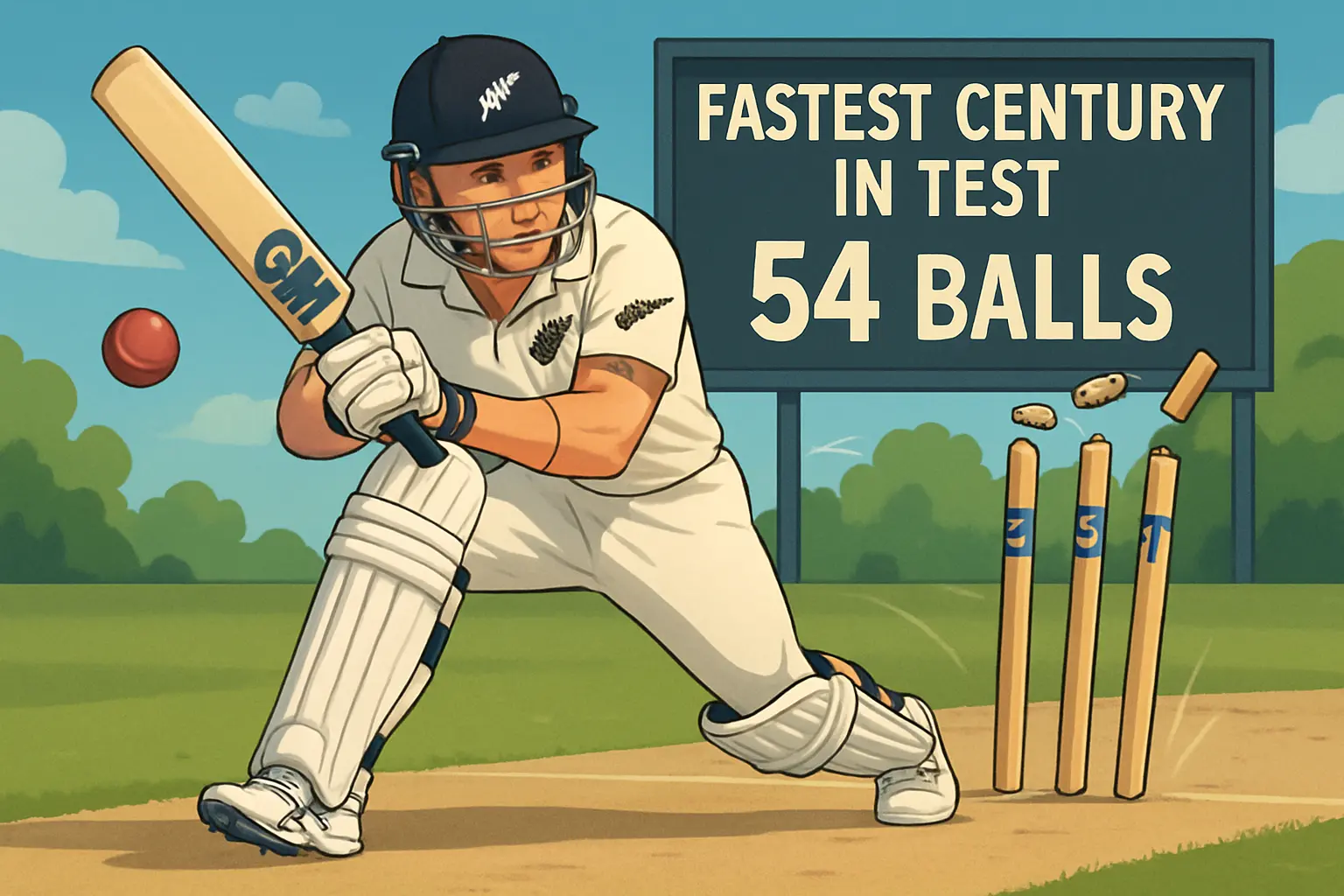
The fastest century in Test cricket is Brendon McCullum’s 54-ball hundred for New Zealand against Australia at Christchurch. Next: Viv Richards (56 balls), Misbah-ul-Haq (56 balls).
Top three at a glance
- Brendon McCullum — 54 balls (New Zealand vs Australia, Christchurch)
- Viv Richards — 56 balls (West Indies vs England, St John’s)
- Misbah-ul-Haq — 56 balls (Pakistan vs Australia, Abu Dhabi)
Introduction: speed, audacity, and the craft of a Test hundred
Test cricket has a rhythm of its own, but once in a rare while a batter tears up the script. A rapid Test century isn’t just about aggression; it’s a cocktail of pitch feel, psychological warfare, field-mapping, risk audit, and shot execution under pressure. The fewest balls for a Test century is headline fodder because it subverts what the format is supposed to be. It’s not slogging; it’s the art of compressing time without surrendering control—knowing when to punch the top of off, when to dance at the spinner, and when to step away, expose all three stumps, and carve pace behind point.
This is the definitive, expert-led deep dive into the fastest Test century—how it happened, who else lives in that rarefied air, why some venues keep turning up quick tons, what “balls faced” really means in historical context, and how to read the country-wise records without tripping over methodology traps.
Methodology and what “fastest” actually measures
- Primary measure: balls faced to reach 100 runs. Not minutes, not strike rate over the entire innings—just the deliveries taken up to the milestone.
- Why not minutes? Older scorecards often recorded time rather than precise balls. Pace of play, interruptions, and over rates distort “minutes” as a metric.
- Historical caveat: early-era entries may rely on reconstructed ball counts from trustworthy archives; those remain best available, but minor adjustments can occur when new ledger sources surface.
- Scope: this article uses official scorecards and accepted statistical repositories as a baseline for “fewest balls for a Test century,” with notes where ball-by-ball certainty is historically limited.
The all-time fastest Test hundreds (by balls)
Below is a consolidated view of the quickest Test centuries by balls. These entries have become the canonical reference points for speed in the longest format.
- Brendon McCullum — 54 balls | New Zealand vs Australia | Christchurch | Innings: 1
- Viv Richards — 56 balls | West Indies vs England | St John’s | Innings: 2
- Misbah-ul-Haq — 56 balls | Pakistan vs Australia | Abu Dhabi | Innings: 2
- Adam Gilchrist — 57 balls | Australia vs England | Perth | Innings: 2
- Jack Gregory — 67 balls | Australia vs South Africa | Johannesburg | Innings: —
- Shivnarine Chanderpaul — 69 balls | West Indies vs Australia | Georgetown | Innings: —
- David Warner — 69 balls | Australia vs India | Perth | Innings: 1
- Chris Gayle — 70 balls | West Indies vs South Africa | St John’s | Innings: —
- Colin de Grandhomme — 71 balls | New Zealand vs West Indies | Hamilton | Innings: 1
- Majid Khan — 74 balls | Pakistan vs New Zealand | Karachi | Innings: 1
Note: Early-era ball counts (for entries such as Jack Gregory) are widely cited but remain subject to the usual archival-care caveats. The standings above reflect accepted statistical consensus.
How McCullum’s 54-ball landmark happened
Athletic violence wrapped in calm decision-making—that’s the McCullum method. The surface at Christchurch had body and pace. Australia went hard with length. McCullum met pace with pace: early back-foot punches through cover, slashes with an open face behind point, the pick-up pull launched from outside off, and the charge to spin that forced the field to fracture. He didn’t wait to “get in.” He made the bowlers feel like they were the ones under probation.
Key touches from inside the game:
- He targeted fresh seamers straight through the corridor, denying them maiden-dominated control and turning “good balls” into high-value strokes.
- Against off-spin, he changed the line with premeditated shimmies, converting middle-and-off into leg-side leverage or a reverse-chopped window square of third man.
- The acceleration from fifty to a hundred was the burn—once Australia pushed square boundaries deeper, McCullum swept harder and squared the field; the lift-off shot to raise the hundred was a statement.
Short profiles: Viv Richards, Misbah, Gilchrist
Viv Richards — 56 balls: master of intimidation
Viv’s 56-ball blaze combined back-and-across footwork with an early whip through midwicket. He scored fast without handing over tempo—dictatorial yet effortless.
Misbah-ul-Haq — 56 balls: serenity with a sledgehammer
Misbah’s stillness is a weapon. In Abu Dhabi he punished anything two lengths short with the cut and the slog, pacing the innings so the second fifty bloomed with vertical-hitting certainty.
Adam Gilchrist — 57 balls: the Ashes thunderclap
Gilchrist’s hard-bladed, straight hitting on Australian decks produced thick, flat strikes that cleared ropes. His fastest Test hundred was a mood switch in the series.
What makes a 60-ball Test hundred possible
- The deck: hard, even bounce gives mishits carry and rewards timing.
- The ball: Kookaburra softens quickly; pink-ball twilight windows and second-new-ball fade create scoring windows.
- Field placements: deep rings can be exploited by batters who pick gaps.
- Match situation: when the batting side has cover for failure or momentum, hitters flip risk-reward in their favour.
- Plan: the great fast hundreds have clear scoring zones and a rhythm for rotating and detonating.
Country-by-country: fastest Test century holders
Fastest by each team (by balls faced, where verified and widely accepted):
- New Zealand: Brendon McCullum — 54 balls (vs Australia, Christchurch)
- West Indies: Viv Richards — 56 balls (vs England, St John’s)
- Pakistan: Misbah-ul-Haq — 56 balls (vs Australia, Abu Dhabi)
- Australia: Adam Gilchrist — 57 balls (vs England, Perth)
- England: Gilbert Jessop — 76 balls (vs Australia, The Oval) [reconstructed]
- India: Kapil Dev — 74 balls (vs Sri Lanka, Kanpur)
- South Africa: AB de Villiers — modern-era sub-80-ball benchmark
- Sri Lanka: Dinesh Chandimal and other modern entrants in the ~80-ball band
- Bangladesh: Shakib Al Hasan, Tamim Iqbal — quickest entries above the blistering bracket
- Zimbabwe: Andy Flower — leading a set above 80 balls
- Afghanistan: Rahmat Shah — earliest quick hundreds for the nation (no sub-100 yet)
- Ireland: Kevin O’Brien — first Test ton; quickest currently beyond 100 balls
Why list some entries without exact ball counts? For a few countries the fastest hundred sits outside the extreme speeds, and ball counts can vary by source. We stick to verified tallies for sub-100 markers.
Contextual leaderboards that matter
- Ashes: Adam Gilchrist — 57 balls (Perth).
- By a wicketkeeper: Adam Gilchrist — 57 balls.
- On debut: modern mid-80s by balls; Shikhar Dhawan’s debut ton is a standout example.
- Fourth-innings: Gilbert Jessop’s historic dash at The Oval (minutes-based, reconstructed in the 70s by balls).
- Day-night Tests: Pink ball dynamics shift the window; quick hundreds here often exploit a mid-session lull in movement.
- WTC era: Bazball and counterattacking templates have pushed many fast hundreds into the mid-70s to low-80s by balls.
Tactical blueprints from iconic innings
The great fast hundreds share patterns: premeditated scoring zones, rotation to force fields, and a decisive gear-shift once the batter senses the bowlers’ hesitation.
McCullum: speed through width
Locate square gaps early, refuse dots to spinners, and finish with straight or inside-out lofts once the field blinks.
Viv Richards: length crunching and aura management
Wait for micro-mistakes in length, convert those into big strokes, and use presence to force captains into suboptimal fields.
Misbah: measured violence
Gather information early, then punish back-of-a-length and short deliveries—slog-sweep and cut become psychological weapons.
Decoding the environment
- Venues: Perth, Christchurch, St John’s, Georgetown—when true and fast they reward aggressive intent.
- Ball type: Kookaburra vs Dukes vs pink—each alters windows for scoring.
- Session choice: middle session often offers the best blend of conditions for quick scoring.
Why strike-rate alone doesn’t tell the story
A fast century is about phases: initial assessment, boundary clusters and field manipulation, then a final gear shift where loft and straight hitting finish the job. The last phase is often decisive.
Country sections: nuance, not just numbers (high level)
Briefly: Kapil Dev’s 74-ball ton anchors India’s fastest list; Australia’s lineage runs from Jack Gregory to Gilchrist and Warner; England’s Jessop sits in lore alongside modern Bazball entries; Pakistan’s Misbah provides the calm template; New Zealand’s McCullum retooled risk; West Indies built power as orthodoxy; South Africa’s AB defined modern demolition.
The record-chaser’s toolkit
- Premeditated scoring zones and deep guards to manipulate length.
- Late hands and soft control to keep edges from ballooning.
- Early spin-hunting to shatter field shapes.
- Fitness and between-wicket urgency—two-run temperament matters.
Bowling and captaincy: how teams try to stop the avalanche
- Bouncer traps, well-executed short-ball plans and leg-side riders to stifle pull and cut.
- Around-the-wicket cross-seam into the hip to deny loft over midwicket.
- Conservative, ugly fields (7–2 off-side) to choke the carve—but once singles leak, pressure flips.
Era comparisons and adjacencies
Past eras require careful reading: uncovered pitches and minutes-based records skew comparisons. Modern equipment, truer pitches in some venues and white-ball technique have increased the pool of quick hundreds. Related records include fastest fifties, fastest doubles and most sixes in an innings.
Frequently asked questions (expert quick hits)
- Who scored the fastest century in Test cricket?
- Brendon McCullum, in 54 balls, for New Zealand against Australia at Christchurch.
- Who has the fastest Test hundred for India?
- Kapil Dev reached his hundred in 74 balls against Sri Lanka at Kanpur.
- What is the fewest balls for a Test century?
- Fifty-four deliveries—McCullum’s benchmark.
- Is Brendon McCullum still the fastest Test centurion?
- Yes. Viv Richards and Misbah-ul-Haq share second on 56 balls.
- Who hit the fastest Test hundred in the Ashes?
- Adam Gilchrist, 57 balls, at Perth.
- Which wicketkeeper has the fastest Test century?
- Adam Gilchrist’s Perth thunderbolt leads the wicketkeeper charts.
- What’s the fastest Test double century?
- Nathan Astle authored the most devastating charge from 100 to 200 in Tests, a defining acceleration.
- Fastest Test century by a left-hander?
- Adam Gilchrist’s 57-ball Ashes blast heads the left-handers’ list.
A closer look at the top 10: situational context and tactical beats
- Brendon McCullum — 54 balls, Christchurch: carved pace behind point, bullied spin, and accelerated from fifty to a hundred with a deliberate plan.
- Viv Richards — 56 balls, St John’s: used wristwork and presence to force fields into surrendering gaps.
- Misbah-ul-Haq — 56 balls, Abu Dhabi: punished indecision in length; calm and clinical.
- Adam Gilchrist — 57 balls, Perth: straight, flat hitting that capitalized on a hard deck.
- Jack Gregory — 67 balls, Johannesburg: early-era exception with reconstructed counts; fast deck, powerful driving.
- Shivnarine Chanderpaul — 69 balls, Georgetown: efficient rotation until the field blinked, then striking power.
- David Warner — 69 balls, Perth: opener who pushes Test tempo from ball one on a hard deck.
- Chris Gayle — 70 balls, St John’s: full-length bombardment and muscle hitting.
- Colin de Grandhomme — 71 balls, Hamilton: simple, effective: short balls lifted, full balls driven.
- Majid Khan — 74 balls, Karachi: elegant acceleration that felt inevitable rather than frantic.
How captains use quick hundreds
- As a declaration weapon to seize the game-state advantage.
- As a rescue device to shift momentum and open scoring avenues for teammates.
- As a grind-breaker on flat decks to prevent stalling and force results.
Why filters matter for record hunters
Country, venue and era filters correct for domestic batting cultures, pitch characteristics and equipment. Comparing cross-era records without context misleads; filters restore meaning.