|
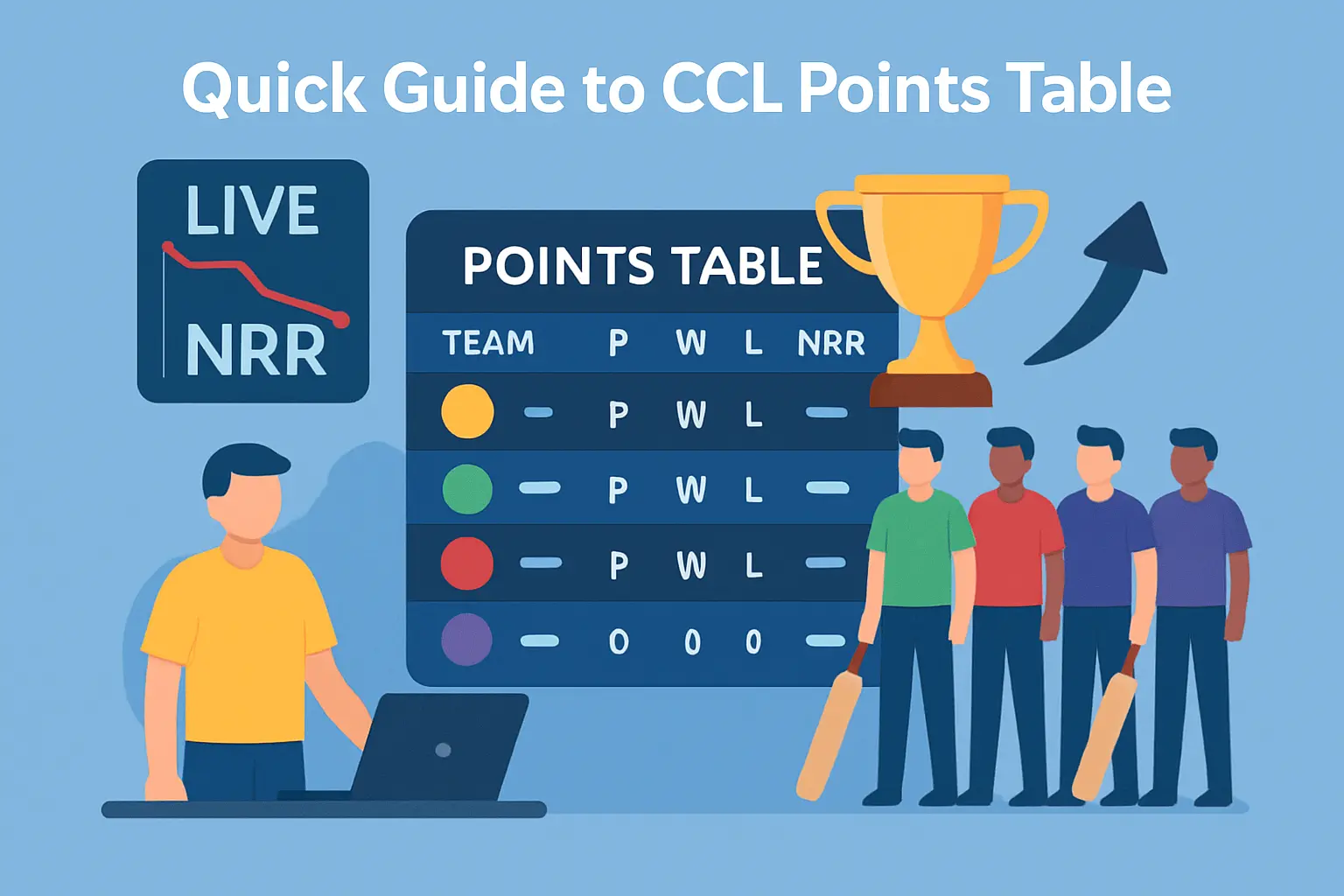
Understand how CCL standings shift, how Net Run Rate (NRR) works, what teams need to qualify, and where to watch the matches.
|
|
A match in the Celebrity Cricket League has a rhythm: crowds, anthems, stars warming up — and the scoreboard. By season’s end it’s the humble CCL points table that writes the real story. Read this complete guide to the CCL points table: how it’s built, how to read it on matchday, how group dynamics affect qualification, NRR basics, team insights, playoff math and where to stream the action.
|
Live CCL points table — how to read it today
A proper CCL table gives you the tournament in miniature. Columns show the currents that decide who reaches the playoffs and who goes home. The logic is the same at the first over or at stumps.
Key columns you will always see:
- Team — the franchise name.
- Played (P), Won (W), Lost (L) — results to date.
- Points (Pts) — 2 for a win, 0 for a loss, 1 each for tie or no result.
- NRR — Net Run Rate, the crucial tiebreaker.
- Last 5 — form tracker using W/L marks.
- Qualified/Eliminated — badges when a state is confirmed.
Illustrative example (for understanding only, not live data):
| Team |
P |
W |
L |
Pts |
NRR |
Last 5 |
| Telugu Warriors |
3 |
3 |
0 |
6 |
+1.442 |
W W W |
| Karnataka Bulldozers |
3 |
2 |
1 |
4 |
+0.315 |
W L W |
| Chennai Rhinos |
3 |
1 |
2 |
2 |
-0.210 |
L W L |
| Mumbai Heroes |
3 |
0 |
3 |
0 |
-1.325 |
L L L |
Read it like a pro:
- Positive NRR means a side scores faster than it concedes across the season.
- Form isn’t fate. A late dominant win can overturn a run of losses on NRR.
- Watch the “qualified” marker once a team becomes mathematically safe.
|
Celebrity Cricket League points table structure and season format
The CCL typically features eight teams split into two groups. The top two from each group advance to the semifinals.
Two groups, four teams each:
- Group A and Group B each contain four teams. Fixtures usually focus on intra-group matches with occasional cross-group games depending on the edition.
- The top two from each group move to the semifinals (Semifinal 1: Group A #1 vs Group B #2; Semifinal 2: Group B #1 vs Group A #2).
|
Points allocation in the CCL table
| Outcome |
Points |
| Win |
2 |
| Loss |
0 |
| Tie or No Result |
1 each |
| Penalties |
Deductions (rare) |
In rain-hit or shortened matches, points follow the official result method. NRR calculations follow the overs and targets recognized by officials.
|
CCL net run rate — the beating heart of standings
NRR is calculated across the league stage by subtracting the run rate conceded from the run rate scored.
Base formula:
- Team run rate scored = total runs scored / total overs faced
- Team run rate conceded = total runs conceded / total overs bowled
- CCL NRR = (runs scored / overs faced) – (runs conceded / overs bowled)
Worked example (illustrative):
If a side scores 380 runs in 40 overs and concedes 350 in 40 overs: run rate scored = 9.50; conceded = 8.75; NRR = +0.75.
Special cases:
- All out early: overs faced counted as full quota for that innings.
- Bowling a side out early: only overs actually bowled are counted for the conceding team.
- Rain and DLS: official overs and targets feed NRR math.
- No result: excluded from NRR if not a completed match.
|
Tie-breakers in the CCL table
When teams finish on the same points, standard tie-break rules apply. The usual order:
- Net run rate
- Head-to-head result among tied teams (mini-table if three or more are tied)
- Higher total runs scored in league stage
- Fewer wickets lost across the league stage
- Committee decision or draw of lots if all else fails
Editions may vary the sequence (some elevate head-to-head). Always check the season handbook for the authoritative order.
|
Playoff bracket, semifinal qualification, and the thin line between in and out
Semifinal qualification is simple on paper: top two from each group. But the run-in is rarely simple — celebrity squads surge, tactics change, and NRR decides tight races.
Common qualification patterns:
- Early pace-setters: 2–0 or 3–0 often locks a semifinal spot.
- Middle crunch: Even records make head-to-head clashes decisive.
- NNR drama: A final dominant win can push a losing-record side into second place on NRR.
|
Team-wise points and standings insight
Below are concise lenses for each franchise — what moves their NRR and common tactical traits.
| Telugu Warriors
Calm chases and middle-over control. NRR benefits from steady partnerships and low dismissals.
Karnataka Bulldozers
Powerplay punch and early wickets. Their NRR often moves quickly through dominant early overs.
Chennai Rhinos
Bowling-first identity; anchored chases can protect results but limit NRR spikes.
Mumbai Heroes
Squad depth gives flexibility; NRR improves when finishers produce back-loaded runs.
Bhojpuri Dabangg
Big-hitting identity — a single big win can lift NRR quickly.
Bengal Tigers
Fielding intensity keeps matches tight; low-scoring thrillers protect NRR.
Kerala Strikers
Precision cricket and the twos economy — steady wins that steadily build NRR.
Punjab De Sher
Spin-savvy and stage-aware; late cameos and spin combos move NRR in careful steps.
|
|
How last-5 form intersects with NRR
Last 5 runs reveal tactical shape:
- W W W — roles nailed, healthy-margin wins that boost NRR.
- L W L — volatility or role experiments; a final win can flip momentum and table position.
- L L L — not terminal; teams often rejig and can surge late into contention.
|
“CCL points table today” and the fixtures that change it
Matchdays that tilt standings share a few properties: fresh pitches that favor new-ball bowlers, double-header dynamics, dew in late games and derby intensity that produce statement margins.
Results ripple:
- Close losses can damage the table if rivals win big elsewhere.
- No results can reopen groups by awarding single points.
- Upsets create openings in NRR races.
|
Celebrity Cricket League points table — language snippets for regional fans
Short labels for searches and regional coverage:
- Hindi: CCL अंक तालिका (ccl ank talika)
- Telugu: CCL పాయింట్స్ టేబుల్
- Tamil: CCL பாயின்ட்ஸ் டேபிள்
- Kannada: CCL ಪಾಯಿಂಟ್ಸ್ ಟೇಬಲ್
- Malayalam: CCL പോയിന്റ്സ് ടേബിൾ
- Bengali: CCL পয়েন্টস টেবিল
- Punjabi: CCL ਪਾਇੰਟਸ ਟੇਬਲ
|
How teams qualify for the CCL semifinals — scenario playbook
Typical arcs:
- Frontrunner lock: Win three early and manage resources and NRR.
- The grind: Reach the final game needing a win or NRR edge.
- Late sprint: Two big wins late lift NRR dramatically.
- Rain/tied lifeline: Extra points can reshape the group late.
Dugouts do ball-by-ball math for NRR in decisive fixtures; tactics shift to meet exact overs/balls targets.
|
Tie-breaker explanations with real-world nuance
- In three-way ties the rules may create a mini-table filtered to the tied teams; NRR within that mini-table can decide final order.
- Runs scored as a tiebreaker rewards consistent aggression over settling for par.
- Fewer wickets lost rewards batting smart — keeping wickets can decide deep tiebreaks.
|
The art of managing CCL NRR
- Batting first: set par-plus targets to put pressure on the chase.
- Batting second: chase efficiently; finishing inside plenty of balls is an NRR gem.
- Bowling macro: two tight overs late can be more valuable than an isolated wicket.
- Fielding micro: misfields and extras are silent NRR killers — save runs and the table shifts.
|
Where to watch — CCL live streaming and telecast channels
Broadcast usually spans multiple regional channels with concurrent digital live streaming on the network’s OTT partner. Language feeds commonly include Hindi, Telugu, Tamil, Kannada, Malayalam, Bengali and Punjabi. Match center and league socials publish definitive watch links and language options.
|
Tickets price and booking
Ticketing opens in waves: early-bird slabs, single vs double-header pricing, and premium hospitality tiers. Online booking partners host primary sales; stadium kiosks sometimes allow on-the-day windows until sold out.
|
The statistical spinoffs: most runs, most wickets, and their points-table echo
- Top run-scorers (200–250) usually come from semifinal teams; strike rate and balls faced matter for NRR protection.
- Most wickets: strike and economy together move both matches and conceding rate.
- MVPs often contribute in both disciplines — these players can swing NRR and results.
|
Past seasons points table and champions patterns
Repeat champions pair a bowling core that travels well with batters who can swap roles. Final tables often show decimal NRR separations and single moments that changed seasons.
|
How schedule design interacts with standings
- Clustered travel weeks favor deeper benches.
- Venue traits (dew, altitude, spin tracks) alter par scores and NRR planning.
- Rest windows influence early aggression and late fatigue; the table tightens when rest is mismanaged.
|
Umpiring, playing conditions, and their effect on the CCL table
- Powerplay fielding rules and misreads can concede early boundaries that blow up conceding rates.
- Over-rate pressure can force rushed bowling plans that leak runs.
- DLS awareness is critical in shortened games to avoid hidden defeats.
|
CCL table myths, debunked
- Myth: Toss decides NRR. Reality: It shapes tactics but mid-innings control and death-overs clarity govern decimals.
- Myth: One big win solves NRR forever. Reality: It helps, but a big loss erases cushions.
- Myth: Lower-order runs don’t matter. Reality: The last 20 runs can move NRR more than any other phase in tight leagues.
|
Data you’ll find in a robust celebrity cricket league points table
Expect P, W, L, Pts, NRR plus:
- Team filters and micro-tables
- Head-to-head summaries
- Form notes after each update
- Semifinal progression module with ‘qualified’ / ‘eliminated’ chips
|
The power of mini scenarios — a few that come up every season
- Must-win + NRR target: e.g., ‘Win by 35’ or ‘Chase in 17.2 overs.’
- Three-way tie: mini-table logic often decides the outcome; early big wins in the season can prove decisive.
- NNR vs morale: a narrow thriller loss can still preserve NRR and boost confidence for the next match.
|
CCL fixtures today — patterns that enhance viewing
- Early games: slower scoring as pitches wake up; ceremonial build-up.
- Late games: dew and lights help chases; late slots often produce NRR fireworks.
- Venue-switch weekends: home bounce and boundary familiarity can influence results and table shifts.
|
How the CCL table treats rain and interruptions
- Abandoned match: one point each, no NRR change.
- Shortened match: DLS targets and official overs feed NRR calculations.
|
Celebrity Cricket League table — group-by-group tactical blueprints
Group A:
Spin, middle-overs control and fielding intensity. Qualification often hinges on the two overs after the first time-out.
Group B:
Powerplay-focused and higher par scores; death-overs defense normally decides the table.
|
The production layer — why broadcast and OTT matter to the table
Live analytics, split-screen NRR targets, and multilingual commentary turn decimals into actionable tactics fans can follow in real time.
|
The human layer — celebrity cricket, serious edges
Discipline on the field beats highlight reels over a season. Dance backgrounds, studio precision and deliberate throwdowns translate into reliable match performances that the table rewards.
|
CCL table FAQs — crisp answers
NRR calculation in CCL
NRR = average runs per over scored − average runs per over conceded. All-out innings count full quota of overs; DLS-adjusted values apply where used.
How many teams qualify for CCL semifinals
Four teams (top two from each group) enter the semifinals.
Who is on top of the CCL points table today
The leader is the team with the most points; NRR breaks ties. The table updates after every match.
Tie-breaker rules in CCL
Points, NRR, head-to-head, runs scored, fewer wickets lost, then committee call/draw if still tied (edition handbook prevails).
|
Editorial notes and final word
Strong coverage timestamps updates, shows concise change notes, and links match reports back to the table. The CCL points table counts every over and every fielding save: win smart, lose small, and let NRR act as insurance when the league comes down to decimals.
Appendix — quick-reference blocks for power users
| Points allocation
Win: 2 · Loss: 0 · Tie/No result: 1 each
|
| NRR core rule
NRR = (total runs scored / total overs faced) − (total runs conceded / total overs bowled). All-out innings count full quota. DLS-adjusted values apply.
|
| Tie-breakers (common)
Points → NRR → Head-to-head → Runs scored → Wickets lost → Committee/draw
|
| Team-specific quick tags
Telugu Warriors: measured chases · Karnataka Bulldozers: powerplay punch · Chennai Rhinos: new-ball smarts · Mumbai Heroes: bench depth · Bhojpuri Dabangg: par-busting bursts · Bengal Tigers: fielding pressure · Kerala Strikers: twos economy · Punjab De Sher: spin spine
|
One line summary: Win smart, lose small, and let net run rate be the insurance policy that pays out when the league turns to decimals.
|
|
Sources: Official match centre and broadcast match reports are the canonical sources for points, NRR and tie-break confirmations. For season-specific rules, consult the edition handbook.
|