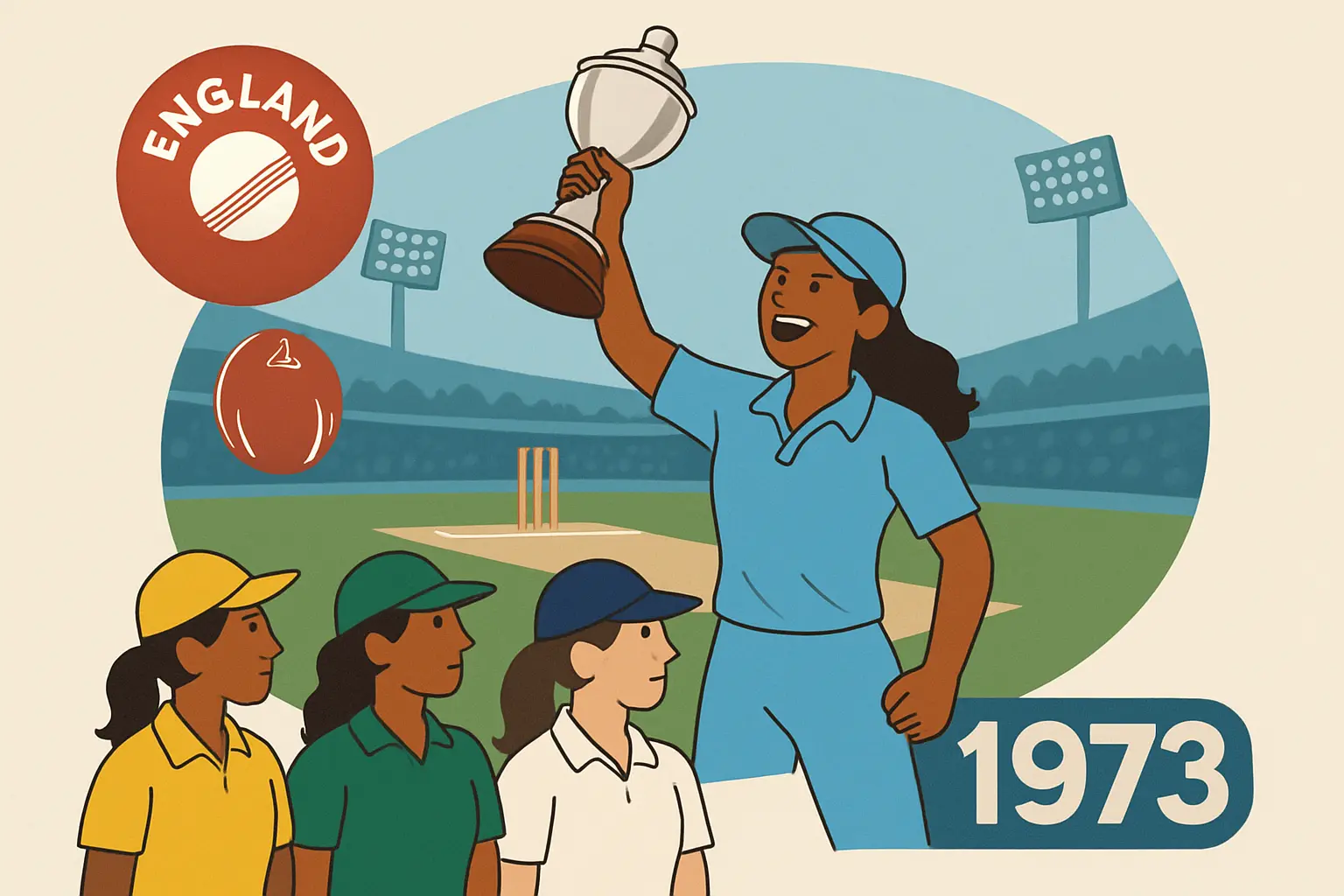
A crisp English summer, heavy wool flannels, and a red ball cutting through salt air along the south coast—that is where women’s limited-overs cricket first announced itself as a world event. Not in the shadow of the men’s game, but ahead of it. The first women’s ODI World Cup arrived with the spirit of a start-up: stubborn belief, a shoestring budget, and a handful of visionaries who refused to wait for permission. By the time it was over, England were champions, the sport had a blueprint, and an entire generation of girls had a new picture of who belonged on the field.
This is the full, expert reconstruction of that inaugural women’s cricket world cup—how it began, who made it happen, where it was staged, what the format looked like, who won, and why its impact was far larger than the column inches it earned at the time.
Quick facts about the inaugural Women’s ODI World Cup
- Host country: England
- Champions: England Women
- Captain of champions: Rachael Heyhoe Flint
- Format: One-day internationals; 60 overs per side; round-robin; points-table winner; no final
- Number of teams: Seven
- Participants: England, Australia, New Zealand, International XI, Young England, Jamaica, Trinidad & Tobago
- First official women’s ODI: Played on the opening day of the tournament, with the earliest-recognized fixture logged between Young England and Australia on the south coast
- Match conditions: Red ball, white clothing, day games, no fielding circles or powerplays
- Defining legacy: The women’s world cup began before the men’s and set the template for WODI cricket
Why the women’s world cup started first—and how it actually got off the ground
The origins of the first women’s ODI world cup owe less to large committees and more to a small group’s willpower. The Women’s Cricket Association (WCA) in England carried the administrative weight, but the personality who made it feel inevitable was Rachael Heyhoe Flint. Already an accomplished batter and captain, Heyhoe Flint had a second, equally potent skill: persuasion.
She did the exhausting, unglamorous work of knocking on doors, pitching the vision, and refusing to let “no” be the final answer. The idea of a one-day world tournament for women in England sounded fanciful at the time; funding was a bigger barrier than logistics. Yet one significant ally emerged—businessman and philanthropist Jack Hayward—whose backing provided the financial runway. Without that underwriting, there is no realistic path to the inaugural event. With it, the WCA could think ambitiously while still operating frugally.
Why England? The country already had a comparatively mature domestic women’s set-up. County grounds were accessible, there was a network of volunteers and administrators who understood the calendar, and a summer window was available. But the choice was also psychological. Staging the event in England had symbolic value: this was cricket’s historical home, and the sight of women’s one-day internationals in established county venues sent a clear message—this was proper cricket.
Most importantly, that first tournament happened before a men’s one-day world cup existed. That timeline matters. It removed the usual excuse that women’s sport must follow in the wake of the men’s version. On this occasion, the template flowed in the opposite direction. From the length of the innings to the structure of the schedule, the women’s game pioneered an international limited-overs format and delivered a tournament that felt complete.
Teams, captains, venues, and format: the building blocks of the first edition
The seven teams—and why two of them were unusual
- England: Hosts, favorites, and the most organized unit. Their combination of discipline with bat and ball, and Heyhoe Flint’s authority, gave them the look of serial champions even before a ball was bowled.
- Australia: A hardened side with a strong seam and spin core, and the familiar Australian appetite for contest. They came to win, and pushed England hard.
- New Zealand: Talented, tidy, and exceptionally tough in English conditions, led by cool-headed leadership and a well-drilled bowling unit.
- International XI: A composite team assembled to ensure competitive balance and to broaden opportunity. Drawn from multiple countries, it reflected the WCA’s openness: if a nation could not field a side, talented players still deserved a stage.
- Young England: A development squad, effectively an England A. It gave rising players world-cup intensity and is a unique artifact of that first edition. No later tournament has tried the same experiment in quite that way.
- Jamaica: Standing alone under its own flag, with a core of proud, skillful cricketers from a domestic scene that was still stitching itself together.
- Trinidad & Tobago: A second Caribbean entrant in an era before a unified West Indies women’s team took shape. Together with Jamaica, they showed that the region’s depth—batting flair, leg-spin guile, athletic fielding—was already real.
Notable leaders and on-field generals
- England’s captain: Rachael Heyhoe Flint—organizer, batter, conscience, and PR engine all rolled into one.
- New Zealand’s captain: Trish McKelvey—calm presence, a leader who understood tempo and match management in English conditions.
- Australia’s captain: Anne Gordon—off-spinner and shrewd leader whose sides rarely beat themselves.
- International XI’s captain: Audrey Disbury—experienced and authoritative, holding together a multi-national dressing room.
- Young England’s captain: Susan Goatman—tasked with the trickiest job of all: developing emerging talent while playing the strongest teams in the world.
The exact leadership across all teams on every day often reflected local decisions and availability, but the names above tell you how the tournament actually felt from the middle: organized, determined, and led by cricketers cut from serious cloth.
Venues and conditions
The match list crisscrossed England’s county circuit. South-coast grounds with sea breeze and swinging morning air. Midlands outfields that rewarded the along-the-ground drive. Outgrounds in the Home Counties where a misjudged length died on tackier surfaces. This matters for understanding the cricket: openers needed precise judgment, seamers loved the first hour, and spinners grew stronger as the red ball got older and the pitch took a thin film of polish. Several fixtures ran on venues better known for county championships, not international showpieces—a pragmatic decision that kept costs low and crowds intimate without compromising the cricket.
Format: the early WODI template
- Overs per side: 60, with six-ball overs.
- Clothing and ball: whites and a red ball—limited-overs cricket before colored clothing and white balls.
- Day games only: daylight dictated everything; there were no floodlights.
- Field restrictions: none of the modern circles or powerplays; spinners and seamers both had to create their own pressure.
- Round-robin scoring: the points table crowned the champion; there was no final.
- Intent: play every team, reward consistency, and let the best side across the whole month lift the title.
It reads simple today. That was exactly the point. Keep it clean, make it fair, and give every team the fullest possible tournament.
The first official women’s ODI: how it unfolded
On the opening day, official statisticians logged the first women’s One-Day International. The earliest recognized fixture on the ledger is Young England against Australia, played on the south coast. From that moment, the WODI format existed as an international standard. Elsewhere in that same opening swing, England’s top order tore into the International XI with an opening act that felt like the genre had found its voice immediately: brisk running, aggressive use of width, and the kind of scoreboard movement more often associated with the men’s professional circuit. The message was not subtle—the women weren’t dabbling in a novelty; they were setting the pace.
Points table and notable matches: England rise, Australia chase, New Zealand grit
The league table at the end told a convincing story. England were the best team over the breadth of the tournament. Australia chased them hard. New Zealand, resilient and organized, kept everyone honest. The composite International XI surprised a few. The Caribbean outfits had their moments of pure flair. Young England took their knocks and learned quickly.
Final standings (round-robin winner takes the title)
- England
- Australia
- New Zealand
- International XI
- Trinidad & Tobago
- Jamaica
- Young England
The specific points tallies matter less than the rhythm of the tournament: England controlled the narrative from early on, pocketing wins with disciplined seam bowling and batting that understood risk better than the opposition. Australia produced the fiercest fight—results between the two felt like chess matches played on a green checkered board. New Zealand’s strength was game awareness. They turned middling totals into defendable positions with bowlers who hit the same line until a batter broke.
One match, in particular, lives on in dressing-room storytelling: England’s early-round statement at a windswept coastal ground where their openers batted with full authority, posting a total that forced the rest of the field to reconsider what a par score looked like in women’s one-day cricket. The net effect over the month was clear: England’s combination of structure and skill set a standard others struggled to match over a sustained run.
Key players and records: who shaped the inaugural women’s ODI World Cup
Rachael Heyhoe Flint, England: the captain who built a tournament
Heyhoe Flint was more than a figurehead. She embodied both the aesthetics and the politics of the moment. With the bat, she was technical but unsentimental, quick to cash in on width and fully capable of killing a chase with the kind of 70 that looks modest in a scorebook and monumental in context. As a leader, she was careful with statements and bold with decisions. She kept the core tight, the messaging clear, and turned a good team into champions. Her greatest performance might have been off the field—persuading administrators, wooing sponsors, and making sure cameras and notebooks turned up wherever the team played.
Enid Bakewell, England: the all-round engine
Bakewell’s value cannot be overstated. A left-hand batter with a fluent, full-faced swing, and an off-spinner who could steal a wicket when it mattered, she bridged formats with a quiet certainty that felt generational. In the inaugural world cup, Bakewell scored heavily and often, and contributed with the ball in the middle overs when the innings wanted to drift. In an era before strike-rate obsessed commentary, her tempo was perfect for 60-over cricket: steady drawl early, sharper bursts later. Tournament memory remembers a pair of openers setting up a thumping win early in the league; Bakewell’s partner Lynne Thomas matched her stroke for stroke. Between them they carved an innings that still gets talked about when old pros compare opening acts.
Lynne Thomas, England: the tone-setter
Thomas played with sunlight in her bat. Her early-tournament hundred was more than a number; it was a mood. She hit in straight lines, met good-length balls with a stride and high elbow that delighted coaches, and forced fielding captains to move from instinct to guesswork. Few batters in that campaign were better at punishing length that was barely off.
Anne Gordon, Australia: the shrewd operator
Australia’s captain marshaled a side that squeezed value from each over. Her spin was about angles and deception; her captaincy about patience and trap-setting. She found bowlers overs when another captain might not have, and kept Australia in the title race deep into the schedule.
Sharon Tredrea, Australia: pace and presence
A brisk, competitive fast bowler who would become one of the greats of the early WODI era, Tredrea gave Australia the new-ball authority they needed on English pitches. She bowled attacking lines without losing discipline—a difficult art for quicks in swing-friendly conditions where a mistimed length can become a gift.
Trish McKelvey, New Zealand: brains and ballast
McKelvey’s leadership was the reason New Zealand appeared to play ten overs smarter than their opponents. She paired the best bowlers with the worst match-ups for batters, and turned low-scoring afternoons into chess puzzles New Zealand usually solved. It is no coincidence that they comfortably sat in the top half of the table.
Caribbean pioneers: Louise Browne, Beverly Browne, Dorothy Hobson
From the Caribbean came a defiant style. Trinidad & Tobago were spearheaded by the Browne sisters—Louise and Beverly—who carried the batting burden with swagger, while Jamaica drew strength from craft, particularly Dorothy Hobson’s leg-spin, which could make the ball look two sizes larger in a batter’s mind. These teams’ presence, distinct and proud, pulled the region toward a future unified West Indies women’s side, but in this inaugural edition they were rightly independent and dangerous.
International XI: the glue side
A composite team can feel like a yesterday’s-when collection; this one did not. Led with clarity by Audrey Disbury, the XI weren’t tourist extras. They beat good teams and pushed better ones. The stranger-in-a-strange-land vibe that can haunt ad hoc teams was replaced by a charming novelty: players learning each other’s rhythms on the fly, then building simple, repeatable plans that held up under pressure. Their presence widened the tournament’s map: if a nation had pockets of talent but no structure, the International XI was the bridge.
What the numbers tell us—without drowning in them
- England finished top of the table with a cushion; they beat the two strongest challengers and rarely looked flustered.
- Australia pushed England closest; the gap felt like one pivotal result, not a gulf in quality.
- New Zealand’s net advantage came from bowling disciplines—rarely did they leak out-of-control overs.
- Bakewell was among the tournament’s leading run-scorers and also chipped in with key wickets.
- England’s spin and accurate seam used the conditions better than anyone; think disciplined lengths, fields that made singles look tight, and patience rewarded.
- Several opening stands were match-defining. The shift from three-day thinking to one-day urgency happened right there at the top of the order.
How the cricket actually looked: tactical snapshots from the middle
Sixty-over one-day cricket is a different animal from the modern 50-over sprint. It rewards poise and punishes panic. That first women’s ODI world cup showcased a kind of tempo control too easily forgotten now.
- The new ball mattered a lot. A cloudy morning on the south coast, a touch of moisture, and suddenly 30 for 3 looked like a standard script. Top orders survived by playing later, using leaves as statements of intent, and scoring square when the line strayed.
- Middle overs belonged to spinners and nagging seamers. The best captains took pace off, forced batters to hit through fewer gaps, and waited for a release shot miscued into midwicket’s hands.
- Running between the wickets was a separator. England’s best pairs turned hallways into doorways—tiny angles, immediate calls, and bruising of ring fielders who were always a half-step late.
- Death overs in 60-over cricket are more like slow-burn finales than sprints. Fives and sixes an over were respectable and, on many days, match-winning. The biggest risk at the end wasn’t failing to hit; it was losing set batters to greedy shots.
- Fielding was deceptively modern. Australia, New Zealand, and England used ring-squeeze tactics that looked like the precursors to today’s powerplay containment: two steps in, no easy single, make the batter go aerial to escape.
The England blueprint: calm, coherent, and ruthless
If you want a masterclass in building a champion, that England side is a museum piece. They picked balanced XIs. They were happy to bat first whenever conditions allowed because they understood the scoreboard pressure of a tidy 60-over total in English conditions. They squeezed the middle overs with dot-ball pressure rather than looking for miracle balls. Their batters trusted method: leave well, cash in on width, don’t burn the insurance policy early. The team’s culture—assertive but unshowy, ambitious without hubris—wasn’t accidental. It was the captain’s personality imposed on the collective.
Cultural context: the pyrrhic victories that turned into permanent wins
Media coverage was modest, crowds varied from intimate to lively, and some grounds felt more like community festivals than grand showpieces. That was fine. The aim wasn’t spectacle. It was existence. The first women’s ODI world cup created images: whites flaring under weak English sun, girls in county age-group jumpers waiting near boundary ropes with autograph books, seasoned men’s members looking up from their teas with surprise at the quality in front of them.
Sponsorship was not a flood; it was a lifeline. Volunteers did what volunteers always do—everything. The WCA’s logistics team, an army of unsung administrators, did the miles, the phone calls, the last-minute plan B’s. It would be easy to downplay all this as minor-league. That’s wrong. This is what building a sport looks like in its most honest form.
The arrow that pointed forward: legacy and impact on women’s ODI cricket
- A world tournament before the men’s: This single fact flipped the script. It proved women’s cricket didn’t need to be a shadow—its administrators and players could lead.
- A formalized WODI standard: Overs, ball, playing conditions, and tournament pacing were now tangible. You could schedule, prepare, and select with a real template in mind.
- Caribbean consolidation: Separate Jamaica and Trinidad & Tobago teams were stepping stones toward a unified West Indies women’s team. Exposure at this level accelerated that journey.
- New Zealand’s validation: The White Ferns’ strength in English conditions gained international respect and translated into a seat at every important table thereafter.
- The door to India and beyond: India’s women wouldn’t appear until a later edition, but the inaugural event is the hidden hinge—once the door was built, others could walk through it.
- Professionalization by degrees: No one turned pro overnight. But incremental gains—more fixtures, better coaching access, recognition from national boards—trace back to the credibility born in that first tournament.
- Institutional handover: In time, governance and structuring would align more closely with the global cricket body. The journey from WCA-era DIY to centrally managed international women’s cricket starts on this path.
Evolution of format: from 60-over marathons to modern 50-over clarity
After the inaugural event validated the idea, the women’s world cup model slowly tightened. Semi-finals arrived later, finals became standard, and the 50-over frame settled as the international one-day length for both women and men. Colored clothing, white balls, daytime-nighttime staging, and curated pitches would arrive in tandem with television’s priorities. What faded was the romance of those long afternoon builds; what improved was reach, visibility, and the professionalism that flows from broadcast schedules and sponsors with real budgets. That trade-off made sense. The soul of one-day cricket survived the shift, and the women’s game profited from the structure.
Context for India and the subcontinent
For readers who track India’s arc in the women’s game, the inaugural world cup is the necessary prologue. It created a tournament to aspire to, a set of standards to prepare for, and a calendar slot national boards could plan around. India would join the party later and eventually become one of its centerpieces, driving viewership and producing modern icons. But the seed was planted in England, under grey skies and stubborn optimism.
What “International XI” and “Young England” really meant
Two teams require a little glossary:
- International XI: This wasn’t a novelty act. It was a serious cricketing solution. Instead of excluding good players because their home boards weren’t yet ready, organizers formed a composite side. The XI trained properly, captained properly, and competed properly. For the players involved, it was a career-altering pathway.
- Young England: Unique to the first edition, this was a development team with national colors. It meant the host country could blood talent while sustaining the schedule. Yes, results were harsh at times. But the experience compressed years of learning into a month. Future England depth charts owe plenty to this experiment.
In-match craft: lessons from coaches and captains
- Build batting around a spine, not a flash. In those conditions, a 60-over innings needs a long-breath anchor at one end and rotating strike at the other. England nailed this dynamic repeatedly.
- Bowl to a plan, not a batter. Given the lack of fielding restrictions, captains built fielding webs designed to suffocate singles into the leg-side and dare batters to force pace. Australia and New Zealand excelled at this.
- Win the first 15 overs twice. Coaches liked to say the innings had two “first hours”—from overs 1 to 15 and again from 31 to 45. Sides that reasserted control during these windows usually won.
- Make early declarations with your best players. The opening match days made it clear: let your first-choice openers and lead bowlers set the standard, not the mood of the day. Momentum resulted, not preceded.
A gallery of moments that still breathe
- An opening stand that throttled the International XI and recalibrated what a par total meant at an English outground.
- A New Zealand squeeze where even mishits felt like catching practice, and the opposition bled out in ones and dots until panic took a wicket.
- A Trinidad & Tobago counterattack built on cuts and pulls that had spectators flashing back to Caribbean men’s batting of the era—unapologetic, joyous, and effective.
- A Young England fielding day where a ring of eager cricketers threw like demons and took catches that silenced the snickering about development sides.
In one sentence: England, with Heyhoe Flint’s leadership and Bakewell’s all-round steel, were the best team on the most important stage the women’s game had ever set to that point.
Beginner-friendly explainer: ODI vs Test cricket, and why that mattered here
Test cricket is a long-form examination—multiple days, a red ball, and almost infinite time for correction and counter. One-Day Internationals are a puzzle of finite resources: a set number of overs, a clock that never stops, and an urgent need to adapt. For women who’d grown up on multi-day county or regional fixtures, the first world cup forced fresh skills. Shot selection had to compress. Bowlers had to learn how to defend a boundary without losing wickets as a threat. Keepers had to stand up more often to keep batters anchored. This tactical resetting is a big reason the inaugural world cup mattered beyond sentiment. It trained a generation in a format that would become the sport’s most widely watched.
Why the first women’s world cup still wins today
- It came first. That alone gives it a stubborn heroism. The women didn’t wait for validation.
- It created a shared language. Coaches, selectors, captains, and statisticians now had a way to talk about international one-day cricket that wasn’t hypothetical.
- It changed the audience’s eye. Once you’ve seen a women’s day game played well, you cannot unsee its integrity.
- It grew the game laterally. Jamaica and Trinidad & Tobago as separate teams, an International XI as connective tissue—these are decisions that sent value across borders, not just up to the top.
The facts, answered straight
- Host country of the first women’s ODI World Cup: England.
- Winner and captain: England Women, captained by Rachael Heyhoe Flint.
- Number of teams: Seven.
- Format: Round-robin WODIs of 60 overs per side; points-table winner; no final.
- First official women’s ODI: Logged on the opening day of the tournament, earliest fixture recorded as Young England vs Australia on the south coast.
- Did the women’s world cup precede the men’s? Yes—by multiple seasons.
A simple table for orientation
Key facts at a glance
| Fact | Detail |
|---|---|
| Host | England |
| Champions | England Women |
| Captain (champions) | Rachael Heyhoe Flint |
| Teams | England; Australia; New Zealand; International XI; Young England; Jamaica; Trinidad & Tobago |
| Format | Round-robin; 60 overs per side; red ball; whites; day games |
| Standings (top three) | 1) England; 2) Australia; 3) New Zealand |
Final standings
| Rank | Team |
|---|---|
| 1. | England |
| 2. | Australia |
| 3. | New Zealand |
| 4. | International XI |
| 5. | Trinidad & Tobago |
| 6. | Jamaica |
| 7. | Young England |
Venues and conditions (what to expect)
- South coast outgrounds: wind-affected swing, fast-scoring once set
- Midlands pitches: true bounce, value for off-side strokeplay
- Home Counties surfaces: slower seam movement, spinners into the game early
- Outfields: variable pace; heavy after rain, lightning quick in dry spells
A word on credit: the people who made it possible
Every world cup needs stars. But the first women’s ODI world cup needed institutional pioneers even more. The WCA’s administrators, county volunteers opening gates at dawn, scorers who learned the quirks of a brand-new international ledger, groundstaff who presented a fresh wicket every few days in England’s temperamental summer—these are the characters who gave the event its backbone. Jack Hayward’s funding, the steadying hand of organizers who trusted Heyhoe Flint’s vision, and the players themselves, who trained and played like professionals without the safety net of professionalism, are why the tournament stands up to history’s scrutiny.
How the inaugural edition shaped what came next
- Scheduling certainty: Once a world cup exists, boards build calendars. Tours have purpose. Domestic scenes prepare with specific benchmarks in mind.
- Standards and selection: Training didn’t just target “good cricket” anymore; it targeted one-day cricket. Selection panels looked for strike rotation, death bowling, and fielding prowess.
- Broadening the map: Hosts multiplied. The tournament rotated through different homes across subsequent cycles—India, New Zealand, Australia, back to England, and beyond—each adding culture, conditions, and new crowds.
- Convergence with global governance: Over time, the women’s world cup aligned with the top tier of the sport’s decision-makers. Central contracting, broadcast deals, and commercial investment followed.
Human stories that refuse to fade
There’s a moment that anyone who was around that first world cup remembers. A small crowd, the kind where you can hear individual claps. The England openers walking out in dead-white kit, bat labels scuffed by a thousand throwdowns. A hush before the first ball. And then something ordinary and indescribably new: a forward press, a full face, and a ball that runs between extra-cover and mid-off like it had its own ambition. The scoreboard clicks over. International women’s one-day cricket is alive.
Another: a Caribbean huddle, deep laughter, someone clapping high and loud, a compression of energy that travels through a small ground. They’re playing for islands, for families who saved for train fares, and for teammates who could not make the trip. The legspinner floats one, and the batter’s eyes widen a fraction too much. Stumped. The team swallows the batter whole in a joystorm. Somewhere, a headline the next day will miss the point. It won’t matter. They know what they just did.
And one more: the International XI applauding in unison after a tight win, a captain’s speech that tries to balance gratitude with pride. A composite team that refused to act like a composite. The easiest thing in cricket is to say “we were thrown together.” They did the harder thing—they became a side.
Conclusion: a beginning that didn’t wait for permission
The first women’s ODI World Cup is part cricket tournament, part miracle. It assembled seven teams, rewrote assumptions, and gave the world a living model of international one-day women’s cricket. England, led by Rachael Heyhoe Flint, lifted the trophy. Bakewell and Thomas put the fear of an opening stand into opponents. Australia and New Zealand showed the iron of their programs. The Caribbean declared itself ready in its own voice. an International XI turned a logistical fix into competitive theatre. Young England took their lumps and their lessons.
Most tellingly, it all happened before the men had their version. That fact is the quiet thunder underlying this whole story. The women’s game went first. It set terms. And even now, in an era of packed stadiums, broadcast deals, and stars whose names trend globally, the sport still lives off the courage and clarity of that month across England’s county grounds. If you love the modern women’s ODI World Cup—the finals, the statistics, the history—it began with those whites, that red ball, and a captain who convinced the world to turn its head and watch.